
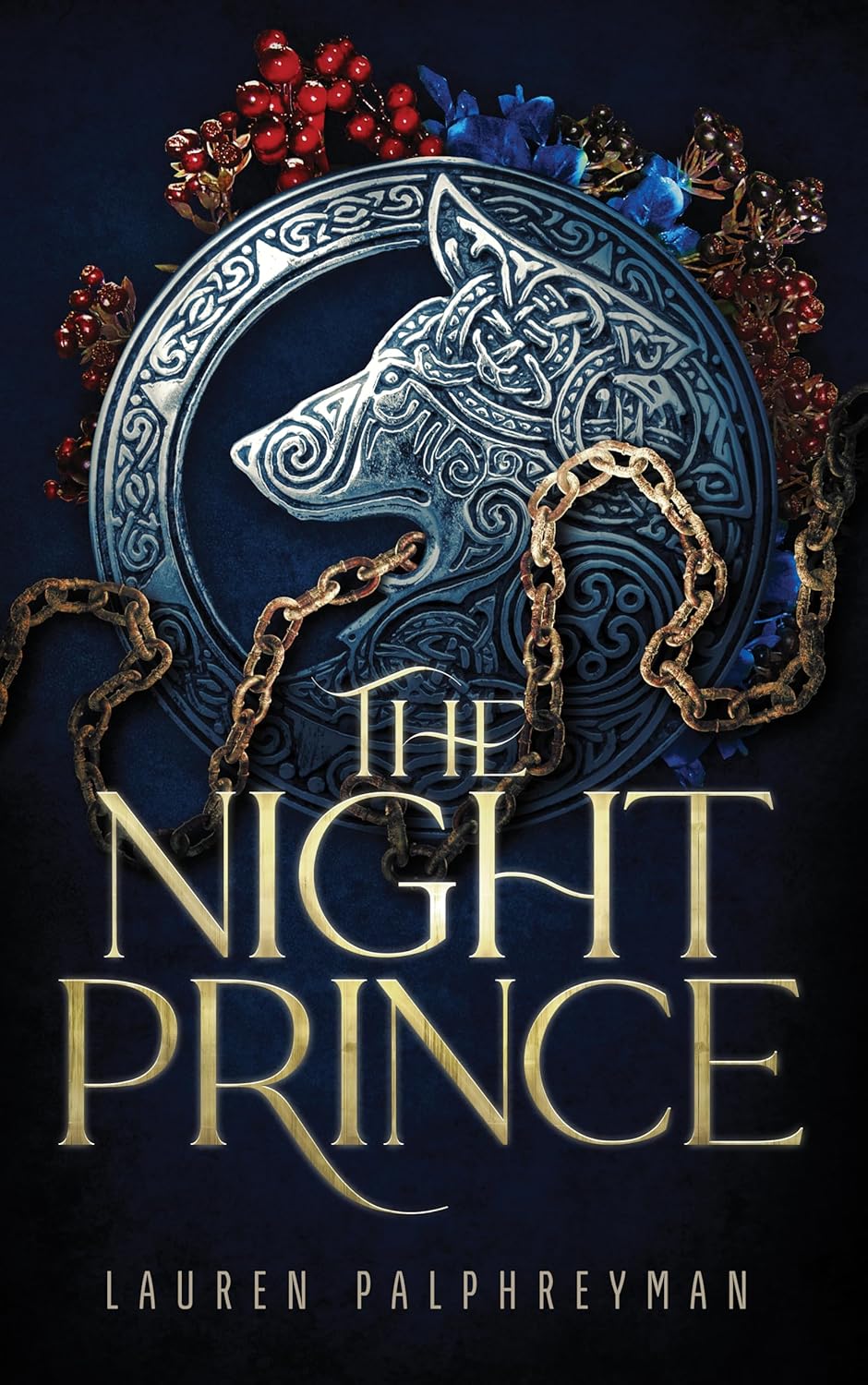
The Night Prince by Lauren Palphreyman takes everything that worked about The Wolf King and makes it darker, messier, and considerably more dangerous.
Aurora has survived the events of the first book, but survival hasn’t given her freedom. The Wolf King’s bite has created another claim over her body and future, Callum is fighting to reclaim the Wolf Throne, and Aurora’s life has become magically bound to Blake, one of the most feared and morally complicated alphas in the Northlands.
If Blake dies, Aurora dies too. That’s a particularly inconvenient connection to have with a man she doesn’t trust.
What surprised me most about The Night Prince is how dramatically it expands the story. The Wolf King introduced the conflict between humans and Wolves and established Aurora and Callum’s forbidden attraction. This sequel opens the mythology much wider, introducing deeper questions about the Moon Goddess, the God of Night, ancient power, Wolf rituals, hidden allegiances, and the supernatural forces operating behind the fight for the throne.
At the same time, Aurora finds herself caught between two very different alphas. Callum represents the relationship and trust she’s already built. Blake represents danger, uncertainty, temptation, and a connection neither of them completely understands.
That combination makes The Night Prince considerably more emotionally complicated than its predecessor.
The Night Prince Quick Review
- Heroine: Princess Aurora
- Major Romantic Interests: Callum and Blake
- Romance: Love triangle, forbidden romance, enemies to lovers
- Fantasy Elements: Werewolves, alphas, gods, magical bonds, royal politics
- Spice: Explicit/high heat
- Standalone: No
- Series: Must be read in order
The publisher describes the book as a romantasy featuring wolf shifters, a princess-and-alpha dynamic, enemies to lovers, forbidden romance, a captive heroine, and a love triangle. It also explicitly positions Aurora between two powerful alphas fighting for the Wolf Throne.
For me, though, the strongest part of The Night Prince is how it turns the question of romantic choice into something much larger. Aurora isn’t simply trying to decide who she loves. She’s trying to decide who she can trust while everyone around her seems determined to claim some part of her.
The Night Prince Summary
The Night Prince begins after Aurora survives the Wolf King’s bite. Unfortunately, surviving creates an entirely new problem.
Under Wolf law, James’s bite gives him a claim over Aurora, and he wants her returned. Aurora has absolutely no intention of allowing another man, king, alpha, or law to decide that she belongs to someone simply because he marked her.
Meanwhile, Callum still intends to take the Wolf Throne from his brother. Doing that requires allies. One of the most important, and most dangerous, is Blake, the Alpha of Lowfell.
Blake isn’t someone Aurora trusts. He’s feared throughout the Northlands, operates according to motives he rarely explains, and has already entangled his life with hers through a supernatural bond.
If Blake is killed, Aurora will die with him. That means she can’t simply escape him or treat him as another enemy. Their lives are literally connected.
Aurora initially wants that bond broken, but the connection increasingly exposes both of them to things they would rather keep hidden. Emotions, memories, vulnerability, and attraction begin slipping through barriers that should have kept them separate.
At the same time, Callum remains enormously important to Aurora.
Their relationship developed throughout The Wolf King, and his feelings haven’t disappeared simply because Blake has entered the equation. That creates a genuine emotional triangle, not just another attractive alpha for drama.
But romance is only one piece of the story.
The conflict over the Wolf Throne is becoming increasingly dangerous, alliances between clans are unstable, Wolf law continues to threaten Aurora’s autonomy, and the mythology surrounding the Moon Goddess and the God of Night begins moving from legend into something much more immediate.
Aurora gradually realizes that the battle over who rules the Wolves may not be the greatest threat facing either kingdom. Something older is awakening. And she may be connected to it far more closely than anyone realized.
The Night Prince Characters
The character dynamics are considerably more complicated in The Night Prince because Aurora is surrounded by people who want very different things from her. Some want her power. Some want her loyalty. Some want her politically. And some want her in ways that are much harder to define.
Princess Aurora
Aurora remains the emotional center of the series, but she isn’t the same woman we met in The Wolf King.
She’s becoming more aware of how often the men and institutions surrounding her attempt to turn her into property, leverage, or political currency.
Her father has used her. Wolf law attempts to define her ownership. James considers her claimable because of his bite. Callum loves her but carries powerful alpha instincts of his own. Blake binds his life to hers without giving her much choice in the matter.
Aurora’s real journey in The Night Prince is therefore about agency.
She isn’t simply developing magical power or becoming physically stronger. She’s deciding whether anyone other than Aurora gets to determine what happens to Aurora.
I found that much more compelling than a traditional chosen-one transformation.
Her growth isn’t smooth.
She’s frightened, angry, attracted to people she doesn’t entirely trust, and increasingly aware that the world is far more complicated than the moral divisions she once understood.
That’s exactly why she works.
Blake
Blake completely changes the emotional landscape of the series. He’s one of the most feared Wolves in the Kingdom, the Alpha of Lowfell, and a man whose intentions are almost impossible to separate from his manipulations.
He’s also now bound to Aurora.
That connection creates one of my favorite dynamics in the book because neither character can easily retreat from the other.
Aurora wants answers. Blake rarely gives straightforward ones.
She wants control over the bond. Blake understands far more about it than he’s willing to reveal. She wants to know whether she can trust him. The reader spends much of the book wondering the same thing.
What makes Blake compelling isn’t simply that he’s morally gray. Plenty of fantasy-romance heroes are described that way.
Blake actually behaves like someone whose morality operates according to a different set of calculations.
He can protect someone while manipulating them. He can show tenderness while withholding crucial information. He can make a choice that appears cruel and still believe he’s preventing something worse.
That unpredictability gives every scene between Blake and Aurora an edge that differs completely from her relationship with Callum.
Callum
Callum remains Aurora’s emotional connection to everything that happened in The Wolf King. He’s protective, honorable, powerful, and still deeply connected to her.
But The Night Prince makes their relationship harder, rather than letting Book 1’s romance settle into something comfortable.
Callum fights for the Wolf Throne, deals with his brother, navigates unstable clan alliances, and watches Aurora develop an increasingly complicated connection with Blake.
That forces him to confront instincts he might rather believe he has completely under control. Possessiveness and jealousy become more complicated when you’re an alpha in a culture where power, mating, claiming, and loyalty are all connected.
I appreciated that Palphreyman doesn’t simply turn Callum into the obviously good alternative so Blake can occupy the dangerous side of the triangle.
Callum has his own flaws. He may love Aurora, but loving someone doesn’t automatically mean understanding exactly what freedom requires.
James
James remains an important threat even when he isn’t physically dominating every scene. As the Wolf King, his claim to power is already central to Callum’s conflict. His claim over Aurora makes everything more personal. Wolf law says his bite means something that Aurora absolutely refuses to accept: that another person can possess her.
That makes James more than a villain standing between Callum and a throne. He represents the system Aurora is increasingly determined to resist. His role also reinforces one of the most interesting themes in the series: laws aren’t automatically moral simply because they’ve existed for generations.
Aurora, Callum, and Blake’s Love Triangle
Yes, The Night Prince has a real love triangle. And it works because Callum and Blake aren’t interchangeable versions of the same alpha hero. Aurora’s connection with Callum comes from shared history, trust, attraction, and everything they survived together in the first book. Her connection with Blake begins under almost opposite circumstances. She doesn’t trust him. She isn’t certain what he wants. She resents the bond between them.
And yet that bond gives Blake access to emotional spaces neither character intended to share. The contrast creates much of the romantic tension. Callum represents something Aurora already understands. Blake represents everything she doesn’t. The question isn’t simply which man is hotter or more powerful. It’s what each relationship reveals about Aurora and what kind of future each connection might require from her. That’s a far more interesting triangle.
The Night Prince Tropes
Readers who choose romantasy by trope will find:
- Wolf shifters
- Princess x alpha
- Love triangle
- Enemies to lovers
- Forbidden romance
- Morally gray hero
- Dangerous alliance
- Magical life bond
- Forced proximity
- Rival alphas
- Royal politics
- Captive heroine
- Possessive heroes
- Hidden powers
- Ancient gods
- Warring kingdoms
- Political intrigue
- Heroine discovering her power
- Touch her and die energy
The publisher specifically identifies wolf shifters, princess x alpha, captive heroine, enemies to lovers, forbidden romance, humans versus Wolves, and a love triangle among the central elements of the series.
Is The Night Prince Spicy?
Yes. The Night Prince is an adult romantasy with explicit sexual content and significant sexual tension. The heat is much more intertwined with the power dynamics than a simple series of romantic scenes.
Sourcebooks specifically describes the novel as balancing high heat with political conflict and supernatural stakes, and its content information includes explicit sexual material.
What worked for me is that the sexual tension isn’t separated from the emotional danger. Aurora’s attraction doesn’t automatically create trust. In fact, sometimes it makes everything worse.
Desire becomes another thing she has to examine carefully because she’s surrounded by powerful men in a culture where possession and attraction are frequently treated as though they’re the same thing. Aurora increasingly refuses to accept that equation.
The World-Building Is Much Bigger This Time
One of the best things about The Night Prince is how much larger the mythology becomes. The fight over the Wolf Throne remains important, but it’s increasingly obvious that political control of the Northlands is only one layer of the conflict.
The Moon Goddess, Ghealach, and the God of Night, Oidhche, become much more important to the mythology. Rituals such as Oidhche Fhada connect Wolf culture to lunar cycles, religious history, supernatural imprisonment, and ancient power. These elements don’t feel like extra lore added simply to make the fantasy world seem deeper. They affect politics. They affect Aurora. They affect Blake.
And eventually they reshape how we understand the danger threatening both the Kingdom of Wolves and the Kingdom of Men. I especially liked that the mythology complicates the book’s obsession with darkness and light. Palphreyman doesn’t treat darkness as automatically evil or light as automatically safe. Power depends on who holds it and what they’re willing to do with it. That’s much more interesting.
Wolf Law and Aurora’s Fight for Autonomy
The most compelling theme in the book for me is autonomy. Aurora spends much of The Night Prince confronting systems that insist someone else has authority over her body.
James’s bite supposedly gives him a legal claim. Alpha structures place enormous power in the hands of dominant Wolves. Political systems view Aurora as a princess before they view her as an individual.
Even magical bonds can take choices away from her. That makes her resistance much more meaningful than a generic heroine insisting she’s independent. She’s fighting a world that has actual laws and traditions designed to contradict her.
The book repeatedly asks an uncomfortable question: what happens when something is legal, sacred, traditional, or culturally accepted but still strips someone of choice?
Aurora’s answer becomes increasingly clear. Tradition doesn’t make ownership acceptable.
What I Loved About The Night Prince
Blake is probably the biggest reason this sequel feels so different. His presence destabilizes nearly everything Aurora believes she’s figured out. I never completely trusted him. That’s also why I kept wanting him on the page.
There’s an unpredictability to Blake that makes his interactions with Aurora crackle. He’s intelligent enough to understand exactly what he’s doing, controlled enough to hide what he doesn’t want seen, and emotionally damaged enough that moments of genuine vulnerability carry enormous weight.
The love triangle also works much better than I expected. I’m often skeptical when a sequel introduces another major romantic possibility because it can feel like manufactured conflict.
This doesn’t. Blake isn’t simply inserted between Aurora and Callum. His connection to Aurora is woven into the mythology, political conflict, supernatural threat, and larger questions surrounding her identity. That makes the triangle part of the plot rather than a distraction from it. Aurora’s development is equally strong.
She doesn’t suddenly become fearless because she discovered power. She’s still trying to understand herself while navigating men, gods, traditions, and kingdoms that all seem to have opinions about who she should become. Her determination to stop being anyone’s pawn gives the story its emotional backbone.
The Night Prince Is Darker Than The Wolf King
The Wolf King has danger, war, captivity, and forbidden attraction, but it also carries more of the exhilaration of discovering a new world. The Night Prince is about what happens after that discovery. Now Aurora understands enough to recognize just how dangerous the Northlands can be. Relationships are more complicated. Political alliances are less stable. Wolf law becomes personally threatening. The mythology becomes darker. And the romantic situation is far less straightforward. That gives the sequel a heavier tone. It’s still romantic and often intensely sensual, but the sense of uncertainty is much stronger. Who can Aurora trust? What does Blake actually want?
How much of Callum’s protectiveness comes from love, and how much comes from alpha instinct? What is happening to Aurora herself? And what happens if the threat gathering behind all these political conflicts is far larger than any of them anticipated? Those questions kept me far more invested than another straightforward battle for a throne would have.
What Might Not Work for Every Reader
The love triangle will probably be the biggest dividing line. If you finished The Wolf King completely committed to Aurora and Callum and don’t enjoy another serious romantic possibility entering the story, Blake’s increasingly prominent role may frustrate you.
For me, the complication works because it’s meaningful. But it absolutely changes the emotional direction of the series. The book also spends considerable time on politics, mythology, relationships, internal conflict, and shifting alliances.
Readers looking exclusively for nonstop action may find some sections more deliberate. I liked the slower tension because so much of this story depends on suspicion and uncertainty. The reader needs time to wonder what Blake isn’t saying.
Do You Need to Read The Wolf King First?
Absolutely. The Night Prince is Book 2 of The Wolf King trilogy and continues directly from the first novel. The central relationships, Wolf politics, Aurora’s circumstances, James’s bite, and Callum’s claim to the throne all depend heavily on what happened in The Wolf King.
This isn’t an interconnected series where every book follows a new couple. It’s one continuing story. Start with The Wolf King.
The Wolf King Series Reading Order
The trilogy should be read in this order:
- The Wolf King
- The Night Prince
- The Wolf Queen
Penguin identifies the series as a three-book trilogy, with The Wolf Queen serving as the finale.
What Comes After The Night Prince?
The Wolf Queen is Book 3 and the final installment of the trilogy. The continuation is particularly important because The Night Prince expands the conflict beyond the Wolf Throne and makes the ancient supernatural threat increasingly central to Aurora’s fate. This is definitely not a series I’d recommend reading out of order.
Who Should Read The Night Prince?
I’d recommend The Night Prince to readers who want their romantasy emotionally messy.
If you love werewolves, powerful alphas, morally gray heroes, love triangles, forbidden attraction, political intrigue, ancient gods, magical bonds, royal conflict, and heroines fighting for autonomy, this sequel delivers much more of all of it than the first book.
It’s especially good for readers who enjoy romantic tension where there isn’t an immediately obvious safe choice.
Callum and Blake bring completely different energies to Aurora’s story. One relationship has history. The other has danger and mystery. Neither is simple.
The Night Prince Review: Final Thoughts
The Night Prince is a stronger and more complicated sequel because Lauren Palphreyman refuses to let Aurora remain the same woman she was in The Wolf King.
Everything is shifting. Her understanding of the Wolves has changed. Her understanding of herself is changing. Her relationship with Callum is being tested. Her connection to Blake becomes increasingly impossible to dismiss.
Even the conflict over the Wolf Throne begins to look smaller once the deeper mythology surrounding Night, the Moon, and Aurora’s own power comes into focus.
And Blake changes everything. He’s manipulative, dangerous, intelligent, frustrating, unexpectedly vulnerable, and almost impossible to categorize as simply hero or villain.
That’s exactly why he works. His connection with Aurora adds a darker current to the romance because attraction never completely separates itself from suspicion.
Callum offers something different: history, devotion, familiarity, and the relationship readers watched develop in the first book. Putting Aurora between those two men could easily have reduced her to the prize in yet another alpha rivalry.
Instead, her determination not to belong to either of them becomes one of the book’s strongest themes. That’s the part I loved most. Everyone wants something from Aurora.
Kings want her obedience. Alphas want her loyalty. Wolf law wants to define who owns her. Ancient powers have their own plans. Aurora is finally beginning to understand that perhaps the most important question isn’t who she belongs with. It’s whether she belongs to anyone except herself.
The Night Prince takes the romantic fantasy established in The Wolf King and makes it darker, sexier, stranger, and far more morally complicated. I finished it less certain about who Aurora should trust than when I started. For this series, that’s a very good thing.
The Night Prince FAQ
What is The Night Prince about?
The Night Prince follows Princess Aurora after the events of The Wolf King. James’s bite gives him a claim over her under Wolf law, Callum is fighting to take the throne from his brother, and Aurora’s life has become magically tied to Blake, one of the most feared Wolves in the Kingdom. At the same time, a larger supernatural threat begins emerging from the mythology surrounding the God of Night.
Who are the main characters in The Night Prince?
The central character is Princess Aurora. Callum and Blake become her two main romantic interests, while James remains an important political and personal threat.
Who is Blake in The Night Prince?
Blake is the Alpha of Lowfell and one of the most feared Wolves in the Northlands. He forms a supernatural life bond with Aurora, meaning their lives become connected, and his secretive motives make him one of the book’s most important morally gray characters.
Does The Night Prince have a love triangle?
Yes. Aurora is caught emotionally between Callum and Blake. The publisher explicitly describes the book as involving two powerful alphas and lists a love triangle among its romantic tropes.
Is The Night Prince enemies to lovers?
Enemies-to-lovers tension is an important part of Aurora and Blake’s dynamic. She initially distrusts him and wants to escape the bond connecting them, while their forced connection gradually becomes much more complicated.
Is The Night Prince spicy?
Yes. The Night Prince contains explicit sexual content and significant on-page romantic heat. Sourcebooks describes it as high-heat romantasy.
Is The Night Prince a werewolf romance?
Yes. Werewolves, alpha hierarchies, Wolf law, clan politics, shifting, and supernatural Wolf mythology form the foundation of the series.
Is The Night Prince a standalone?
No. It’s Book 2 of The Wolf King trilogy and should be read after The Wolf King.
What book comes after The Night Prince?
The Wolf Queen is Book 3 and the finale of the trilogy.
Who is the Night Prince?
Major spoiler: The identity of the Night Prince is one of the book’s important revelations. The Night Prince is Blake. His connection to the God of Night and the larger supernatural mythology explains much of the mystery surrounding him and significantly raises the stakes heading into the final book.