
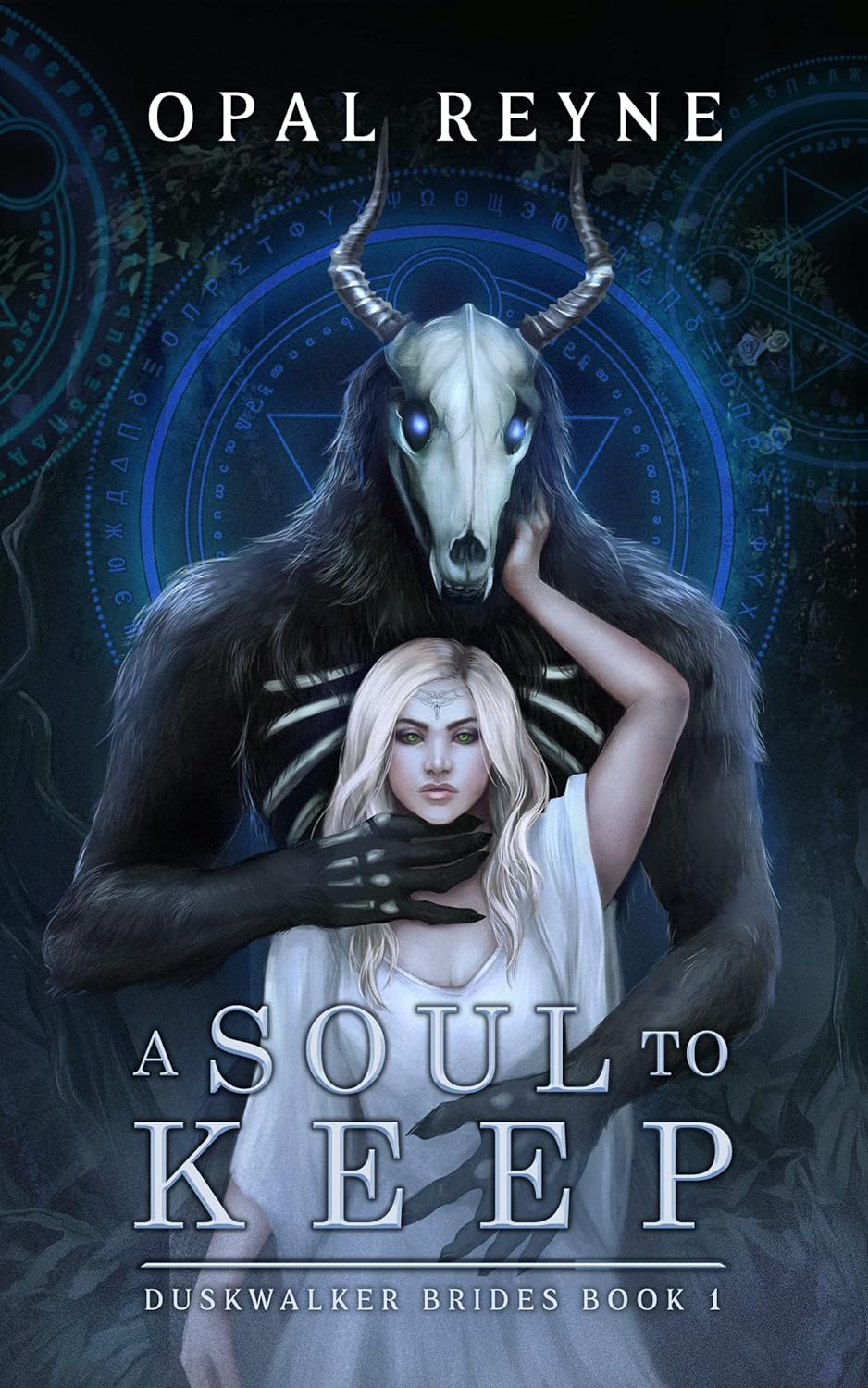
A Soul to Keep, the first installment in Opal Reyne’s Duskwalker Brides series, is a hauntingly beautiful paranormal romance that blends darkness and tenderness in equal measure. Set in a world ravaged by monsters, superstition, and fear, this novel explores love not as something gentle and easy, but as something hard-won, transformative, and deeply necessary for survival.
Entering Opal Reyne’s work for the first time, especially after hearing widespread praise for her monster romances, felt like stepping into unfamiliar territory. A Soul to Keep does not shy away from its premise or soften its edges. This is monster romance in the truest sense, unafraid to embrace fear, isolation, and moral ambiguity. Yet beneath the bones, claws, and shadows lies a story that is surprisingly tender and emotionally resonant.
At the heart of the novel is Reia, a young woman who has known cruelty and loneliness for most of her life. Branded as a harbinger of misfortune after the brutal death of her family, Reia has been ostracized, feared, and blamed by her village for events far beyond her control. Her survival becomes a mark against her rather than a miracle, and she grows up isolated, stripped of kindness and human connection. When she is finally offered as a sacrificial bride to a Duskwalker, it feels less like a sudden tragedy and more like the inevitable conclusion of a lifetime of abandonment.
Reia’s character is one of the novel’s greatest strengths. She is not naïve, nor is she weak. Her fear is palpable, but it is paired with defiance, curiosity, and an unyielding desire for freedom. Even when facing a creature the world insists is a monster, she refuses to surrender her humanity. Her kindness is not performative. It is hard-earned, forged through suffering, and that makes it all the more powerful.
Orpheus, the Duskwalker, is equally compelling. Visually, he is every inch the nightmare creature humans fear. With his skeletal visage, towering presence, and supernatural abilities, he embodies everything the village warns against. Yet Reyne subverts expectations almost immediately. Orpheus is not cruel, nor is he driven by hunger or malice. He is lonely. He is weary. He is bound by duty and centuries of isolation, collecting brides not out of desire to harm them, but in the desperate hope that one might choose to stay.
What makes Orpheus such a fascinating romantic lead is the way his monstrosity exists alongside deep emotional restraint. He does not demand affection. He does not force intimacy. In fact, much of his arc revolves around learning how to coexist with another being without consuming or overwhelming them. His yearning for companionship feels genuine and tragic, and his patience with Reia allows their bond to develop organically rather than through fear or coercion.
The romance between Reia and Orpheus is the emotional core of the story, and it unfolds with careful pacing and surprising warmth. Their relationship does not ignite instantly. Trust is slow, tentative, and often fragile. Reyne allows space for fear, misunderstanding, and vulnerability, making every moment of closeness feel earned. Orpheus’s gentle treatment of Reia, paired with her gradual willingness to see beyond his monstrous exterior, creates a dynamic that is both emotionally intimate and deeply moving.
Their interactions are filled with small, meaningful gestures rather than grand declarations. Shared meals, quiet conversations, and moments of mutual curiosity become stepping stones toward connection. The pet name “little doe,” while potentially divisive, underscores Orpheus’s protective instinct and growing affection, reinforcing the tenderness that exists beneath the darkness of their world.
The setting of A Soul to Keep is richly imagined and deeply unsettling. Reyne’s world-building establishes a bleak, dangerous environment where demons roam freely, humanity clings to survival, and superstition dictates morality. The Veil, home of the Duskwalkers, is especially evocative, serving as both a physical and symbolic boundary between fear and understanding. The lore surrounding demons, human sacrifices, and Duskwalkers adds depth to the narrative and hints at a much larger world waiting to be explored in future installments.
One particularly effective element is the contrast between perceived monsters and true cruelty. While the Duskwalkers are feared and vilified, it is often the humans who commit the most heartless acts. Reia’s village, with its casual cruelty and willingness to sacrifice one of its own, serves as a stark reminder that monstrosity is not defined by appearance alone. This thematic undercurrent gives the story emotional weight and challenges the reader to question traditional notions of good and evil.
The introduction of another Duskwalker, whose story remains untold in this installment, is a clever narrative choice. His presence expands the scope of the series and builds anticipation for future books without detracting from Reia and Orpheus’s journey. It reinforces the idea that each Duskwalker bride will have her own story of fear, connection, and transformation.
Thematically, A Soul to Keep is deeply invested in ideas of sacrifice, acceptance, and the human need for belonging. Reyne does not romanticize suffering, but she does explore how love can grow in its aftermath. The story asks difficult questions about choice, autonomy, and what it means to truly be seen. Love, in this world, is not safe or easy, but it is healing.
Overall, A Soul to Keep is a striking and emotionally rich entry into the paranormal romance genre. It balances darkness with tenderness, fear with longing, and monstrosity with humanity in a way that feels intentional and thoughtful. Opal Reyne demonstrates a remarkable ability to craft a romance that is both unsettling and deeply comforting, offering readers a story that lingers long after it ends.
For readers who enjoy monster romance with emotional depth, slow-burn intimacy, and immersive world-building, this book is an absolute must-read. It is not just a love story between a human and a supernatural being, but a meditation on loneliness, trust, and the courage it takes to choose connection in a world built on fear. The anticipation for the rest of the Duskwalker Brides series is well deserved.
A Soul To Keep Summary
A Soul to Keep tells the story of Reia, a young woman who has lived her entire life as an outcast in a fearful, dying human world plagued by demons. Branded as cursed after the violent death of her family, Reia grows up isolated and blamed for misfortune she did not cause. In her village, superstition outweighs compassion, and when the time comes to offer a human sacrifice to the Duskwalker, Reia is chosen without hesitation.
The Duskwalker, Orpheus, is a powerful and terrifying being who dwells beyond the Veil, a boundary separating the human lands from a realm of monsters and ancient magic. To humans, Duskwalkers are creatures of legend and horror, believed to devour or destroy the brides sent to them. Reia expects death when she crosses into Orpheus’s domain, resigned to her fate after a lifetime of rejection.
Instead of cruelty, she finds something unexpected. Orpheus does not harm her. He offers her safety, shelter, and choice. Though physically monstrous and bound by a dark duty to guard the Veil from demons, Orpheus is deeply lonely and has spent centuries searching for a companion willing to stay of her own free will. He desires not a victim, but a partner.
As Reia adapts to life in the Veil, she begins to see beyond Orpheus’s frightening exterior. He treats her with patience and gentleness, allowing her autonomy and never forcing intimacy. Their relationship develops slowly through shared routines, quiet conversations, and mutual curiosity. Reia learns that the world she came from was far crueler than the so-called monster meant to kill her.
While Reia finds peace and safety with Orpheus, the outside world remains dangerous. Demons grow more aggressive, and the fragile balance holding the human lands together begins to fracture. Orpheus’s role as guardian becomes increasingly perilous, and Reia is forced to confront the reality that loving him means embracing a life of danger and sacrifice.
As their bond deepens, Reia must choose between returning to a world that rejected her or committing herself fully to the Veil and the monster who has given her kindness, protection, and belonging. In choosing Orpheus, Reia reclaims her agency and reshapes her identity, no longer as a cursed girl or a sacrifice, but as a woman who chooses love in a world built on fear.
A Soul to Keep is ultimately a story about finding humanity in the monstrous, challenging prejudice, and discovering that home is not defined by birth or blood, but by safety, acceptance, and choice.