
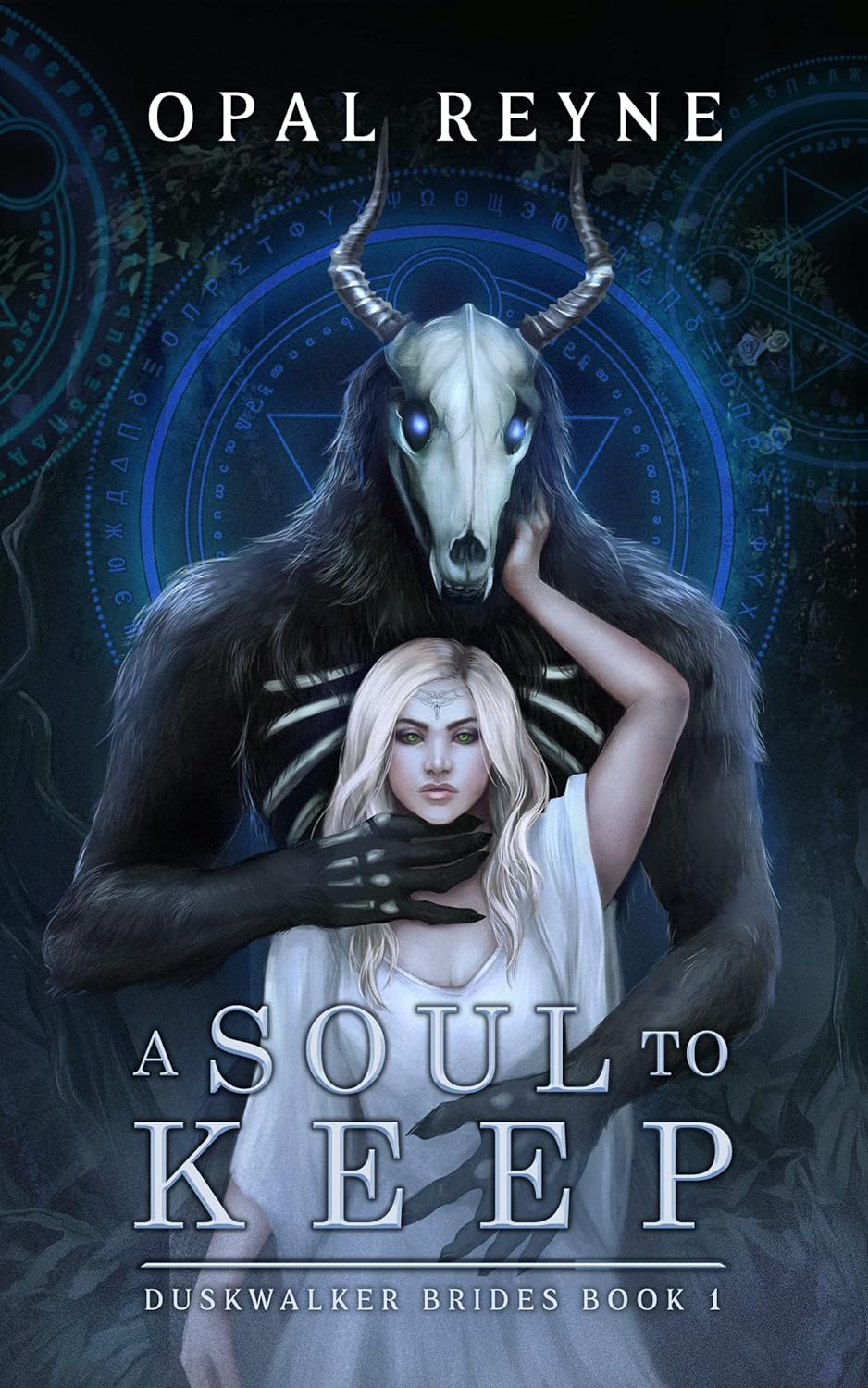
A Soul to Keep by Opal Reyne opens the Duskwalker Brides series with a romance built around one of monster romance’s most compelling questions: what happens when the creature everyone calls a monster treats you with more humanity than the people who raised you?
Reia has spent most of her life blamed for tragedy she didn’t cause. After the violent deaths of her family, her village marks her as unlucky, dangerous, and somehow responsible for misfortune simply because she survived. That isolation shapes almost everything about her, from how she expects others to treat her to the ferocity with which she clings to any opportunity for freedom.
When the village chooses Reia as a sacrificial bride for a Duskwalker, nobody seems particularly troubled by sending her beyond the Veil to what they assume will be certain death. Reia has already spent years being treated as disposable, so the sacrifice feels less like an unexpected betrayal and more like the logical conclusion of everything her community has taught her about her own value.
Then she meets Orpheus.
He looks like exactly the kind of nightmare humans have warned her about, with a towering monstrous body, skeletal features, supernatural strength, and a presence designed to trigger every survival instinct she possesses. What Reia discovers, however, is a lonely and surprisingly gentle being who wants companionship far more than obedience.
That reversal gives A Soul to Keep its emotional power. Reia enters the Veil believing she has been delivered to a monster, only to discover that the people who sacrificed her may have understood monstrosity far less clearly than they believed.
A Soul to Keep Quick Review
A Soul to Keep is the first book in Opal Reyne’s Duskwalker Brides series and follows Reia, a human woman sacrificed by her village, and Orpheus, the Duskwalker who takes her into his home beyond the Veil. Their relationship develops slowly through fear, curiosity, companionship, everyday routines, and the gradual realization that neither is what the other initially expected.
The novel blends paranormal romance, monster romance, dark fantasy, slow burn, forced proximity, sacrificial bride, gentle monster hero, protective hero, found emotional safety, and Beauty-and-the-Beast-style themes. The larger fantasy world includes demons, the Veil, human settlements struggling to survive, and Duskwalkers whose frightening reputations may tell only part of the truth.
For me, the strongest part is the contrast between how humans treat Reia and her experience with Orpheus. The people who look like her deprive her of belonging and eventually sacrifice her, while the creature she has been taught to fear gives her shelter, patience, and room to make choices.
A Soul to Keep Summary
Reia grows up inside a human community shaped by fear, superstition, and the constant threat of demons. After her family dies violently, the village decides that her survival must mean something sinister, and she becomes an outsider inside the only home she has ever known.
She is blamed for misfortune, denied normal relationships, and repeatedly taught that others consider her less valuable than everyone around her. Reia survives that treatment without becoming passive, but years of rejection leave her desperate for freedom from a community that has never truly accepted her.
That opportunity arrives in the worst possible form.
The village must provide a human bride to a Duskwalker, and they select Reia for the sacrifice. Nobody expects her to return, and Reia crosses the Veil believing she is being delivered directly into the hands of something monstrous.
Orpheus certainly looks the part.
He is enormous, supernatural, and frightening enough that Reia initially has every reason to assume the stories are true. Duskwalkers exist in human folklore as creatures of death, danger, and the hostile territory beyond the Veil, and Reia has no reason to believe her fate will be different from what happened to the women sent before her.
Instead, Orpheus offers her shelter.
He feeds her, protects her, speaks with her, and gradually reveals that his desire for a bride has far more to do with loneliness than violence. He doesn’t want another victim, because what he has been searching for is someone capable of seeing him as something other than a nightmare.
Reia remains cautious, and the story is better because of it. Years of human cruelty don’t disappear just because one supernatural being behaves kindly, and Orpheus’s frightening appearance keeps reminding her that she lives beside something physically capable of overwhelming her.
Trust develops through repetition. Every meal shared without threat, every conversation that ends without punishment, and every boundary Orpheus respects gives Reia another reason to question everything she has been taught about him.
As Reia begins understanding Orpheus, she also learns more about the Veil, the demons threatening both worlds, and the responsibilities that keep Duskwalkers tied to dangerous territory. The monster she initially views as her captor gradually becomes the person who offers her the greatest sense of safety she has ever known.
That leaves Reia with a choice far more complicated than simply escaping. She has to decide whether freedom means returning to the human world that rejected her or choosing a life beside the creature who has finally given her somewhere she feels wanted.
A Soul to Keep Characters
The relationship works because Reia and Orpheus both understand loneliness even though they have experienced it in very different ways. Reia has spent her life surrounded by people who deliberately exclude her, while Orpheus has spent centuries separated from the ordinary companionship he desperately wants.
That shared isolation creates common ground before romantic attraction becomes important. Neither needs the other because fate announces they belong together, but both gradually recognize what it feels like to have someone stay present without treating their existence as a burden.
Reia
Reia is a strong heroine because the novel doesn’t confuse fearlessness with courage. She is frightened by Orpheus, demons, the Veil, and the precarious situation she has been thrown into, but fear never completely destroys her curiosity or her desire to understand what is happening around her.
Her history also makes her skeptical for good reason. Reia has spent years being judged by people who decided who she was before bothering to know her, so trusting another being simply because he behaves gently for a few days would feel emotionally false.
Instead, she watches Orpheus.
She notices how he behaves when she disagrees with him, how he responds when she is afraid, and whether the choices he offers remain genuine once her decisions become inconvenient. Those details gradually become more convincing than the frightening stories she heard growing up.
Reia’s kindness is equally important because it isn’t born from innocence. She knows what cruelty feels like, which makes her willingness to avoid inflicting the same treatment on someone else much more meaningful.
Her arc is ultimately about reclaiming the right to define herself. She begins the story as the cursed girl, the unwanted outsider, and eventually the sacrificial bride, all identities imposed on her by other people.
Her relationship with Orpheus gives her room to become simply Reia.
Orpheus
Orpheus works particularly well as a monster-romance hero because Reyne doesn’t simply give a handsome human man horns and call him monstrous. His appearance is genuinely frightening, and his physical differences from Reia remain part of the relationship rather than disappearing once she starts caring about him.
Emotionally, however, he is much softer than his appearance suggests.
Orpheus is lonely, curious about human companionship, and deeply affected by a history in which brides have never provided the lasting connection he hopes to find. His desire for Reia to remain therefore carries sadness alongside romantic longing.
What makes him appealing is the restraint he shows despite wanting her badly. He has enough physical power to make resistance nearly impossible if he chose to behave that way, but the relationship only develops because he gives Reia space to become comfortable with him.
That distinction matters enormously.
Orpheus doesn’t become romantic because he lacks the ability to dominate Reia. He becomes romantic because he has tremendous power and gradually shows he won’t use it to force the affection he wants.
His emotional growth also extends beyond learning how to please Reia. Orpheus has to understand that wanting companionship doesn’t mean someone owes him permanence, and that a bride who stays because she has no alternative is fundamentally different from a partner who actively chooses him.
Reia and Orpheus’s Relationship
The romance between Reia and Orpheus succeeds because attraction isn’t allowed to erase the circumstances of their meeting. Reia has been sacrificed to him by people who expect her to die, which means the relationship begins with an enormous imbalance in both knowledge and physical power.
The story therefore needs trust before romance can feel convincing.
Orpheus earns that trust through ordinary behavior rather than a single dramatic act. He provides food and shelter, answers questions, gives Reia room to adjust, and repeatedly demonstrates that her fear doesn’t offend him enough to become dangerous.
Reia responds gradually as she notices the difference between appearance and behavior. The villagers who look human treated her as though she was cursed, while the creature who resembles something out of a nightmare consistently behaves with greater patience and compassion.
That discovery doesn’t instantly transform fear into desire. It creates curiosity first, then familiarity, then emotional safety, and eventually attraction.
The pace is one of the relationship’s greatest strengths because every stage has room to matter. Reia doesn’t fall in love with Orpheus merely because he is kinder than the village, and Orpheus doesn’t love Reia simply because she is the latest bride placed in his care.
They learn each other.
That distinction turns what could have been a captivity romance into something much more focused on chosen companionship.
The Sacrificial Bride Setup Works Because Choice Eventually Matters
Reia begins the book with almost no control over what happens to her. Her village chooses her, decides her life is expendable, and sends her into the Veil without giving her meaningful authority over the decision.
That makes choice especially important once she reaches Orpheus.
If he simply replaced one form of captivity with another, the romance would reinforce everything Reia has already experienced. Instead, her growing ability to make decisions becomes part of what separates life with Orpheus from life in the village.
The emotional question eventually shifts away from whether Reia can escape him. What matters is whether she would still choose him if escape were genuinely possible. That distinction is fundamental to the romantic payoff. Being sacrificed to Orpheus is something done to Reia. Staying with him becomes something Reia does for herself.
A Soul to Keep Tropes
The major romance elements include monster romance, paranormal romance, sacrificial bride, slow burn, forced proximity, human heroine with a nonhuman hero, protective monster, gentle giant energy, Beauty-and-the-Beast themes, found emotional safety, strangers to lovers, hurt/comfort, and a strong emphasis on choosing the person everyone else has taught you to fear.
The tropes reinforce one another especially well because the sacrificial-bride premise creates the initial danger while the slow burn gives Reia time to discover that her assumptions about Orpheus are incomplete. The monster-romance element then becomes inseparable from the larger theme of questioning who actually deserves to be considered monstrous.
The Humans Can Be More Frightening Than the Monsters
One of the most effective ideas in A Soul to Keep is the reversal between appearance and behavior. Orpheus looks monstrous, while the villagers look completely human, yet Reia’s experience repeatedly challenges the idea that physical appearance reveals anything meaningful about morality.
Her village has years to show her kindness. Instead, they isolate her. They blame her for the tragedy. Eventually, they decide her life is an acceptable price for their own security.
Orpheus has every physical advantage over Reia, yet he offers something the villagers rarely did: space to exist without being treated as though her presence itself is a problem.
That contrast gives the monster romance more thematic substance. Reia isn’t simply discovering that one scary creature happens to be nice, but beginning to question an entire moral framework she inherited from people whose behavior never justified the authority they claimed.
The Veil Is Both Dangerous and Liberating
The Veil initially represents everything Reia has been taught to fear. It separates the fragile human settlements from demons, Duskwalkers, ancient magic, and a world where the protections of human civilization no longer apply.
Yet crossing that boundary also removes Reia from the community that spent years deciding who she was allowed to be. That makes the Veil contradictory in an interesting way. Physically, it is more dangerous than the village. Emotionally, it may be safer.
Reia has to worry about demons and supernatural threats, but she no longer has to live every day surrounded by people who believe her existence brings misfortune.
The setting therefore reinforces her character arc. Moving into the supposedly monstrous world creates enough distance from human judgment for Reia to begin imagining an identity that isn’t built around being cursed.
Orpheus’s Loneliness Makes Him More Than a Protective Monster
Orpheus could easily have become appealing simply because he is enormous, dangerous, and protective of Reia. Those elements are part of the fantasy, but his loneliness gives them emotional context.
He doesn’t simply want a woman inside his home. He wants someone to remain.
That creates an important vulnerability because Orpheus can physically protect Reia from almost anything outside their relationship, yet he can’t force her to give him the one thing he actually wants without destroying the meaning of it.
Companionship only matters if Reia chooses it. That leaves an immensely powerful creature emotionally dependent on something power cannot obtain.
For me, that contradiction makes Orpheus considerably more compelling. His greatest strength can kill demons, but it cannot manufacture belonging.
Reia’s Desire for Freedom Changes Meaning
At the beginning, freedom means getting away.
Reia wants distance from a village that has mistreated her and from a future others have chosen for her. Being sent to Orpheus appears to remove even that possibility because she assumes she is crossing into permanent captivity or death.
As the story progresses, freedom becomes more complicated.
Reia begins discovering that having choices matters more than simply occupying a particular location. Returning to the human world would technically restore familiar surroundings, but those surroundings never provided genuine belonging.
Staying with Orpheus might look, from the outside, like choosing the place where she was originally sent as a sacrifice, yet the meaning changes completely once staying becomes voluntary.
That development ties Reia’s romantic decision to her larger character arc. She doesn’t stop wanting freedom because she falls in love.
She begins defining freedom for herself.
The Slow Burn Gives the Monster Romance Credibility
A faster romance would weaken this premise because Reia has too many legitimate reasons to fear Orpheus. The physical differences between them, the circumstances of her sacrifice, and everything she has heard about Duskwalkers require time before emotional intimacy can feel convincing.
The gradual development gives ordinary interactions unusual weight. Shared meals matter because Reia begins learning that Orpheus intends to care for her rather than consume her.
Conversations matter because they reveal intelligence and vulnerability behind the monstrous exterior. Quiet moments matter because fear slowly becomes familiarity.
By the time romantic intimacy becomes possible, the relationship has already been built through repeated evidence that Reia is safe with him. That makes attraction feel like an extension of trust rather than an inexplicable response to captivity.
The “Little Doe” Pet Name Fits Their Dynamic
Orpheus calling Reia “little doe” reinforces the contrast between his frightening appearance and the gentleness he gradually shows her. The name carries a protective quality that fits the enormous difference in their physical presence without automatically reducing Reia to helplessness.
I can also understand why the pet name might not work equally well for every reader. It leans strongly into the creature-and-delicate-human dynamic that monster romance often embraces, so readers who dislike repeated pet names or highly protective heroes may find it less appealing.
For me, its effectiveness depends on the relationship surrounding it. Because Reia retains personality, defiance, and the ability to challenge Orpheus, the tenderness behind the name matters more than the physical imbalance it acknowledges.
The World-Building Gives the Series Room to Grow
A Soul to Keep has to accomplish more than introducing one romantic couple because it also establishes the supernatural framework for the entire Duskwalker Brides series. The Veil, demons, sacrificial traditions, Duskwalkers, human settlements, and the uneasy boundaries between different forms of life all create a world capable of supporting much larger stories.
Introducing another Duskwalker reinforces that sense of scope. Reia and Orpheus remain firmly at the center of this novel, but the wider world clearly contains other creatures with their own histories, needs, and potential relationships.
That works particularly well for a series built around different Duskwalker romances. The first book can establish how little humans truly understand about these beings while leaving later installments room to reveal how different one Duskwalker may be from another.
What I Loved About A Soul to Keep
The contrast between human cruelty and monstrous tenderness is the biggest reason this story works for me. Reia has been taught that appearance determines danger, yet almost everything she experiences forces her to question that belief.
Orpheus is equally compelling because his gentleness doesn’t require him to remove the characteristics that make him monstrous. He can remain strange, frightening, physically overwhelming, and unmistakably nonhuman while still being patient, lonely, protective, and emotionally vulnerable.
I also appreciated Reia’s gradual shift from sacrifice to participant. Her village makes the first major decision for her, but the story increasingly returns decisions to Reia as she learns more about Orpheus and the world beyond the Veil.
That agency makes the romance considerably stronger. She isn’t happy in the end because the people who sacrificed her accidentally chose the right husband. She becomes happy because she gains enough freedom and understanding to make a choice they never intended to give her.
What Might Not Work for Every Reader
Monster romance requires readers to accept a genuinely nonhuman romantic hero, and Orpheus isn’t designed to become visually conventional once the relationship grows warmer. Readers uncomfortable with skeletal features, dramatic size differences, supernatural anatomy, or physically monstrous love interests may struggle with the central romance.
The story also has a deliberate pace. Much of the relationship develops through domestic routines, conversations, emotional adjustments, and Reia slowly becoming comfortable in a completely unfamiliar environment rather than through constant action.
The sacrificial-bride setup may create another point of discomfort. Reia begins the story in a situation she didn’t choose, and the enormous physical power imbalance between her and Orpheus remains obvious even when he behaves gently.
For me, the distinction between involuntary arrival and voluntary staying is exactly what makes the romance effective. Readers who prefer relationships that begin on more equal footing, however, may still find the setup challenging.
Is A Soul to Keep a Monster Romance?
Yes. Orpheus is a genuinely nonhuman Duskwalker whose appearance, physiology, supernatural abilities, and role beyond the Veil are all central to the story.
The romance embraces those differences rather than treating them as superficial decoration. Reia has to confront real fear before she can become curious about him, which makes her gradual attraction much more believable within the premise.
Is A Soul to Keep a Slow-Burn Romance?
Yes. Reia and Orpheus build trust gradually through shared routines, conversation, caretaking, protection, and growing emotional understanding before their relationship becomes fully romantic.
That pacing is especially important because Reia arrives as a sacrifice. The story needs enough time for her to understand that Orpheus isn’t going to force affection from her before any romantic development can feel emotionally satisfying.
Is A Soul to Keep a Fated-Mates Romance?
Based on the relationship described here, the romance is driven much more by choice and gradually earned trust than by an unavoidable fated-mate bond. Reia is delivered to Orpheus through a sacrificial tradition, but that circumstance doesn’t automatically make their eventual love predetermined.
The emotional payoff depends on Reia choosing him after she has enough information and freedom to understand what the choice means. That emphasis on voluntary companionship is one of the most important parts of Orpheus’s arc as well.
Does A Soul to Keep Have a Happy Ending?
Reia and Orpheus reach a hopeful romantic resolution in which she chooses a future with him rather than simply remaining because she was sacrificed to him. That distinction matters because her ending reflects the agency she was denied at the beginning of the book.
The conclusion also leaves room for the larger Duskwalker Brides world to continue. Reia and Orpheus’s relationship provides the emotional center of this installment while other Duskwalkers and supernatural questions create possibilities for future stories.
Who Should Read A Soul to Keep?
I’d recommend A Soul to Keep to readers who want monster romance that fully embraces the monster rather than gradually turning him into a conventional romantic hero. It should especially appeal to readers who enjoy slow burn, sacrificial-bride stories, forced proximity, gentle monster heroes, protective supernatural beings, Beauty-and-the-Beast themes, dark fantasy settings, and heroines who gradually reclaim the ability to choose their own lives.
The novel will probably resonate most strongly with readers who like romance built around belonging. Reia and Orpheus are both lonely before they meet, but the story doesn’t suggest that any companionship would have solved that loneliness.
They become important because they gradually know each other well enough for staying to become meaningful.
A Soul to Keep Review: Final Thoughts
What stays with me most about A Soul to Keep is the irony that Reia has to leave humanity behind before she experiences what humane treatment actually feels like.
Her village looks ordinary.
Orpheus looks terrifying.
Yet the people who claim civilization abandon Reia, while the creature they describe as monstrous becomes the person who gives her safety, patience, and eventually a genuine home.
That reversal could have remained a simple Beauty-and-the-Beast-style message about appearances being deceiving, but the story becomes more meaningful because Reia’s treatment shapes the way she understands herself.
She has spent years being told she is cursed. She has been treated as if surviving her family somehow made her responsible for their deaths. Eventually, the village decides that sacrificing her costs less than sacrificing someone they value more.
Reia therefore arrives at Orpheus’s home already carrying the belief that other people can decide whether her life matters.
The romance gradually dismantles that assumption. Orpheus gives her food and shelter, but those material comforts are only the beginning. What matters more is that he starts giving Reia room to make choices in a life where others have repeatedly made the biggest choices for her.
At the same time, Reia gives Orpheus something he cannot obtain through strength.
She sees him.
His loneliness becomes one of the relationship’s most compelling aspects because it reveals the limits of supernatural power. Orpheus can defend the Veil, fight demons, and physically overpower most threats, but none of those abilities can make another person genuinely want his company.
That desire has to be freely given. The romance becomes meaningful once both characters understand that difference. Reia has to know that staying is optional before staying can become love.
Orpheus has to know that wanting her isn’t the same thing as having a right to keep her.
Those lessons transform the sacrificial-bride premise from something imposed by human superstition into a relationship built on decisions the village never expected Reia to make for herself.
I also love that neither character needs to become less unusual for the relationship to work. Reia doesn’t have to erase the anger, loneliness, or distrust created by years of rejection.
Orpheus doesn’t have to stop being physically monstrous. Their relationship works because being known changes how those qualities are understood.
Reia becomes more than the cursed girl.
Orpheus becomes more than the monster beyond the Veil.
Together, they begin creating an identity based on how they actually treat each other rather than what everyone else has decided they represent.
That is what makes A Soul to Keep such an effective opening to the Duskwalker Brides series. It establishes a world filled with genuine monsters and supernatural danger while immediately challenging the assumption that monstrous appearance and moral cruelty are the same thing.
For Reia, home ultimately isn’t the place where she was born or the community that shares her species. Home becomes the place where she is safe enough to choose who she wants to be.
A Soul to Keep FAQ
What is A Soul to Keep by Opal Reyne about?
A Soul to Keep follows Reia, a young woman who has been ostracized by her village since the deaths of her family and is eventually chosen as a sacrificial bride for a Duskwalker. She expects Orpheus to be the monster everyone warned her about, but life beyond the Veil gradually reveals a lonely and surprisingly gentle creature who offers her more patience, safety, and choice than the humans who sent her away.
Who are the main characters in A Soul to Keep?
The central characters are Reia and Orpheus. Reia is a human woman whose village has treated her as cursed and disposable, while Orpheus is a powerful Duskwalker whose frightening appearance hides a lonely, protective, and emotionally restrained personality.
Is A Soul to Keep a monster romance?
Yes. Orpheus is a genuinely monstrous supernatural being rather than a mostly human romantic hero with a few fantasy characteristics, and his physical differences from Reia remain part of the relationship throughout the story.
Is A Soul to Keep a slow burn?
Yes. Reia begins the story afraid of Orpheus, so their romance develops gradually through repeated demonstrations of safety, shared routines, conversation, curiosity, and emotional trust.
Is Reia a sacrificial bride?
Yes. Her village selects her as the human bride sent to Orpheus, believing that being given to a Duskwalker will likely lead to her death. That involuntary beginning becomes especially important because Reia’s eventual decision to remain with Orpheus is something she chooses for herself.
Who is Orpheus in A Soul to Keep?
Orpheus is a Duskwalker who lives beyond the Veil and guards against supernatural threats. Humans view him as a terrifying monster, but Reia gradually discovers that he is lonely, protective, curious about companionship, and far gentler than his appearance suggests.
Is Orpheus evil?
Orpheus is frightening and extremely powerful, but the story described here doesn’t present him as cruel toward Reia. Much of the romance depends on the contrast between his monstrous appearance and his patient treatment of her.
What is the Veil in A Soul to Keep?
The Veil separates the human world from a dangerous supernatural realm inhabited by demons, Duskwalkers, and ancient magical forces. For Reia, it also becomes symbolic because crossing it removes her from the human community that rejected her and introduces her to a world where her assumptions about monsters are repeatedly challenged.
Is A Soul to Keep a fated-mates romance?
The relationship is described much more strongly through choice, companionship, and gradually earned trust than through an unavoidable fated-mate bond. Reia’s decision to stay with Orpheus matters precisely because the story moves from an involuntary sacrifice toward voluntary partnership.
Does A Soul to Keep have a happy ending?
Reia and Orpheus reach a hopeful romantic resolution in which their relationship is based on the connection they have built rather than the sacrificial arrangement that originally brought Reia into his life. The wider supernatural world remains open for the later Duskwalker Brides stories, but their relationship receives meaningful emotional resolution.