
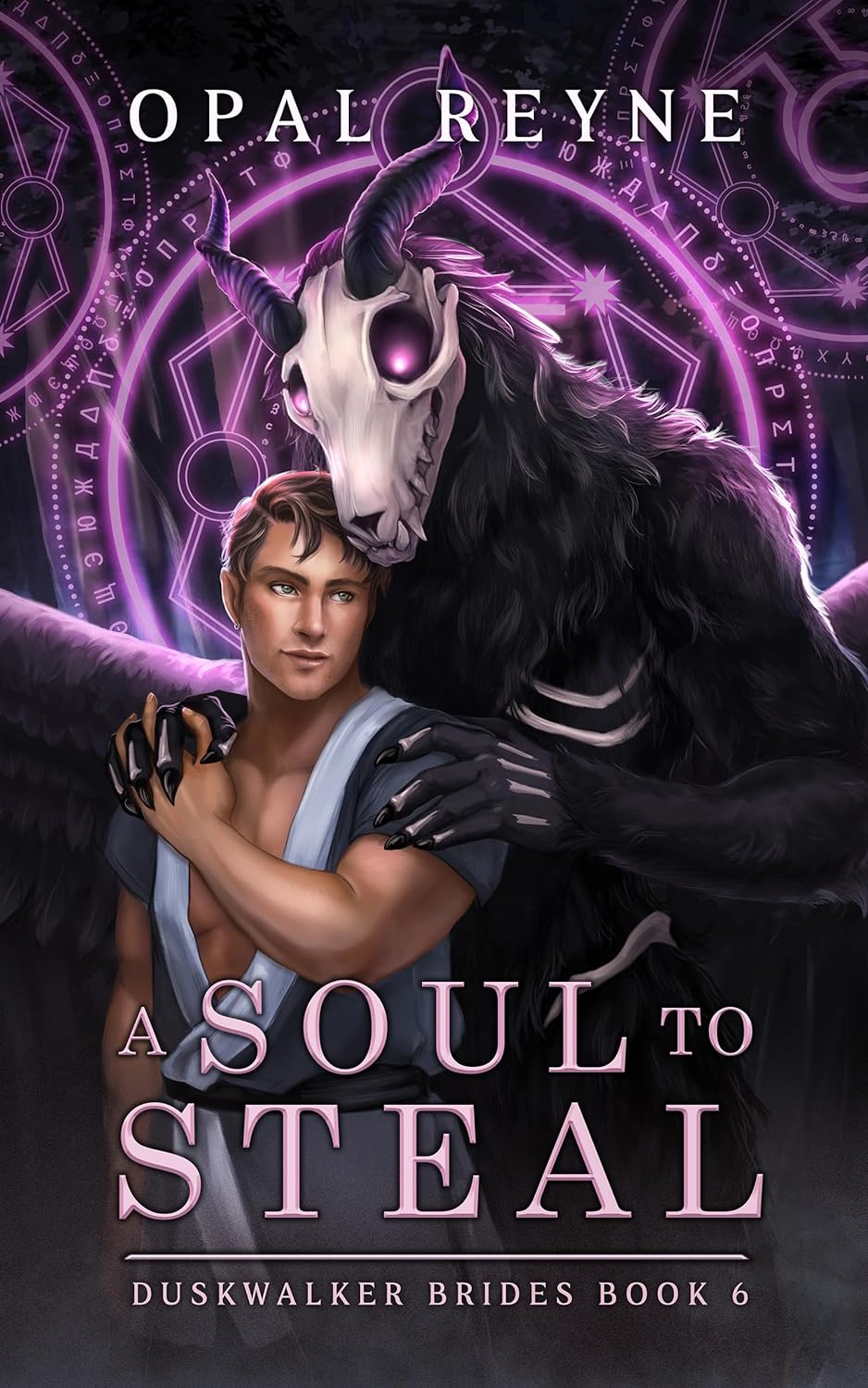
A Soul to Steal by Opal Reyne is one of the most emotionally introspective installments in the Duskwalker Brides series, shifting the focus from physical survival to a more unsettling question: what remains of a person after death when memory itself begins to disappear?
The story follows Gideon, a young man who awakens in Tenebris furious, devastated, and completely unprepared to accept that his life is over. He didn’t get enough time; he didn’t get to finish becoming the person he wanted to be, and he certainly didn’t get the chance to say goodbye to everyone he loved. His grief is messy rather than dignified, which immediately makes him feel painfully human.
Then there is Aleron, a Duskwalker left behind in the afterlife after being separated from his twin. Aleron is monstrous in appearance but emotionally gentle, curious, and profoundly lonely, and his need for companionship mirrors Gideon’s fear that death will eventually erase every trace of who he was.
Their relationship develops slowly because neither begins by searching for romance. Gideon needs something that can keep him anchored to consciousness, while Aleron needs someone willing to stay long enough to see him as more than a creature lurking in the afterlife. What grows between them becomes tender precisely because it begins with presence, not desire.
For me, that is what makes A Soul to Steal stand out. It is a monster romance, an afterlife fantasy, and a slow-burn love story, but beneath those labels is a book about the terror of disappearing and the extraordinary comfort of having one person remember you.
A Soul to Steal Quick Review
A Soul to Steal is the sixth installment in Opal Reyne’s Duskwalker Brides series and centers on Gideon and Aleron in Tenebris, the afterlife realm where souls risk losing their memories and eventually fading away. The romance develops from reluctant dependence into friendship and then intimacy, with emotional safety, touch, memory, and companionship becoming central to both characters’ survival.
The story blends paranormal romance, monster romance, dark fantasy, afterlife fantasy, LGBTQ+ romance, slow burn, and character-driven fantasy. Those genres fit together unusually well because the supernatural world-building exists primarily to deepen the emotional questions surrounding grief, identity, loneliness, and the fear of being forgotten.
What worked best for me is how restrained the romance feels. Gideon and Aleron don’t suddenly become each other’s cure, and the story doesn’t pretend love erases grief. Instead, connection gives both men a reason to keep existing inside a realm where identity itself can disappear.
A Soul to Steal Summary
Gideon awakens in Tenebris after death with very little patience for whatever comes next. He is angry that his life ended before he was ready, devastated by everything he lost, and increasingly frightened by the realization that death hasn’t preserved his identity as securely as he imagined.
In Tenebris, memory is unstable. Souls can begin losing pieces of themselves, and the danger is not simply being dead but slipping so far into dreamlike oblivion that nothing meaningful remains.
Aleron becomes Gideon’s anchor.
The Duskwalker has been left behind in Tenebris after separation from his twin, and his own existence has become defined by waiting, loneliness, and the hope that someone might eventually remain. He doesn’t always understand human emotion, but he understands abandonment and the need to matter to someone.
Their connection begins from necessity. Gideon needs Aleron’s presence and touch to stay conscious and grounded, while Aleron needs Gideon’s attention because being acknowledged gives him a sense of purpose he’s been missing.
Over time, necessity becomes familiarity. Familiarity becomes trust, and trust gradually becomes intimacy.
Gideon teaches Aleron about human memory, emotion, and the complicated ways people hold onto identity. Aleron gives Gideon something equally important by remaining beside him without demanding that his grief become quieter or easier to handle.
As their bond deepens, both characters begin confronting the same underlying fear from different directions. Gideon fears being forgotten by the living, while Aleron fears that nobody will ever choose to stay with him.
A Soul to Steal Characters
The character work succeeds because Gideon and Aleron are lonely for different reasons. Gideon has lost a complete life he desperately wanted to continue living, while Aleron has spent his existence yearning for a kind of belonging he has never fully experienced.
Neither character enters the relationship whole, but the novel doesn’t treat brokenness as a shortcut to romance. Their bond grows because each begins learning how to stay present with the other’s pain without trying to make it disappear.
Gideon
Gideon feels unusually human because he isn’t graceful about death. He is angry, resentful, grieving, and painfully conscious of all the things he will never get to do, which gives his emotional state far more credibility than a protagonist who immediately accepts the afterlife as another adventure.
His greatest fear gradually becomes larger than death itself. Gideon begins worrying that the person he was will disappear as memories fade, leaving behind something that technically exists but no longer feels like him.
That gives his relationship with Aleron enormous emotional significance. Aleron remembers him. Aleron sees him.
Most importantly, Aleron remains present when Gideon is angry, afraid, or emotionally difficult instead of requiring him to perform gratitude for whatever version of existence Tenebris has given him.
Gideon’s arc therefore becomes less about accepting death and more about deciding whether identity can still have meaning when the life that originally created it is gone.
Aleron
Aleron is almost the opposite of Gideon emotionally. His loneliness is quieter, and his desire for connection has been shaped by such prolonged isolation that even simple companionship carries enormous meaning.
His innocence makes him especially compelling because it never becomes stupidity. Aleron understands humanity through observation rather than lived experience, so he approaches Gideon with curiosity instead of assumptions.
He doesn’t always know what grief requires. Sometimes he offers touch because that is the form of comfort he understands. Sometimes he simply stays.
That consistency becomes increasingly important because Gideon doesn’t need someone to explain why he should feel better. He needs someone willing to remain beside him while he feels terrible.
Aleron’s emotional journey is equally meaningful because Gideon eventually proves he can be wanted for more than function or duty. Being chosen becomes transformative for a creature who has spent so long expecting everyone else to leave.
Gideon and Aleron’s Relationship
The romance between Gideon and Aleron works because companionship comes before desire. Gideon initially needs Aleron to remain grounded in Tenebris, while Aleron needs another conscious presence to ease the loneliness that has defined his existence.
That dependency could easily have become uncomfortable if the story had immediately translated it into sexual attraction. Instead, their relationship develops through conversation, silence, physical closeness, emotional honesty, and repeated demonstrations that neither intends to abandon the other.
Trust becomes the foundation long before romance does.
Gideon slowly learns that Aleron’s monstrous appearance doesn’t make him dangerous in the ways Gideon fears, while Aleron learns that caring for a human requires patience with emotions he doesn’t always understand.
Their relationship becomes especially moving once touch takes on new meaning. Early physical contact helps keep Gideon anchored, but later intimacy becomes something they actively choose because being close has evolved from survival into affection.
That progression makes the romance feel earned. The story never needs a sudden magical bond to explain why these two people matter to one another because we have already watched them become important through repeated acts of care.
Memory Is Survival in Tenebris
The most compelling part of the world-building is the way Tenebris connects memory to existence. Gideon isn’t merely afraid of losing people he loved because he has already lost them through death, but he also has to face the possibility that his memories of those people might disappear.
That creates a much more existential kind of horror.
If Gideon forgets his past, he doesn’t simply lose information. He loses the experiences that tell him who he is.
The question of memory therefore becomes inseparable from identity. A person can technically continue existing while gradually becoming disconnected from everything that once made that existence meaningful.
Aleron offers one possible answer to that fear. Being remembered by another person becomes a form of survival.
That makes their relationship emotionally powerful because love isn’t just companionship in Tenebris. It becomes a way of insisting that another person existed, mattered, and deserves to remain more than a fading impression.
Tenebris Is More Than an Afterlife Setting
Tenebris works because it doesn’t feel like a conventional heaven, hell, or fantasy kingdom with dead people added to it. The realm imitates aspects of life without fully reproducing them, creating an unsettling sense that everything is almost familiar but slightly wrong.
That wrongness reinforces Gideon’s emotional displacement. He wants the world he lost, not a distorted approximation of it.
The fractured quality of Tenebris also allows the setting to participate directly in the story’s themes. Time, consciousness, memory, and physical reality behave differently, which constantly reminds Gideon that the rules governing his old identity no longer apply in exactly the same way.
Aleron belongs there more naturally, but even he experiences Tenebris as a place of absence. His loneliness proves that existing in a realm doesn’t automatically mean having a meaningful place inside it.
Together, Gideon and Aleron begin creating that meaning for themselves.
The Romance Is Built Around Emotional Safety
One of the things I especially appreciated is that intimacy grows from comfort rather than possession. Aleron doesn’t claim Gideon simply because supernatural logic says they belong together, and Gideon isn’t magically stripped of grief once romance develops.
Their physical relationship emerges from emotional trust. That distinction matters because Gideon begins the story feeling as though almost every meaningful choice has been taken from him. Death itself happened without permission, and Tenebris threatens to take his memories next.
Choosing Aleron becomes significant because it is one of the few choices Gideon still gets to make. Aleron benefits from the same dynamic. He doesn’t want Gideon to stay because some supernatural rule requires it. He wants Gideon to stay because Gideon actually wants him.
That shared need to be chosen gives the romance much more emotional power than a predetermined bond would have provided.
A Soul to Steal Tropes and Subgenres
The book sits at the intersection of several romance and fantasy categories, with the strongest being paranormal romance, monster romance, dark fantasy romance, afterlife fantasy, LGBTQ+ romance, slow burn, and character-driven fantasy. The combination works because the romance and supernatural setting are built around the same emotional concerns rather than feeling like separate genres forced together.
Readers can also expect a human soul paired with a monstrous supernatural love interest, reluctant companionship that becomes love, emotional caretaking, loneliness, grief recovery, unusual afterlife world-building, and a strong emphasis on touch as comfort. The novel appears far more interested in emotional intimacy and identity than in action-heavy fantasy conflict.
Gideon’s Anger Makes His Grief More Convincing
I liked that Gideon isn’t presented as noble simply because he is suffering. He can be angry, bitter, resentful, frightened, and emotionally volatile because losing your entire future would probably make most people considerably less philosophical than fiction often allows.
That anger keeps the book from becoming sentimental. Gideon isn’t immediately grateful for Aleron because at least he has companionship after death. He still wants what was taken from him.
The romance grows stronger because Aleron doesn’t require Gideon to let go of his old life before he can care about the person in front of him. Those feelings can coexist.
Gideon can mourn everything he lost while slowly discovering that something meaningful can still happen afterward.
Aleron Isn’t a Monster Who Needs to Be Tamed
Aleron’s monstrous appearance naturally places A Soul to Steal within monster romance, but the story doesn’t treat his humanity as something Gideon needs to teach him through romantic domestication.
Aleron already possesses empathy, curiosity, tenderness, and the capacity for deep attachment. What he lacks is experience with human emotions and social behavior.
That distinction makes him much more appealing. Gideon helps him understand humanity, but he doesn’t manufacture Aleron’s ability to care. Aleron similarly doesn’t fix Gideon.
He provides companionship and stability, but Gideon still has to process the reality of his own death and decide what existence in Tenebris can mean to him.
The romance succeeds because neither character becomes responsible for transforming the other into someone worthy of love.
Being Remembered Becomes an Act of Love
The most moving idea in the novel is probably the connection between memory and love. Gideon fears being forgotten by the people still living, but eventually the question shifts toward who remembers him now.
Aleron does. That may not replace the life Gideon lost, but it changes what forgetting means. If identity exists partly through relationships, then having one person witness who you are can become a defense against oblivion.
Aleron has the same need from the opposite direction. He has spent so long without meaningful companionship that Gideon remembering him, choosing him, and treating him as someone worth knowing becomes proof that his existence matters too.
Their romance therefore becomes reciprocal in a particularly beautiful way. Gideon anchors Aleron emotionally. Aleron anchors Gideon existentially.
What I Loved About A Soul to Steal
The emotional restraint is probably the strongest element for me. The book has every opportunity to turn death, grief, and monster romance into melodrama, but the relationship appears to develop through much quieter moments of companionship and vulnerability.
I also love the idea of memory functioning as survival. It gives the afterlife setting genuine stakes without requiring a conventional villain constantly threatening the characters.
Gideon’s emotional messiness makes the philosophical material more effective because the story never turns him into a convenient mouthpiece for elegant thoughts about mortality. He remains angry enough to make the questions feel personal.
Aleron gives the story its tenderness. His attempts to understand Gideon, even when human grief makes little sense to him, reinforce the idea that care doesn’t always require complete understanding.
Sometimes it requires staying.
What Might Not Work for Every Reader
A Soul to Steal appears to be much more introspective than action-driven, so readers coming to the Duskwalker Brides series primarily for physical danger, adventure, or fast-moving external conflict may find the pacing quieter than they expect.
The heavy emphasis on death, grief, memory loss, identity, loneliness, and existential fear can also make the story emotionally difficult. Gideon spends significant time processing the unfairness of dying young rather than quickly accepting the afterlife.
For me, that sounds like one of the novel’s strengths because those emotions give the romance its meaning. Readers wanting lighter monster-romance escapism, however, may find the atmosphere considerably heavier.
The relationship is also a slow burn built first around dependence and companionship. Anyone looking for immediate attraction or rapid romantic payoff should expect something much more patient.
Is A Soul to Steal an LGBTQ+ Romance?
Yes. The central relationship is between Gideon and Aleron, making the book an LGBTQ+ romance as well as a monster romance and paranormal fantasy. The draft describes their queerness as integrated naturally into the relationship rather than treated as a separate source of conflict.
The emotional conflict instead comes from grief, death, identity, loneliness, and the strange rules of Tenebris. That allows the romance to focus on whether these two characters can build something meaningful after both believed meaningful connection had become impossible.
Is A Soul to Steal a Slow-Burn Romance?
Yes, and the gradual development appears central to why the relationship works. Gideon and Aleron begin through mutual need, develop companionship, build trust, and only later move toward romantic and physical intimacy.
That progression fits the emotional circumstances surrounding both characters. Gideon is grieving his death, while Aleron has spent so long isolated that immediate romantic certainty would feel inconsistent with everything the story establishes about them.
That patience lets attraction emerge from understanding. That makes the eventual intimacy much more meaningful.
Is A Soul to Steal a Monster Romance?
Yes. Aleron is a Duskwalker, and his nonhuman nature places the central relationship firmly within monster romance.
What makes the monster-romance element especially effective is that Aleron’s appearance doesn’t become shorthand for danger or emotional savagery. His monstrous body contrasts with an unexpectedly gentle personality, letting the story explore the difference between what something looks like and what it actually is.
Who Should Read A Soul to Steal?
I’d recommend A Soul to Steal to readers who enjoy monster romance but want substantial emotional and philosophical depth. It should especially appeal to readers who like slow-burning relationships, male-male romance, grief-centered stories, afterlife fantasy, unusual supernatural settings, emotionally gentle monster heroes, and romances built around companionship before desire.
Readers who enjoy stories about memory and identity may find even more to appreciate. The central question isn’t simply whether Gideon and Aleron fall in love, but whether being known by another person can preserve something essential when everything else begins disappearing.
That gives the romance unusually high emotional stakes without relying on conventional action.
A Soul to Steal Review: Final Thoughts
What stays with me most about A Soul to Steal is its refusal to treat death as the end of emotional complexity. Gideon reaches the afterlife carrying exactly the kinds of feelings people often hope death magically resolves: anger, regret, resentment, grief, unfinished longing, and the desperate conviction that his life should have contained more.
Tenebris doesn’t give him easy answers. Instead, it begins taking other things away.
Memory becomes unstable, identity becomes vulnerable, and Gideon has to confront the possibility that even the person he was might eventually disappear if nobody remains capable of remembering him.
Then Aleron stays. That simple fact becomes increasingly powerful.
Aleron doesn’t restore Gideon’s old life or give him back the future he lost. He cannot erase the injustice of dying young, and he can’t guarantee that every memory Gideon treasures will remain untouched forever.
What he can do is witness him. He can listen. He can remember. He can care whether Gideon remains himself.
Gideon eventually gives Aleron the same gift. The Duskwalker has spent his existence waiting, separated from meaningful companionship and uncertain whether anyone will ever choose him for himself rather than tolerate him because circumstance requires it.
Their romance grows in the space between those fears. Gideon is afraid nobody will remember the person he was. Aleron is afraid nobody will choose the person he is.
Love gives both of them an answer.
That is why the romance feels especially moving. Neither character rescues the other from grief, loneliness, or uncertainty, but they make those experiences survivable by refusing to let the other endure them completely alone.
For a story set after death, A Soul to Steal is surprisingly interested in what makes existence meaningful. Its answer isn’t immortality. It isn’t perfect memory. It isn’t freedom from pain. It is connection.
The possibility that another person can see you clearly, know what frightens you, understand that you are imperfect, and still decide your presence matters becomes its own form of survival.
That makes A Soul to Steal one of the more philosophically interesting stories. The monster romance works because, beneath the supernatural premise, lies a profoundly human desire to know that when everything else disappears, someone will still remember you were here.
A Soul to Steal FAQ
What is A Soul to Steal by Opal Reyne about?
A Soul to Steal follows Gideon, a young man who awakens after death in Tenebris and struggles with grief, anger, fading memories, and the fear that his identity will eventually disappear. His connection with Aleron, a lonely Duskwalker left behind in the afterlife, gradually grows from necessary companionship into friendship, trust, and love.
Who are the main characters in A Soul to Steal?
The central characters are Gideon and Aleron. Gideon is a human soul furious over the life he lost, while Aleron is a gentle but lonely Duskwalker searching for companionship and purpose in Tenebris.
Where does A Soul to Steal take place?
Much of the novel takes place in Tenebris, the afterlife realm of the series. It is portrayed as an unsettling liminal world where time and memory behave differently and where souls risk gradually losing themselves.
Is A Soul to Steal a monster romance?
Yes. Aleron is a Duskwalker, and his romantic relationship with Gideon places the book firmly within monster romance as well as paranormal romance and dark fantasy.
Is A Soul to Steal an LGBTQ+ romance?
Yes. Gideon and Aleron form the central romantic relationship, making the novel an LGBTQ+ romance in addition to its fantasy and monster-romance elements. This is a M/M monster romance as both Gideon and Aleron are male.
Is A Soul to Steal a slow burn?
Yes. Their relationship develops gradually through companionship, trust, shared vulnerability, physical comfort, and emotional intimacy rather than immediate romantic attraction.
What role does memory play in A Soul to Steal?
Memory is one of the novel’s central themes because souls in Tenebris risk losing their sense of identity as memories fade. Gideon’s fear of being forgotten and Aleron’s desire to matter to someone turn remembrance into both a form of emotional survival and an important part of their relationship.
What genre is A Soul to Steal?
The review places the novel across paranormal romance, monster romance, dark fantasy romance, afterlife fantasy, LGBTQ+ romance, slow-burn romance, and character-driven fantasy. Its strongest emphasis seems emotional and philosophical rather than action-heavy.