
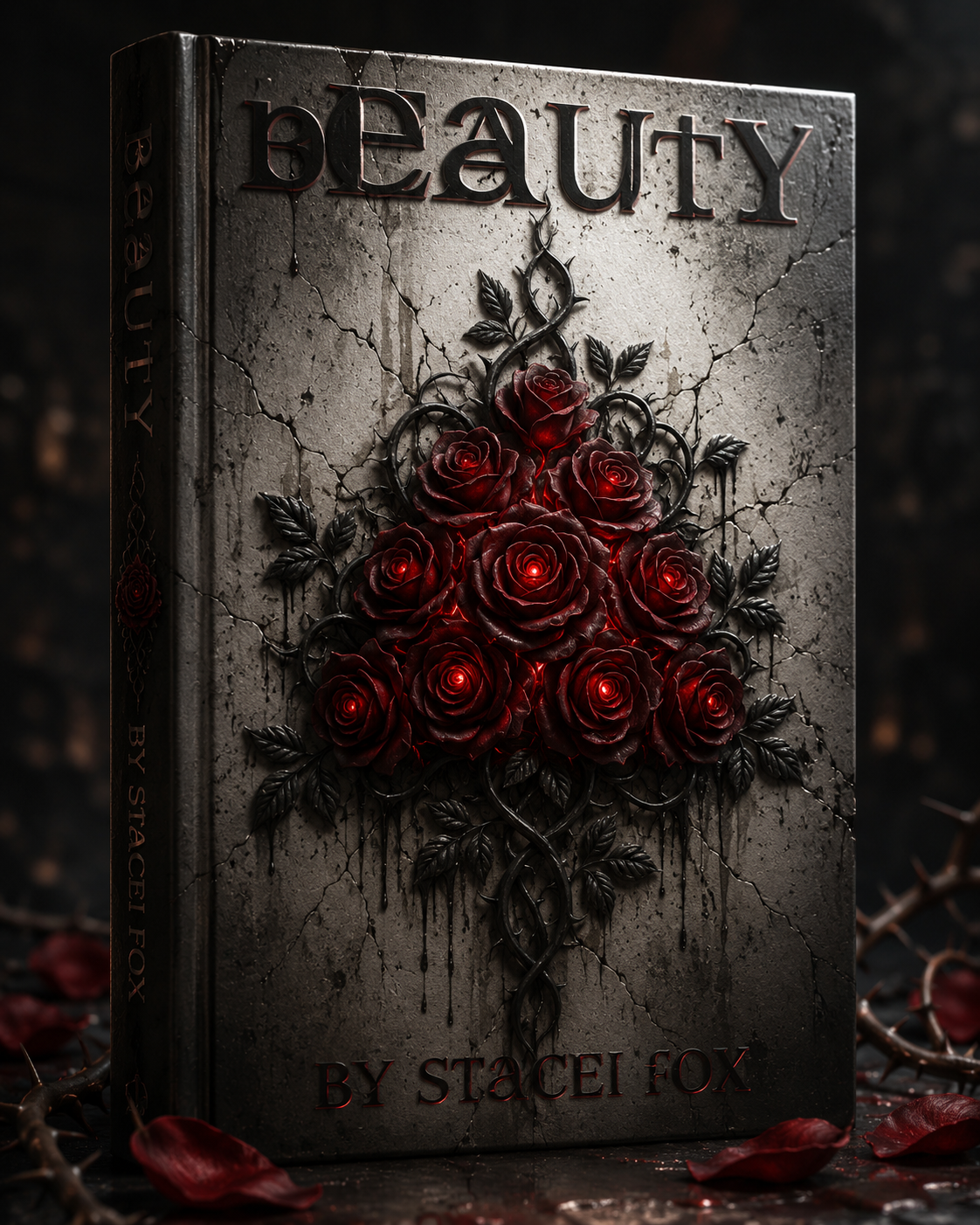
Beauty: A Gothic Romance by Stacei Fox takes one of the world’s most familiar fairy tales and makes it feel strange again. This isn’t simply Beauty and the Beast with a darker setting. Fox reimagines the story as a true gothic romance, filled with enchanted forests, impossible architecture, glowing roses, hidden grief, psychological tension, and two profoundly isolated people who slowly begin to recognize themselves in one another.
What impressed me most was the atmosphere.
The Pacific Northwest forests feel soaked in rain and secrets. Candlelit rooms seem to breathe. The Beast’s estate exists somewhere between ancient castle and impossible modern mansion, as though centuries of magic have quietly adapted to the twenty-first century. Yet underneath all that gothic beauty is a surprisingly intimate story about choice. Bella isn’t simply delivered to a monster. She chooses to go. That single distinction changes almost everything about the familiar fairy tale.
Beauty: A Gothic Romance Quick Review
- Retelling: Beauty and the Beast
- Heroine: Bella Laurent
- Hero: The Beast
- Setting: Contemporary Pacific Northwest and an enchanted estate
- Romance Style: Slow burn
- Major Themes: Choice, sacrifice, loneliness, grief, beauty, identity, isolation, and emotional intimacy
If you love fairy-tale retellings that feel eerie rather than whimsical, Beauty is an especially interesting take on the story. Fox keeps the rose, the Beast, the bargain, and the enchanted estate, but surrounds them with contemporary wealth, technology, media culture, family pressure, and distinctly gothic melancholy.
Beauty: A Gothic Romance Summary
Bella Laurent has grown up surrounded by beauty, wealth, and people who understand exactly how valuable appearances can be. She has never quite fit into that world. While members of the Laurent family curate polished lives built around image and influence, Bella is quieter and more introspective. She’s interested in books, animals, gardens, and overlooked things that don’t necessarily perform well for an audience.
Then the Laurent family’s seemingly perfect world begins to fracture.
A journey into the rain-soaked wilderness leads to something impossible: an enchanted estate hidden where no such place should exist, a rose that carries consequences, and a Beast whose power seems to belong to another age entirely.
A bargain follows. Bella is given a choice, and that’s one of the most important differences in this version of the story. The Beast doesn’t simply drag her into captivity. Bella understands what she’s being asked to sacrifice and chooses to enter his world anyway.
What she finds there isn’t the simple monster-and-maiden story she expects. The Beast is frightening, but he’s also controlled, intelligent, lonely, and far more complicated than his appearance suggests. His home is equally contradictory, beautiful and threatening, impossibly old and strangely modern, welcoming in one moment and unsettling in the next.
As Bella explores the estate and spends time with its mysterious master, fear gradually gives way to curiosity. Curiosity becomes understanding. And somewhere inside an impossible house filled with magic, silence, and secrets, Bella begins to question what beauty actually means.
Beauty: A Gothic Romance Characters
One of the strongest aspects of Beauty is that the characters fit recognizable fairy-tale roles without feeling like copies of characters we’ve seen countless times before. Fox uses the familiar framework as a starting point rather than a limitation.
Bella Laurent
Bella is the emotional center of the story. She’s quiet without being passive, compassionate without being naïve, and observant in a way that makes her particularly suited to a story about appearances.
Her family understands beauty as something visible. Bella notices what exists underneath it.
That difference is established early in the Laurent home, where wealth and elegance create an environment that should feel luxurious but instead often feels emotionally cold. Bella stands apart because she values things that can’t easily be displayed, monetized, photographed, or turned into status.
Her gentleness is also never presented as weakness. Bella’s defining act is a choice that requires enormous courage. She knows entering the Beast’s world will cost her something, and she goes anyway.
That agency matters. Instead of waiting for events to happen to her, Bella repeatedly decides what kind of person she’s going to be when confronted with fear, uncertainty, and sacrifice.
The Beast
The Beast is most effective when Fox refuses to explain him too quickly. He’s introduced through presence before personality.
Rooms feel different when he’s nearby. His voice seems to have physical weight. His size, restraint, power, and silence make him intimidating long before the reader understands who he really is.
That restraint made him far more interesting to me than a Beast who immediately reveals a tragic backstory and starts behaving like a misunderstood romantic hero.
There’s danger here. But there is also control. The Beast’s most compelling quality isn’t that he could overpower Bella. It’s that he repeatedly chooses restraint despite possessing extraordinary power.
His loneliness also gradually becomes as important as his physical monstrosity.
Bella and the Beast appear completely different on the surface, but both exist somewhat apart from the worlds surrounding them. Their romance develops from recognizing that isolation in each other.
Bella’s Father
Bella’s relationship with her father gives the story some of its most grounded emotional moments. Their scenes carry an intimacy that contrasts sharply with the larger supernatural elements. Instead of using him merely as the plot device who accidentally triggers the Beast’s bargain, Fox gives their relationship genuine emotional weight.
That makes Bella’s eventual sacrifice matter more. She’s not acting because a fairy tale requires Beauty to take her father’s place. She’s making a painful decision for someone she deeply loves. The choice feels personal rather than inevitable.
The Laurent Family
The larger Laurent family represents a very different kind of enchantment. Their world is built around wealth, appearance, influence, social visibility, and the careful construction of public identity. That makes them an effective modern contrast to the Beast’s estate. One world looks perfectly normal but often feels artificial. The other is obviously impossible but gradually reveals something more honest underneath its strange exterior.
Bella exists between those worlds, which reinforces one of the novel’s central questions: how much can appearance actually tell us about what is real?
How Is Beauty Different From Beauty and the Beast?
The biggest difference for me is agency. Many versions of Beauty and the Beast depend on some form of captivity. Beauty is traded, surrendered, imprisoned, or otherwise placed in the Beast’s home because circumstances leave her very little meaningful choice.
Fox keeps the sacrifice but changes its emotional foundation. The Beast insists upon choice. Bella understands that choice and makes it.
That shifts the story away from a romance developing entirely within captivity and toward something psychologically more interesting. Two isolated people enter an arrangement neither completely understands, but Bella isn’t stripped of her ability to decide who she will become inside it.
The contemporary setting also changes the familiar story. The Laurent family’s world contains technology, modern wealth, corporate pressure, media culture, and carefully manufactured public images. Against that background, the enchanted forest and the Beast’s impossible estate feel even stranger.
The result doesn’t feel like a historical fairy tale dressed in modern clothing. It feels like magic has survived quietly into the modern world.
Is Beauty Based on the Original 1740 Beauty and the Beast?
Yes, and this is one of the most interesting aspects of the book.
The published description identifies Beauty: A Gothic Romance as a retelling drawing from Gabrielle-Suzanne Barbot de Villeneuve’s 1740 version of La Belle et la Bête. That earlier story contains significantly more mythology than many later adaptations, including fairy politics, supernatural laws, curses, hidden identities, and royal origins.
Fox uses that older tradition as part of the foundation for a darker and more mythic version of the familiar story.
This matters because readers who only know Beauty and the Beast through later children’s adaptations may encounter elements here that feel entirely new.
They aren’t necessarily inventions added to make the fairy tale more complicated. Some are echoes of a much older and stranger version of the story.
The Gothic Atmosphere Is the Star
The atmosphere may be my favorite part of Beauty. Stacei Fox doesn’t simply place a romance inside a mansion and call it gothic. The environment influences how nearly every scene feels.
Rain-soaked forests create isolation. Fog obscures roads and boundaries. Candlelight makes enormous rooms intimate and threatening at the same time. Roses glow with impossible life. Architecture refuses to behave normally.
Even silence feels important. The Beast’s estate becomes more than a setting because Bella has to learn how to read it in much the same way she learns how to read him.
Both appear frightening. Both conceal something beneath the surface. And both become increasingly difficult to define using ordinary rules.
The Romance Is Built on Recognition
The emotional core of Beauty isn’t immediate attraction. It’s recognition. Bella and the Beast begin separated by fear, uncertainty, appearance, and an enormous imbalance in what each understands about the world around them.
The romance develops through observation.
Bella notices his restraint. The Beast notices her compassion. Silences become meaningful. Small choices begin revealing more than declarations could.
That creates a true slow burn.
Rather than constantly escalating the relationship through dramatic confrontations, Fox allows intimacy to emerge from conversations, gestures, shared spaces, and the gradual realization that neither character is quite what the other initially believed.
The result feels particularly appropriate for Beauty and the Beast. A story about looking beyond appearances shouldn’t depend entirely on instant attraction.
It should depend on learning to see someone.
Beauty: A Gothic Romance Tropes
Readers who choose romance by trope will find a combination of Beauty and the Beast retelling, gothic romance, fairy-tale retelling, cursed hero, mysterious hero, enchanted estate, forced proximity, slow burn, dangerous attraction, reluctant companionship, sacrificial heroine, hidden identity, supernatural bargain, opposites attract, isolation, magical roses, family sacrifice, and a romance built around appearance versus reality.
The gothic elements aren’t decorative.
Isolation, dangerous beauty, hidden grief, emotional repression, impossible architecture, and longing restrained by fear form the emotional structure of the story rather than simply its aesthetic.
Bella’s Choice Changes the Entire Romance
One of my favorite decisions in the book is allowing Bella to knowingly choose what happens next.
It would have been easy to reproduce the usual structure where the heroine is effectively imprisoned and readers are expected to eventually forget the circumstances because the Beast becomes sympathetic.
Fox takes a different path. The Beast’s insistence on choice tells us something important about him before Bella truly understands him.
He has the power to demand. Instead, he asks. Bella’s response tells us just as much about her. She isn’t fearless. She simply decides that fear doesn’t absolve her from making the choice she believes is right.
That dynamic gives their eventual intimacy a much stronger foundation.
The Beast Works Because He Remains Mysterious
I especially liked that Fox doesn’t rush to domesticate the Beast. He’s allowed to remain strange.
The reader isn’t immediately given every answer about his nature, history, curse, motives, or power. That uncertainty keeps some genuine danger inside the romance.
His restraint becomes much more interesting because we understand how powerful he is.
There’s an enormous difference between someone being harmless and someone dangerous choosing gentleness. The Beast belongs in the second category. That contradiction makes him compelling.
The Writing Is Patient and Atmospheric
Fox’s prose fits the material particularly well.
The writing slows down when atmosphere matters, allowing rooms, gestures, expressions, weather, and silence to accumulate emotional meaning rather than rushing from plot point to plot point.
That patience won’t work for every reader. If you’re looking for constant action, rapid-fire twists, or a fantasy story driven primarily by external conflict, Beauty may feel deliberately slow.
But that’s exactly why the book worked for me. Gothic romance needs space for unease.
It needs time for readers to wonder whether a hallway feels too quiet, whether a beautiful room is somehow wrong, or whether the monster standing across the table might understand the heroine better than anyone in the supposedly normal world she left behind.
Fox gives those moments room to breathe.
What Might Not Work for Every Reader
The deliberate pacing will probably be the biggest dividing line. This is a slow-burn gothic romance, and much of its tension comes through mood, silence, psychological intimacy, mystery, and gradual emotional change. Readers expecting a plot twist every few chapters may want something faster. The book is also deeply invested in atmosphere and symbolism. Houses, roses, glass, forests, light, architecture, and appearances carry meaning beyond their immediate role in the plot. I loved that approach because it made the story feel richer. Someone looking strictly for a quick, trope-forward romance may respond differently.
Who Should Read Beauty: A Gothic Romance?
I’d recommend Beauty to readers who love fairy tales but wish modern retellings would embrace more of their original strangeness. It’s especially suited to readers who enjoy gothic estates, cursed heroes, quiet heroines, supernatural bargains, enchanted forests, slow-building intimacy, morally complicated magic, and romances where emotional recognition matters more than instant attraction.
Readers interested in older versions of familiar fairy tales may find even more to appreciate here. This isn’t merely asking, “What if Beauty and the Beast were darker?” It’s asking what was lost when an already strange and complicated fairy tale became simplified over generations. Then it begins putting some of that darkness and mystery back.
Beauty: A Gothic Romance Review: Final Thoughts
What stayed with me most after Beauty wasn’t the curse or even the enchanted estate. It was the idea of recognition.
Bella comes from a world obsessed with appearance, yet she is the person least interested in judging value by what photographs well.
Then she’s placed opposite the ultimate contradiction. The Beast looks monstrous. His home should be terrifying. His world operates by rules she doesn’t understand.
Yet the longer Bella remains there, the less reliable appearances become. That’s where Fox’s version of the fairy tale becomes most interesting. The novel isn’t simply asking whether Bella can fall in love with someone who looks like a monster.
It’s asking what makes someone monstrous in the first place. Power doesn’t necessarily make the Beast cruel. Beauty doesn’t necessarily make Bella’s old world kind. Wealth doesn’t create warmth.
A frightening house can become a refuge, while a beautiful glass mansion can feel emotionally empty. That tension runs through the entire novel.
The gothic setting reinforces it beautifully, from the forests and fog to the glowing roses and impossible rooms. Everything seems to be asking Bella to look again.
And she does. That’s ultimately why this retelling worked so well for me. Bella’s strength isn’t loud. The Beast’s tenderness isn’t obvious. Their relationship isn’t immediate, and the world around them can’t be understood at first glance.
The story asks for patience from Bella and from the reader.
In return, it gives us a Beauty and the Beast retelling that feels darker, more psychologically intimate, and much stranger than the softened fairy tale most of us grew up knowing. Beauty: A Gothic Romance isn’t simply about finding beauty inside a monster.
It’s about learning that beauty, monstrosity, fear, kindness, and love are all much harder to recognize than appearances suggest.
Beauty: A Gothic Romance FAQ
What is Beauty: A Gothic Romance about?
Beauty: A Gothic Romance is a modern gothic reimagining of Beauty and the Beast. It follows Bella Laurent as family crisis, an enchanted rose, and a supernatural bargain lead her into the hidden world of a mysterious Beast and his impossible estate.
Who is the main character in Beauty: A Gothic Romance?
The heroine is Bella Laurent, a quiet, compassionate, and observant young woman who stands apart from her wealthy family’s obsession with appearance and public image.
Who is the Beast in Beauty: A Gothic Romance?
The Beast is the novel’s mysterious cursed hero. Fox initially reveals him through his power, restraint, loneliness, and unsettling presence rather than immediately explaining his history or the full nature of his curse.
Is Beauty: A Gothic Romance a Beauty and the Beast retelling?
Yes. The novel reimagines Beauty and the Beast through a contemporary gothic and romantasy lens while retaining central elements including the rose, the Beast, the bargain, sacrifice, enchantment, and the mysterious estate.
Is Beauty based on the original Beauty and the Beast?
The published description says the novel draws from Gabrielle-Suzanne Barbot de Villeneuve’s 1740 version of La Belle et la Bête, which contained substantially more fairy mythology and supernatural politics than many later adaptations.
Is Beauty: A Gothic Romance set in modern times?
Yes. This version places Bella’s story against a contemporary world of wealth, technology, media culture, and modern social expectations while preserving the ancient and supernatural quality of the Beast’s enchanted world.
Is Beauty: A Gothic Romance a slow burn?
Yes. The romance develops gradually through conversation, observation, restraint, shared isolation, and increasing emotional intimacy rather than immediate romantic surrender.
Is Beauty: A Gothic Romance dark?
It’s dark primarily in the gothic sense. The story emphasizes eerie atmosphere, isolation, supernatural danger, hidden grief, mystery, psychological tension, and a powerful cursed hero rather than relying solely on graphic darkness for its tone.
What tropes are in Beauty: A Gothic Romance?
Major elements include Beauty and the Beast retelling, gothic romance, cursed hero, enchanted estate, slow burn, forced proximity, supernatural bargain, sacrificial heroine, hidden identity, dangerous attraction, isolation, opposites attract, and appearance versus reality.
How long is Beauty: A Gothic Romance?
The book has about 167 pages, making it a relatively short gothic romance despite the amount of atmosphere and mythology packed into the story.