
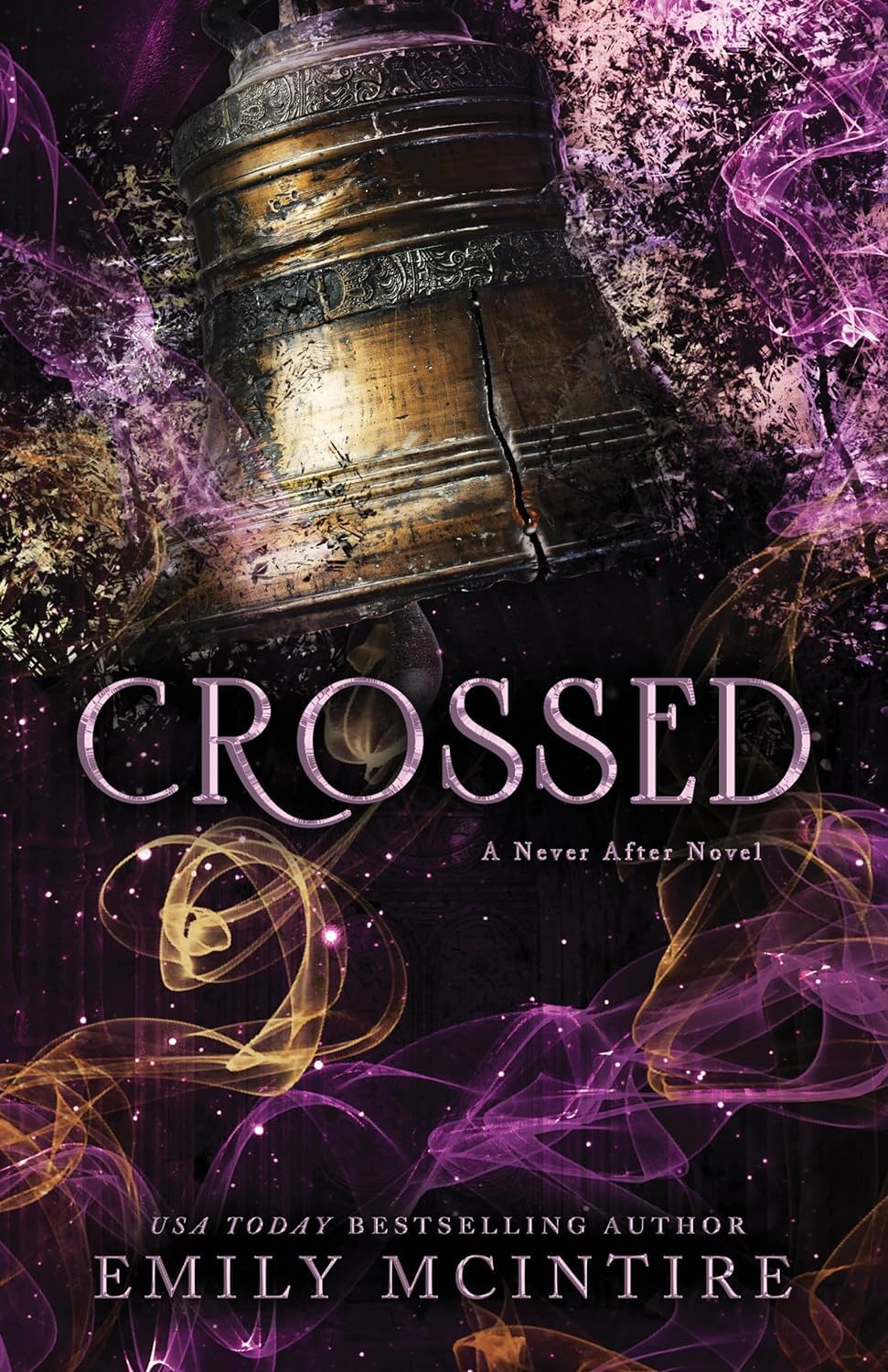
Crossed by Emily McIntire is the fifth complete standalone novel in the Never After series and one of the darkest entries in Emily McIntire’s collection of fractured retellings. Inspired by The Hunchback of Notre Dame, the story centers on Father Cade Frédéric, a priest whose devotion to faith exists alongside an increasingly disturbing compulsion to purge evil, and Amaya Paquette, a woman whose fierce love for her younger brother contrasts with the seductive alter ego she becomes at night.
This book immediately felt heavier than several of the earlier Never After installments. McIntire still delivers the intensity, chemistry, morally complicated characters, and heat the series is known for, but Crossed also leans much further into religious obsession, violence, darkness, temptation, and the uncomfortable places where desire and self-righteousness begin feeding each other.
For me, Crossed belongs beside Hooked as one of the strongest books in the series. Cade and Amaya have the kind of relationship that feels dangerous from the beginning, but underneath the obsession and forbidden attraction is a story about two people who desperately want to be seen without being abandoned.
The book is also considerably more gruesome than I expected. I don’t usually have much difficulty with darker material, but there were moments here that made me physically uncomfortable, so I’d absolutely recommend checking the author’s trigger warnings before reading.
Crossed Quick Review
Crossed is a dark contemporary romance built around forbidden attraction, religious obsession, moral corruption, violence, family devotion, and a hero who increasingly struggles to separate what he believes is righteous from what his own darker impulses are telling him to do. The Hunchback of Notre Dame influence gives the story a recognizable foundation, but McIntire reshapes those elements into something much more adult, sexual, violent, and psychologically intense.
Cade and Amaya are the reason the book works so well for me. Their attraction is immediate enough to feel dangerous, but the relationship becomes much more compelling once Cade’s certainty about Amaya begins colliding with the reality of who she actually is.
Amaya’s devotion to her younger brother Quin gives her character an especially strong emotional center. She may be seductive and mysterious in one part of her life, but the love and responsibility she carries for Quin reveal a tenderness that directly challenges Cade’s early assumptions about her.
The result is a romance where temptation and judgment become tangled together. Cade initially sees Amaya as something dangerous that needs to be resisted or destroyed, yet the closer he gets to her, the more difficult it becomes to maintain the moral categories he has built his life around.
Crossed Summary
Father Cade Frédéric has devoted his life to faith and the church, but his relationship with righteousness is far more complicated than it first appears. He grew up on the streets of Paris before finding a path that eventually led him into the priesthood, and that background gives him a very different relationship with sin, violence, and judgment than someone raised entirely within the safety of religious institutions.
Beneath the priestly exterior is what Cade thinks of as a sickness. He feels compelled to confront evil and purge it, and that compulsion has become intertwined with his understanding of faith to such a degree that the distinction between religious duty and personal darkness becomes increasingly difficult to separate.
When Cade is appointed as the priest in Festivalé, Vermont, he arrives in a town that feels saturated with despair. The darkness he senses there immediately awakens the part of him that believes evil must be confronted directly.
Then he meets Amaya Paquette.
Amaya has built her life around survival and responsibility, particularly when it comes to caring for her younger brother Quin. By day, she is the woman who protects and provides for him, but by night she becomes Esmeralda, a captivating performer whose sensuality and mystery make her impossible for Cade to ignore.
Cade’s reaction to Amaya is immediate and extreme.
Rather than simply accepting that he is attracted to her, he interprets that attraction through the framework of temptation and corruption. He convinces himself that there is something unnatural about her influence over him and begins associating her with witchcraft.
The more he tries to resist her, the more consumed he becomes.
Amaya does not fit neatly into the moral category Cade wants to place her in. She can be provocative and guarded while also being deeply loyal, loving, and protective of Quin, which means every new thing Cade learns about her makes his original judgment increasingly difficult to sustain.
Their attraction develops inside that contradiction. Cade wants to believe that Amaya represents temptation. His desire keeps telling him that she represents something else entirely.
The conflict becomes increasingly dangerous because Cade’s obsession is not simply sexual. It is tied to his ideas about sin, purification, guilt, and the darkness he already carries inside himself.
Amaya has her own reasons for maintaining emotional distance.
Her fear of abandonment makes vulnerability dangerous, and the life she has built around Quin gives her responsibilities that cannot simply disappear because a complicated priest becomes obsessed with her.
Their relationship therefore becomes a collision between two people who are each carrying their own wounds and defenses. Cade tries to destroy temptation instead of admitting what it reveals about him, while Amaya has to decide whether loving someone means risking the possibility that he could become another person who leaves.
As their attraction intensifies, the distinction between righteousness and obsession becomes increasingly unstable. Cade’s greatest battle is not simply resisting Amaya, but confronting the possibility that the darkness he believes he sees in the world may already exist inside him.
Father Cade Frédéric
Cade is one of the most unsettling heroes in the Never After series because his darkness is wrapped in moral certainty. He does not see himself as someone casually indulging violent impulses, because he has created a framework in which those impulses can be interpreted as a righteous response to evil.
That makes him especially dangerous.
A person who knows he is doing something wrong can still feel guilt or hesitation. Cade’s worldview allows him to believe that darkness may be justified when it serves what he considers a holy purpose, and that belief becomes increasingly difficult to separate from his personal compulsions.
His priesthood makes the attraction to Amaya even more destabilizing. Desire is not merely inconvenient. It threatens his identity.
Cade has built his life around spiritual discipline, and Amaya makes him aware of a part of himself that cannot be controlled through prayer, rules, or rigid moral judgment.
His early conclusion that she must possess some form of witchcraft is revealing because it allows him to externalize the problem. If Amaya is the source of temptation, then Cade does not have to examine why he responds to her so intensely.
That defense cannot survive forever.
The more he learns about Amaya, the less convincing it becomes to treat her as the embodiment of evil.
Cade’s strongest character development comes from being forced to recognize that his own capacity for darkness cannot be blamed entirely on another person. Amaya may provoke desire, but she does not create the parts of him that were already waiting beneath the surface.
His physical and psychological portrayal is also one of the reasons I enjoyed the book so much. McIntire makes Cade feel intense even before the romance fully develops, and the combination of restraint, obsession, faith, and violence gives him a presence that dominates much of the story.
Amaya Paquette
Amaya is an effective counterbalance to Cade because she is far more complicated than the temptation he wants her to represent. Her sensuality is genuine, but so is the devotion she shows to Quin, and neither side of her personality cancels out the other.
Her life has taught her to be guarded. She wants love, but abandonment has made emotional dependence dangerous. That makes Cade particularly complicated for her because his interest is anything but casual.
Being desired that intensely can feel intoxicating, but the same intensity can also feel threatening when it comes from a man already struggling to control how he interprets those feelings.
Amaya’s relationship with Quin gives her character much of its emotional depth.
Her love for him is not theoretical or convenient.
She organizes her life around caring for him, which reveals how deeply loyalty and family matter to her.
That devotion also makes Cade’s assumptions about her more uncomfortable.
He sees temptation first. The reader is allowed to see sacrifice, responsibility, tenderness, fear, and resilience alongside it.
That gap between perception and reality becomes central to their relationship. Amaya is also compelling because she does not need to become less sensual to prove that she is worthy of love.
Her identity as Esmeralda is part of her, but it is not the entire definition of who she is. That distinction matters enormously in a story where Cade initially wants to interpret sexuality itself as evidence of moral corruption.
Cade and Amaya’s Relationship
Cade and Amaya have one of those dark-romance dynamics where attraction begins in hostility, judgment, and resistance rather than emotional safety. Cade does not simply believe Amaya is inappropriate for him, because he initially views her as something much more dangerous.
That makes his obsession especially contradictory. The more firmly he convinces himself that Amaya must be resisted, the more completely she occupies his thoughts.
His desire becomes proof of temptation in his mind, and that belief only intensifies the cycle. Amaya does not experience the relationship from the same moral framework.
Her conflict has more to do with trust, abandonment, and whether someone as intense as Cade is capable of loving her without trying to control or destroy the parts of her he finds threatening.
Their relationship therefore operates on several levels at once. There is physical attraction. There is fascination. There is hostility. There is fear. There is also a growing recognition that both characters are seeing parts of themselves reflected back in ways neither finds comfortable.
That is what makes the eventual emotional connection more satisfying than the initial chemistry alone. Cade has to learn that loving Amaya cannot mean purifying her into someone who fits his worldview.
Amaya has to decide whether Cade’s love can become something different from the abandonment and instability she already fears.
The Hunchback of Notre Dame Inspiration
The Hunchback of Notre Dame influence gives Crossed a darker foundation than a conventional forbidden priest romance. Religious authority, desire, moral judgment, obsession, Esmeralda imagery, and the dangerous consequences of confusing attraction with corruption all fit naturally into the inspiration.
McIntire does not appear interested in recreating the source story scene for scene. Instead, she takes recognizable emotional and thematic elements and reshapes them into the darker contemporary style that defines the Never After series.
That approach works particularly well because Cade’s obsession with Amaya echoes the larger conflict between religious repression and desire. The story becomes less about whether attraction itself is sinful and more about what happens when someone refuses to accept responsibility for his own attraction.
Amaya’s Esmeralda identity reinforces the connection without reducing her to a symbolic role. She is sensual and captivating, but she is also a woman trying to protect the person she loves most.
That emotional grounding keeps her from becoming merely the object of Cade’s obsession.
Religion, Obsession, and Moral Certainty
One of the strongest themes in Crossed is the danger of believing personal darkness becomes acceptable when it is wrapped in moral certainty. Cade’s faith is important, but so is the way he interprets his darker impulses through that faith.
That distinction creates much of the psychological tension. The frightening part is not simply that Cade feels capable of violence. The frightening part is that he can sometimes believe violence is justified.
His attraction to Amaya exposes how unstable that certainty can become. He wants to identify a clear source of corruption outside himself because that would allow him to remain righteous in his own story.
Amaya refuses to cooperate with that explanation simply by being more human than the role he assigns her. The closer Cade gets, the harder it becomes to claim that she is the source of everything dark inside him.
Eventually, he has to confront the fact that temptation does not create desire from nothing. It reveals what is already there.
Amaya and Quin Give the Story Its Emotional Center
Amaya’s devotion to Quin is one of the parts of Crossed that stayed with me most because it reveals who she is when nobody is evaluating her sexuality or judging her choices. Her relationship with her brother is rooted in loyalty, protection, and unconditional love.
That bond also makes her fear of abandonment more understandable. When someone has become accustomed to protecting the people they love, relying on another person can feel dangerously unfamiliar.
Cade’s relationship with Amaya becomes more meaningful once he recognizes that her capacity for love has always been present. She does not need him to teach her devotion.
If anything, her relationship with Quin offers evidence that she already understands loyalty in a way Cade initially fails to appreciate. That contrast deepens the romance.
Cade enters believing he can identify righteousness from outward appearances. Amaya repeatedly forces him to confront how poor that judgment can be.
Desire Becomes More Dangerous Because Cade Is a Priest
The forbidden element of the romance works because Cade’s vows are not merely an inconvenient obstacle. His faith is foundational to his identity, which means desire threatens much more than his reputation.
Wanting Amaya destabilizes the story Cade tells himself about who he is. He has chosen a life based on restraint, moral authority, and spiritual dedication.
Amaya awakens something that does not fit comfortably inside those boundaries. That creates much stronger tension than a relationship forbidden only because other people disapprove.
Cade is fighting himself.
The problem is that he initially directs that fight outward.
Instead of admitting that desire belongs to him, he tries to interpret Amaya as the problem.
That psychological displacement makes the romance darker because attraction becomes tangled with punishment, obsession, and the need to destroy what he cannot control.
Crossed Tropes and Genres
The strongest elements include:
- Dark romance
- Contemporary romance
- Forbidden romance
- Priest romance
- Morally gray hero
- Obsessive hero
- Religious obsession
- Enemies-to-lovers elements
- Opposites attract
- Forbidden attraction
- Possessive hero
- Dark retelling
- The Hunchback of Notre Dame inspiration
- Esmeralda-inspired heroine
- Small-town setting
- Family devotion
- Protective sister
- Abandonment fears
- Violence and gore
- High heat
- Psychological darkness
- Temptation
- Redemption
- Love versus obsession
- Light versus darkness
Darkness Is More Than an Aesthetic
One of the reasons Crossed stands apart within the series is that the darkness is not simply a collection of edgy romantic tropes. Cade’s worldview makes darkness part of the actual psychological architecture of the story.
He believes he understands evil. He believes he knows how to identify it. He believes he has a role in destroying it. Amaya gradually exposes the limitations of that certainty.
That makes the story uncomfortable in a productive way because the reader is repeatedly asked to consider whether Cade is confronting darkness or feeding it.
His religious position intensifies that question. Authority can be especially dangerous when someone believes his personal judgment carries moral certainty.
The romance becomes part of his reckoning because loving Amaya eventually requires him to stop treating her as evidence in a case he has already decided.
The Heat Is Intense Because the Repression Is Intense
The sexual tension in Crossed works because Cade spends so much time trying to deny what he feels. Every effort to suppress attraction adds pressure rather than eliminating it, making the eventual intimacy feel explosive rather than casual.
That dynamic reminded me somewhat of the appeal of Priest by Sierra Simone, although Crossed is considerably darker in tone. Both stories draw tension from religious vows and forbidden desire, but Cade’s violent impulses and obsession push McIntire’s book into much more disturbing territory.
The heat also serves the characterization. Cade cannot maintain the illusion that Amaya means nothing to him once his physical reaction becomes impossible to dismiss.
Amaya likewise has to determine whether intense desire can exist alongside the emotional safety she needs. That keeps the sexual relationship connected to the larger psychological conflict.
The Violence Is More Intense Than Earlier Never After Books
Readers should take the trigger warnings seriously before starting Crossed. This was easily one of the more gruesome Never After installments for me, and there were moments that made me uncomfortable even though dark material usually does not affect me strongly.
The violence fits Cade’s character and the larger atmosphere, but that does not mean every reader will enjoy experiencing it. Anyone sensitive to graphic or disturbing material should check the author’s warnings beforehand rather than assuming the level of darkness will be comparable to every other book in the series.
That intensity is also part of what makes the book memorable. McIntire does not soften Cade simply because he is the romantic hero.
His darkness remains genuinely unsettling, which means falling for him requires accepting that this is not a conventional redemption story where the hero becomes harmless by the end.
Love and Obsession Are Constantly Overlapping
Cade’s feelings for Amaya raise an uncomfortable question about the difference between loving someone and being consumed by them. His attraction is so intense that obsession often becomes easier for him to recognize than affection.
That creates tension because unconditional love should require seeing the other person clearly. Obsession often does the opposite. It reduces someone to what they represent.
Early in the story, Cade interprets Amaya as temptation, corruption, danger, and witchcraft. The relationship becomes more meaningful when he begins seeing Amaya herself.
That shift is crucial. Loving her means acknowledging her complexity instead of using her as a symbol in his private war between holiness and desire.
Amaya has her own version of the same challenge. Being intensely wanted can feel like love, but she still needs to know that Cade is capable of accepting the person behind the fantasy.
What I Loved About Crossed
Cade is easily one of the most memorable heroes in the series for me because his physical presence, religious identity, obsessive tendencies, and psychological darkness all work together rather than feeling like separate character traits. McIntire gives him enough complexity that even when his behavior becomes disturbing, I still wanted to understand what was driving him.
Amaya is equally important because she prevents the book from becoming entirely about Cade’s obsession. Her devotion to Quin, fear of abandonment, sensuality, and strength create a character who feels much more complete than the temptation Cade initially wants her to represent.
Their chemistry is also extremely strong.
The forbidden nature of Cade’s attraction creates immediate tension, but the relationship becomes even more compelling as judgment turns into fascination and fascination becomes emotional vulnerability.
I also loved the way the Hunchback of Notre Dame inspiration is incorporated.
The story feels recognizable without becoming a simple retelling.
McIntire takes the religious obsession, Esmeralda imagery, moral judgment, and darker emotional framework and reshapes them into something that fits naturally inside the Never After universe.
Finally, the emotional relationship between Amaya and Quin gives the book a heart that balances some of its most disturbing material.
Amaya’s love for her brother reveals how deeply she is capable of devotion long before Cade learns to understand her.
What Might Not Work for Every Reader
The biggest issue will be the darkness. This book contains material intense enough that even readers comfortable with dark romance may find certain moments difficult.
The author’s trigger warnings are important here, and I would not skip them. Cade himself may also be too extreme for some readers.
His religious obsession, violent impulses, possessiveness, and distorted moral certainty make him considerably darker than a conventional morally gray hero.
Readers who need the romantic lead to become clearly safe or traditionally redeemable may struggle with him. The religious themes can also be uncomfortable depending on the reader.
Cade’s priesthood is deeply intertwined with desire, guilt, violence, temptation, and moral judgment, so anyone sensitive to dark portrayals of faith or religious authority should know that those elements are central rather than incidental.
The level of heat may be another dividing line. This is not a restrained forbidden romance where attraction remains mostly emotional.
The sexual tension and eventual intimacy are intense, and the contrast between priestly repression and desire is one of the major sources of the book’s erotic energy.
Standalone Status and Series Placement
Crossed is the fifth complete standalone novel in Emily McIntire’s Never After series. The book has its own central couple and story, so readers do not need to follow one continuing romantic plot through the earlier installments.
The shared identity of the series comes from its dark reimaginings of familiar stories rather than from one ongoing couple. That structure makes Crossed accessible even to someone who has not read every previous book, although readers already familiar with McIntire’s style will probably have a better idea of how dark and morally complicated these romances can become.
For me, Crossed stands near the top of the series alongside Hooked. Both books take recognizable inspiration and push it into something darker, more obsessive, and more emotionally intense than the source material might initially suggest.
Who Should Read Crossed
I’d recommend Crossed to readers who enjoy dark romance where the hero is genuinely disturbing rather than merely labeled morally gray. It should especially appeal to readers who like forbidden priest romance, obsessive heroes, dark retellings, The Hunchback of Notre Dame inspiration, strong heroines, religious themes, possessive attraction, morally complicated characters, family devotion, and high emotional intensity.
It will also work particularly well for readers who want a romance that embraces discomfort rather than avoiding it. Cade and Amaya are not a soft or uncomplicated couple, and the book does not pretend that their journey toward love happens without darkness, violence, obsession, and significant emotional risk.
Crossed Review: Final Thoughts
Crossed is one of those books where the darkness is impossible to separate from the romance because the central relationship grows directly out of Cade’s inability to understand what Amaya awakens inside him. He wants to interpret desire as evidence of corruption, but every interaction with her makes that explanation more difficult to sustain.
Amaya exposes the limits of his certainty. She is sensual without being corrupt. She is guarded without being incapable of love. She can become Esmeralda at night and still organize much of her life around protecting Quin.
Those contradictions matter because Cade initially wants the world to be morally simple. Amaya refuses to fit inside that simplicity.
Their relationship therefore becomes a challenge to the way he understands righteousness. Cade cannot truly love Amaya while continuing to treat her as a symbol of temptation.
He has to see the person rather than the role. Amaya faces a different version of the same challenge. She cannot accept Cade simply because being wanted so intensely feels powerful.
Her fear of abandonment means she needs evidence that love can remain present after desire stops being novel. That gives the emotional relationship more weight than the erotic obsession alone.
The book’s greatest strength is the way those two arcs collide.
Cade has to learn that love requires humility because he cannot decide what Amaya means before understanding who she is.
Amaya has to learn that vulnerability is not automatically a prelude to abandonment.
Neither lesson is easy. That difficulty is what makes the relationship feel earned within such an extreme story.
The religious elements add another layer because Cade’s faith is not simply decorative. His priesthood shapes the way he understands himself, his attraction, his violence, and his moral authority.
Desire threatens the identity he has built, which makes Amaya dangerous long before she has actually done anything to deserve that designation.
That is where Crossed becomes especially compelling. The real source of danger may never have been Amaya. Cade’s certainty was always the more frightening force.
For me, that psychological tension is what places Crossed beside Hooked as one of the strongest installments in the series.
The romance is hot, obsessive, and deeply forbidden, but it is also built around two people learning how badly they have been wounded by the stories they believe about themselves and others.
The book can be gruesome. It can be uncomfortable. It can also be strangely tender in the moments when Amaya’s devotion to Quin or Cade’s emotional defenses finally crack.
That combination made it difficult for me to put down.
Readers who are comfortable with the trigger warnings and enjoy dark romance that genuinely earns the word dark should find Crossed one of the more memorable books in the Never After series.
Crossed FAQ
What is Crossed by Emily McIntire about?
Crossed follows Father Cade Frédéric, a priest whose devotion to righteousness is complicated by violent impulses and an obsession with purging evil, and Amaya Paquette, a mysterious woman who cares for her younger brother by day and performs as Esmeralda at night. Cade initially interprets his overwhelming attraction to Amaya as evidence that she is dangerous, but the closer he gets to her, the more difficult it becomes to separate temptation from his own darkness.
Is Crossed based on The Hunchback of Notre Dame?
Yes. Crossed is a dark contemporary reimagining inspired by The Hunchback of Notre Dame, using recognizable elements such as religious obsession, moral judgment, Esmeralda imagery, forbidden desire, and the dangerous consequences of treating attraction as corruption.
McIntire reshapes those ideas into the darker adult-romance style of the Never After series. The story is not presented as a simple scene-by-scene recreation of the source material.
Is Crossed a dark romance?
Yes. Crossed is one of the darker installments in the Never After series, with intense themes involving violence, obsession, religion, temptation, and psychologically disturbing behavior.
Readers should check the author’s trigger warnings before beginning the book. Even readers accustomed to dark romance may find some of the material more intense or gruesome than expected.
Who is Father Cade Frédéric?
Father Cade Frédéric is the central male character, a priest who grew up on the streets of Paris before dedicating his life to faith and the church. Beneath that religious identity, he struggles with a darkness he considers a sickness and a compulsion to confront what he believes is evil.
His attraction to Amaya destabilizes his worldview because he initially interprets her effect on him as something supernatural or corrupting. Much of his character arc involves confronting what his obsession reveals about himself.
Who is Amaya Paquette?
Amaya Paquette is the heroine, a guarded and alluring woman living in Festivalé who is deeply devoted to caring for her younger brother Quin. At night, she becomes Esmeralda, a captivating performer whose sensuality immediately draws Cade’s attention.
Her character combines vulnerability, independence, loyalty, and sexuality. Her devotion to Quin also reveals a capacity for unconditional love that challenges Cade’s early assumptions about her.
Is Crossed a priest romance?
Yes. Cade is a priest, and his vows and religious identity create one of the major sources of forbidden tension in his relationship with Amaya.
The priesthood is not merely a background detail. Cade’s understanding of faith, temptation, righteousness, and sin directly influences how he responds to his attraction.
Is Crossed spicy?
Yes. The heat as particularly intense, and Cade’s attempt to repress his attraction gives the sexual tension considerable force. The erotic material is closely connected to the psychological conflict. Cade’s desire threatens the identity he has constructed around religious discipline, which makes intimacy part of the larger struggle rather than an unrelated element.
Is Crossed gruesome?
Yes. Your review identifies Crossed as the most gruesome Never After installment you had read and notes that some material made you uncomfortable despite normally tolerating dark subjects well.
Readers sensitive to gore or intense subject matter should take the trigger warnings seriously. The violence contributes to the atmosphere and Cade’s characterization, but it may be too much for some readers.
Can Crossed be read as a standalone?
Yes. Crossed is the fifth complete standalone novel in the Never After series, with Cade and Amaya receiving their own central romance and story. Readers do not need to follow one continuous couple through the earlier books. The series is connected primarily through its dark reimaginings of familiar stories rather than one ongoing romantic plot.
Who should read Crossed?
Readers who enjoy dark romance, forbidden priest relationships, obsessive heroes, psychologically intense characters, fractured retellings, high heat, and The Hunchback of Notre Dame inspiration should find plenty to engage with here. It is especially well suited to readers who are comfortable with disturbing themes and heroes whose darkness remains genuinely unsettling.