
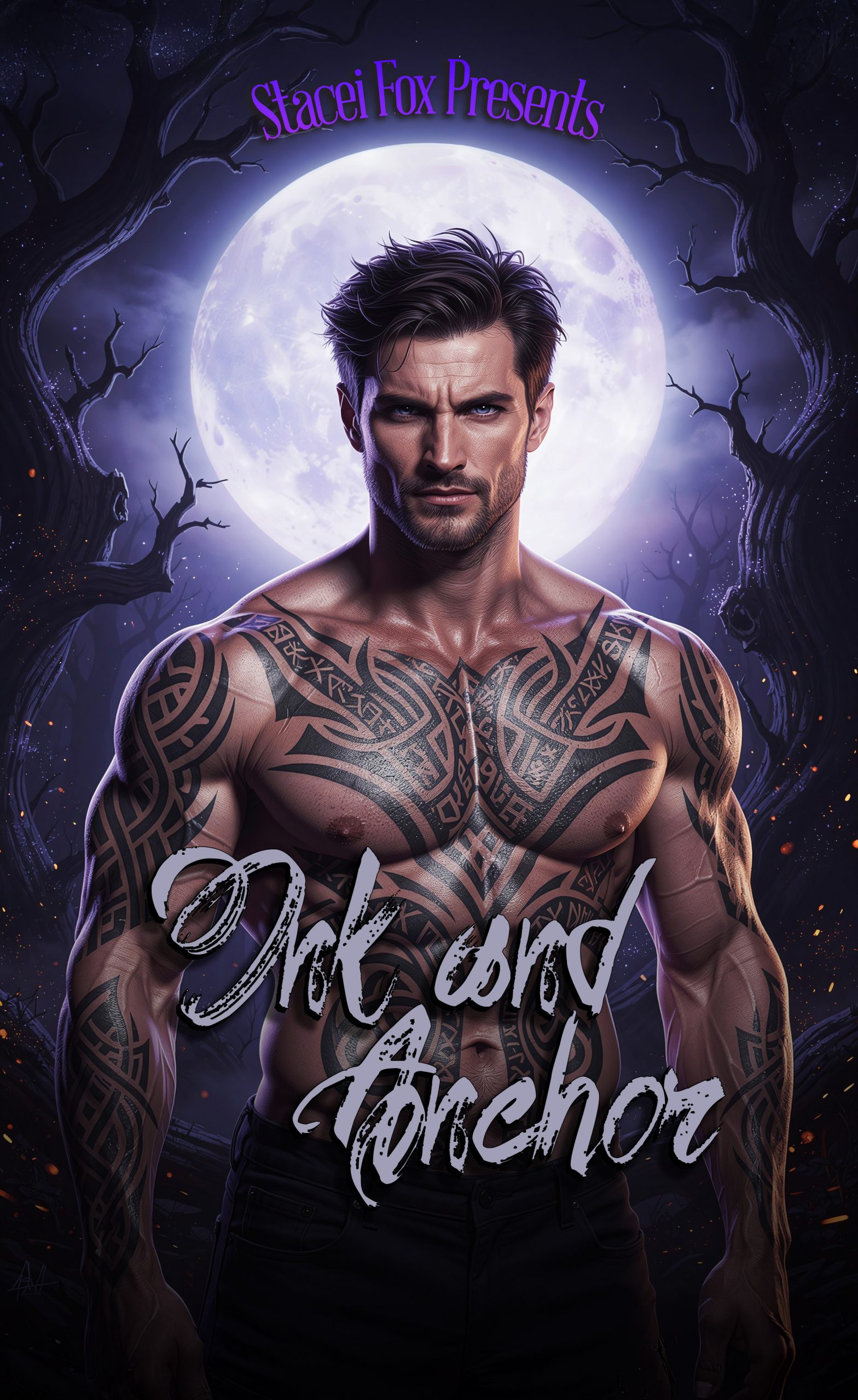
Ink and Anchor by Stacei Fox is a richly layered paranormal fantasy romance that refuses to follow the genre’s most familiar shortcuts. Rather than leaning on fate, instant bonds, or domination disguised as devotion, this novel builds its emotional and romantic stakes through patience, consent, intellect, and earned trust. It is a story about power that learns to listen, love that does not demand ownership, and a heroine who reshapes an ancient supernatural system not through violence, but through precision.
At its heart, Ink and Anchor is a character-driven narrative. While it contains shifters, Pack politics, and supernatural artifacts, the true tension of the story lies in its emotional architecture. This is a novel that asks what happens when power is not meant to conquer, but to be regulated. What happens when love is not about being claimed, but about choosing to stay.
Molly Weston is one of the most compelling heroines to appear in paranormal romance in recent years. She is an archivist and manuscript conservator by trade, a woman whose entire life is built around preserving what others discard. History, language, fragile artifacts, and forgotten truths are her domain. This profession is not decorative or incidental. It shapes how Molly sees the world, how she navigates conflict, and how she ultimately dismantles a supernatural hierarchy that has gone unchallenged for centuries.
When the story opens, Molly’s quiet, precarious life is already under strain. Her beloved shop, Ink & Anchor, which she inherited from her grandfather, is barely surviving. She is broke, exhausted, and emotionally isolated, but still fiercely protective of the work she does. When the shop is deliberately sabotaged, it becomes immediately clear that this is not random vandalism. Someone was searching for something specific. Something valuable.
That something is an Eternal Lunarite ring, an artifact Molly has hidden for years. The ring is not simply rare or powerful. It is a stabilizer for a Lycan Alpha, a piece of supernatural infrastructure that keeps immense power from tipping into violence. The ring was a gift from Torin Ashford, an Alpha Molly fled three years earlier after witnessing how dangerous immortality and dominance could become when control falters.
This single object becomes the fulcrum of the entire narrative. When Molly sells the ring in a moment of desperation, she unknowingly triggers a supernatural alarm that alerts Torin to her location and her betrayal. What follows is not a dramatic kidnapping or a violent confrontation, but something far more chilling. Torin does not rage. He audits.
Torin Ashford is a fascinating romantic lead precisely because he does not behave like a typical Alpha. He is powerful, ancient, and terrifying in his capacity for control, but he is not cruel. He does not force Molly back into his life through brute strength. Instead, he uses law, contracts, and economic leverage to pull her back into his world. He buys her shop. He invokes Lycan law. He binds her through debt.
This is where Ink and Anchor becomes something exceptional. The story does not pretend that Torin’s actions are romantic. Molly recognizes the coercion immediately, and the narrative never excuses it. Instead, the novel interrogates power. It asks what responsibility comes with strength, and whether control without consent can ever be justified, even when motivated by fear or love.
Molly agrees to work off her debt by restoring the Ashford Codices, ancient ink-locked manuscripts that contain the Pack’s biological records, laws, and history. These texts are failing. The ink is fading. Torin believes the knowledge is being lost. Molly, with her trained human eye and deep understanding of material behavior, quickly realizes the truth. The ink is not disappearing. It is protecting itself.
This revelation is central to the book’s thematic core. The Codices were never meant to be read through dominance or force. They are phase locked, responsive to lunar cycles, consent, and patience. They require a human presence, not as an accessory, but as a counterweight. Through this discovery, Molly uncovers a buried truth about the Pack itself. The Alpha was never meant to stand alone.
This is where the novel truly shines. Rather than making Molly powerful through supernatural transformation, Fox gives her power through intellect, language, and law. Molly does not overthrow the system. She rewrites it. She finds the margins. She reads what was omitted. She restores balance not by becoming something other than human, but by insisting that humanity matters.
The romance between Molly and Torin unfolds with extraordinary restraint. There is tension, longing, history, and attraction, but there is no rushing. Torin is forced to confront the reality that his desire to protect Molly has crossed into control. Molly, in turn, must face the truth that she still cares for him, even as she refuses to surrender her autonomy.
What makes their relationship compelling is the constant negotiation of boundaries. Molly insists on professional autonomy. She bills Torin for her work. She challenges him publicly. She demands veto power over Pack decisions that could become dangerous. Torin accepts these conditions, not as a test or a game, but because he recognizes that without her correction, his power is unstable.
This dynamic reframes the concept of a mate bond entirely. There is no fated claiming here. There is choice. Deliberate, informed, sometimes painful choice. Torin learns to want Molly without owning her. Molly learns that staying does not have to mean erasure.
The supporting cast strengthens the narrative without diluting its focus. Marcus, Torin’s Beta, provides warmth and intellectual camaraderie, reminding the reader that Pack culture is not monolithic. Even antagonists are handled with care. Bryson, Molly’s human boyfriend, is not a cartoon villain. He is a forgery, a shallow imitation of partnership that highlights what real respect looks like by contrast.
The stakes escalate steadily, moving from legal threats to arson, black market artifact trafficking, and direct physical danger. Yet even in moments of action, the story remains grounded in Molly’s perspective. She does not suddenly become a fighter or assassin. She uses what she knows. Paper fibers. Ink composition. Evidence. Narrative control.
The climax of the novel is not a battle, but an assembly. Molly stands before the Pack Elders and presents a corrected reading of the Foundational Tome. She introduces the Human Clause, a legal amendment that inserts consent, accountability, and correction into Pack law. It is a radical act, not because it seizes power, but because it redistributes it.
By the end of Ink and Anchor, the romance has not reached a tidy conclusion. There is no rushed bond or permanent resolution. Instead, there is something far more satisfying. A partnership built on mutual restraint. A future shaped by shared governance. A love that endures because it refuses to dominate.
This is not a story about being claimed. It is a story about what endures.
For readers who crave intelligent heroines, slow-burning romance, ethical examinations of power, and paranormal fantasy that respects consent as much as chemistry, Ink and Anchor is an extraordinary read. Stacei Fox has crafted a novel that lingers long after the final page, not because of spectacle, but because of the quiet, radical idea that love should make space rather than take it.
Here are the five best things about Ink and Anchor: A Wolf Shifter Romance
An Exceptionally Intelligent, Grounded Heroine
Molly Weston is refreshingly different from many paranormal romance heroines. Her power comes from expertise, restraint, and intellect rather than supernatural transformation. As an archivist and conservator, she solves problems through observation, history, and precision. Her competence feels earned and realistic, making her agency deeply satisfying to read.
A Thoughtful Examination of Power and Consent
Rather than romanticizing dominance, the novel interrogates it. Alpha power, Pack law, and supernatural authority are treated as systems that can fail without accountability. The story consistently centers consent, choice, and ethical restraint, which adds emotional weight and maturity to the romance.
A Slow-Burn Romance Built on Choice
The relationship between Molly and Torin develops through negotiation, mutual respect, and hard-earned trust. There is no instant bond or forced claiming. Their connection grows because both characters actively choose one another while maintaining autonomy, which makes the romance feel authentic and emotionally grounded.
Unique World-Building Through Language and Law
The use of ancient manuscripts, living ink, lunar magic, and Pack legal structures gives the world a distinctive texture. Magic is tied to preservation, interpretation, and balance rather than brute force. This approach feels fresh and intellectually engaging within the genre.
A Quietly Powerful, Unconventional Climax
Instead of ending with a violent showdown, the story resolves through revelation, correction, and systemic change. The climax centers on knowledge, truth, and reform, reinforcing the book’s core themes and leaving a lasting impression long after the final page.