
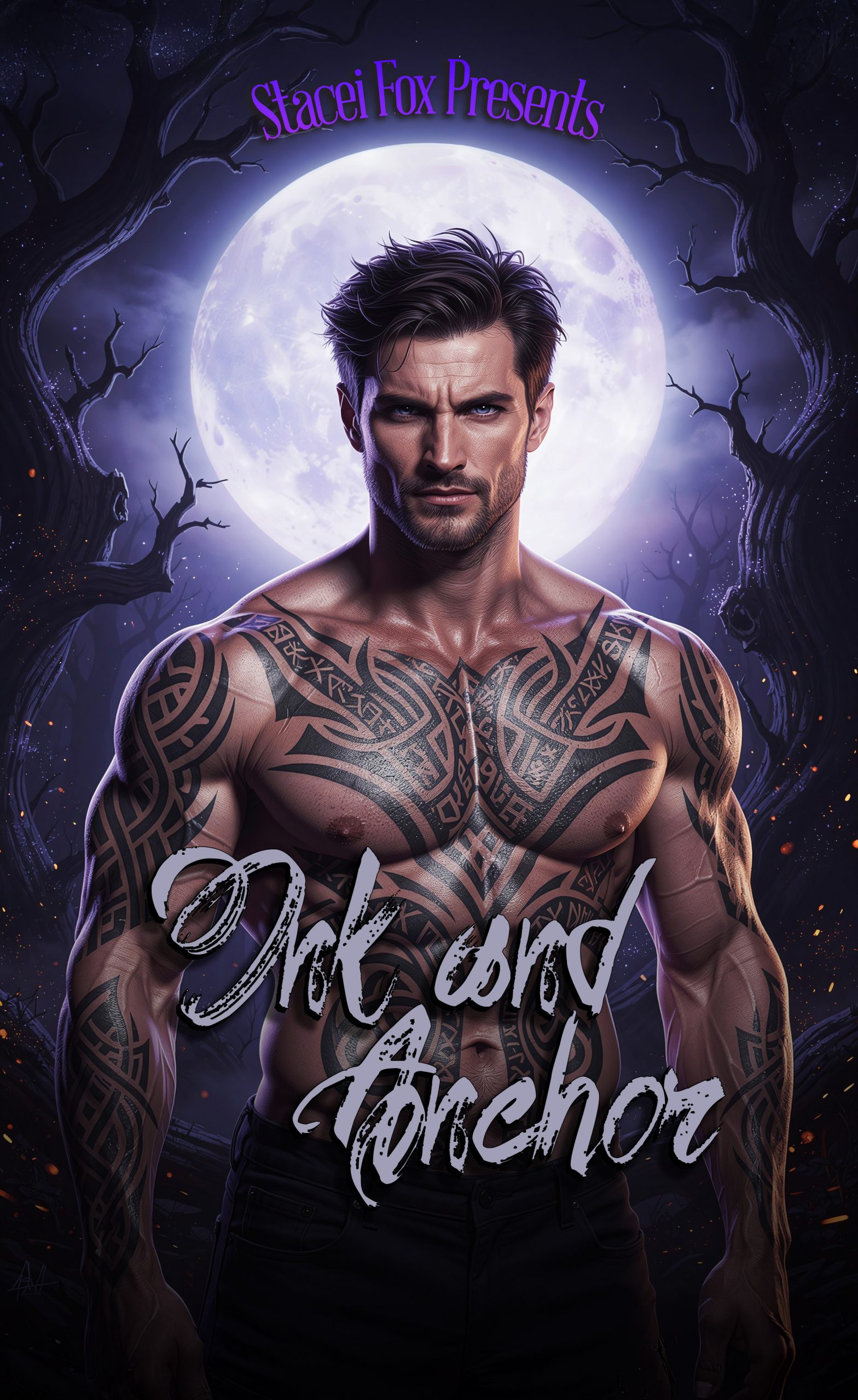
Ink and Anchor by Stacei Fox takes many of the familiar ingredients of wolf-shifter romance and deliberately refuses to use them in familiar ways. There are Alphas, Pack politics, ancient supernatural artifacts, magical bonds, and questions of power, but this isn’t a story where destiny automatically gives one person ownership over another.
Instead, the romance between Molly Weston and Torin Ashford is built around something much harder to achieve than a fated bond: trust.
Molly is an archivist and manuscript conservator whose professional life revolves around preserving fragile things other people might overlook. Torin is an ancient Lycan Alpha whose supernatural power requires control so absolute that one failure could become catastrophic. When circumstances force Molly back into the world she escaped three years earlier, their reunion becomes less about whether they still want one another and more about whether love can exist without repeating the same patterns of control that drove them apart.
That question becomes the emotional foundation of the novel.
What impressed me most is how deeply Molly’s profession is integrated into the story. She doesn’t suddenly develop supernatural powers because the plot needs her to stand beside an Alpha. Her expertise in manuscripts, materials, language, conservation, and historical interpretation becomes the very thing that allows her to recognize truths the supernatural world has missed for centuries.
Molly changes the Pack because she knows how to read what everyone else has overlooked.
That makes Ink and Anchor one of the more intellectually satisfying paranormal romances I’ve read, especially because the solution to unchecked power isn’t greater power. It’s accountability.
Ink and Anchor Quick Review
Ink and Anchor is a paranormal fantasy romance centered on manuscript conservator Molly Weston and Lycan Alpha Torin Ashford. Their story combines a second-chance relationship, slow-burn attraction, wolf-shifter politics, forced proximity, supernatural artifacts, ancient manuscripts, Pack law, and a significant power imbalance that the book examines rather than ignoring.
The romance is particularly strong for readers who enjoy protective or powerful heroes but still want the heroine’s autonomy to matter. Torin possesses extraordinary physical, financial, legal, and supernatural power, yet the central emotional question is whether he can learn that loving Molly doesn’t give him the right to make decisions for her.
Molly’s arc is just as important. She has to discover that choosing to remain beside someone powerful doesn’t automatically mean becoming subordinate to him, especially if she’s willing to insist on the structural protections necessary to keep that power accountable.
That makes the romance feel less like a story about claiming and more like a story about negotiation, balance, and deliberate partnership.
Ink and Anchor Summary
Molly Weston has built her life around preservation.
She’s an archivist and manuscript conservator who understands paper, ink, language, bindings, and the complicated ways fragile objects survive centuries of neglect. She also owns Ink & Anchor, the beloved shop inherited from her grandfather, although keeping it alive has become increasingly difficult.
Money is disappearing faster than Molly can earn it, and the shop she loves is barely surviving.
Then someone breaks in.
The damage isn’t random. Whoever sabotaged Ink & Anchor was looking for something specific, which immediately tells Molly that a secret she has protected for years may finally have caught up with her.
That secret is an Eternal Lunarite ring.
The ring once belonged to Torin Ashford, the Lycan Alpha Molly fled three years earlier. It isn’t simply an expensive piece of supernatural jewelry. Eternal Lunarite functions as a stabilizing force for an Alpha whose immense power can become dangerously unstable without proper regulation.
Molly has kept the ring hidden since leaving Torin.
Desperate for money and trying to save her shop, she makes the decision to sell it.
That decision alerts Torin.
His response is one of the moments that immediately distinguishes him from a more conventional paranormal-romance Alpha. Torin doesn’t storm into Molly’s life in a violent rage, throw her over his shoulder, or simply announce that she belongs to him.
He uses systems.
Torin buys her shop, invokes Lycan law, and turns Molly’s financial desperation into leverage that forces her back into his world. His methods may look civilized compared with brute violence, but Molly recognizes the coercion immediately.
That distinction becomes crucial.
Torin hasn’t physically forced her into submission, but he has used wealth, law, and supernatural authority to reduce her available choices. The story doesn’t excuse that simply because he believes he has good reasons.
Instead, Ink and Anchor begins asking a much more uncomfortable question about power: if someone has enough authority to control another person without ever raising a hand, is the result actually less coercive?
Molly agrees to repay her debt by restoring the Ashford Codices, a collection of ancient ink-locked manuscripts containing Pack history, biological information, laws, and supernatural knowledge.
The manuscripts appear to be deteriorating.
Their ink is fading, and Torin believes priceless information is disappearing with it.
Molly quickly realizes everyone has misunderstood what they’re seeing.
The ink isn’t dying.
It’s protecting itself.
The Codices respond to lunar phases, environmental conditions, human presence, patience, and methods of interaction that the Pack’s traditional scholars have never properly understood. Their attempts to dominate the material have prevented them from reading it accurately.
That discovery eventually becomes much larger than manuscript conservation.
Molly begins uncovering evidence that the Pack’s understanding of Alpha power itself is incomplete.
The Alpha was never meant to stand alone.
Human participation wasn’t an accidental weakness introduced into a supernatural system. It was part of the system’s original balance.
Someone removed that truth.
As Molly restores the manuscripts, she begins restoring something else as well: the missing architecture of Pack law.
Ink and Anchor Characters
The character work is strongest when the novel allows professional expertise, supernatural power, emotional history, and moral conflict to overlap. Molly and Torin aren’t compelling simply because they’re opposites, but because each possesses a type of authority the other initially misunderstands.
Torin has the obvious power. Molly has the knowledge required to understand what that power was originally supposed to be.
Molly Weston
Molly is easily the standout character for me.
She’s human in a world dominated by supernatural strength, but the story never treats humanity as a deficiency she needs to overcome. Her expertise becomes essential precisely because she sees things differently from people raised inside Pack assumptions.
Her work as an archivist and conservator isn’t simply character decoration. It influences the way she approaches almost everything.
Molly looks for evidence before accepting conclusions. She notices physical details other people dismiss. She understands that damage can tell a story, that absence can be evidence, and that whatever survives in an archive is not necessarily the complete truth.
Those skills become extremely important once she begins studying the Ashford Codices. Everyone else sees fading ink. Molly asks why the ink is behaving differently. Everyone else assumes old law must be authoritative because it’s old.
Molly looks at the margins. Everyone else has inherited a supernatural hierarchy. Molly begins asking whether someone altered the instructions. That approach makes her powerful without changing what she is.
She doesn’t need claws, immortality, Alpha dominance, or magical transformation. Molly’s weapons are observation, expertise, evidence, language, and the willingness to challenge interpretations that have gone unquestioned for centuries.
Her emotional strength works the same way.
Molly isn’t powerful because Torin can’t frighten her. He absolutely can. She’s powerful because fear doesn’t stop her from demanding that his power have limits.
Torin Ashford
Torin is an ancient Lycan Alpha whose control is both his greatest strength and one of his most dangerous weaknesses.
He’s extraordinarily powerful, wealthy, intelligent, and accustomed to operating inside systems designed to recognize his authority. That makes him potentially terrifying even when he isn’t behaving violently.
Torin doesn’t need brute force to control a situation. He has law. He has money. He has Pack authority. He has enough resources to change Molly’s circumstances without asking permission. That’s exactly what he does when he buys Ink & Anchor and binds her through debt.
What makes Torin compelling is that the novel doesn’t mistake restraint for innocence. He may be far more controlled than the stereotypical Alpha who solves every problem through dominance, but he still initially believes that protecting Molly justifies reducing her choices.
His emotional arc requires him to understand why that belief is wrong.
Torin loves through protection, but his definition of protection has been distorted by centuries of power. He has to learn that preventing Molly from making a choice because he fears the consequences isn’t the same thing as keeping her safe.
That lesson doesn’t make him less powerful.
It forces him to become more responsible with power.
For me, that’s considerably more interesting than simply making an Alpha softer because he falls in love.
Marcus
Marcus, Torin’s Beta, brings warmth and perspective to a story that could otherwise become overwhelmingly focused on the conflict between Molly and Torin.
He also helps demonstrate that Pack culture isn’t monolithic. Being part of the same supernatural system doesn’t mean every member interprets power, hierarchy, loyalty, or tradition in exactly the same way.
His intellectual rapport with Molly is especially important because it gives her another point of connection to the Pack beyond Torin. She isn’t accepted solely because the Alpha values her, which strengthens the larger argument that Molly’s knowledge has worth independently of her romantic relationship.
Bryson
Bryson works because he isn’t written as an exaggerated villain designed to make Torin look wonderful by comparison. Instead, he represents something much more ordinary. He’s an imitation of partnership.
His relationship with Molly lacks the depth, understanding, and genuine respect that eventually become central to her expectations. That contrast helps clarify what Molly actually wants without requiring Bryson to become a cartoonishly evil romantic rival.
The difference between him and Torin isn’t simply that Torin is stronger, richer, or more passionate. It’s that Torin eventually learns to listen.
Molly and Torin’s Relationship
The romance between Molly and Torin is strongest when it refuses the easiest paranormal-romance solution. They have history. They have attraction. They have unresolved feelings. They also have a serious problem involving power. Molly left three years earlier for a reason.
Torin’s ability to control situations may make him an effective Alpha, but living inside that control made Molly recognize how easily protection could become possession. When he uses financial and legal leverage to bring her back, he initially proves that her fears weren’t unfounded.
That means attraction alone can’t repair their relationship. Torin has to change how he understands love. Molly has to be able to disagree with him without fearing that he’ll simply override her. She has to retain control over her work.
She needs meaningful authority rather than symbolic influence. Her veto has to matter. Her consent has to matter. Most importantly, Torin has to accept those limits even when he believes Molly is wrong.
That is where the slow burn becomes emotionally satisfying. Their relationship isn’t building toward the moment when Molly finally agrees to be claimed. It’s building toward the moment when Torin understands that choosing him has value only if Molly is genuinely free not to.
Ink and Anchor Tropes
Readers who choose paranormal romance by trope will find a distinctive combination here:
- Wolf-shifter romance
- Lycan Alpha hero
- Human heroine
- Second-chance romance
- Slow burn
- Forced proximity
- Protective hero
- Powerful hero
- Intellectual heroine
- Supernatural artifacts
- Ancient manuscripts
- Pack politics
- Hidden history
- Magical law
- Power imbalance
- Consent-focused romance
- Former lovers
- Mystery and sabotage
- Human versus supernatural perspectives
What separates Ink and Anchor from many Alpha romances is that the power imbalance itself becomes part of the text rather than an unquestioned fantasy. Torin’s strength can be attractive and still require limits, while Molly can love him without accepting the idea that love requires submission.
The Eternal Lunarite Ring Is More Than a Magical Artifact
The Eternal Lunarite ring works because it functions on multiple levels at once. On the surface, it’s a valuable supernatural object capable of stabilizing Torin’s immense Alpha power. Selling it creates the event that reveals Molly’s location and pulls Torin back into her life.
The ring also represents something much larger.
Torin’s power requires regulation. That idea becomes increasingly important as Molly learns more about the Pack’s history. The strongest Alpha isn’t meant to become infinitely powerful without opposition, correction, or restraint.
Power needs a counterweight. The ring does that physically. Molly eventually does it structurally. That parallel gives the artifact much more meaning than a convenient magical object used to start the plot.
The Ashford Codices Are One of the Best Parts of the World-Building
I loved the Ashford Codices because they allow Molly’s professional expertise to drive the fantasy plot.
Ancient magical manuscripts could easily have become another collection of mysterious books that conveniently reveal exposition whenever the story needs it. Instead, Fox treats them like actual physical objects with material behavior that must be interpreted.
Ink matters. Paper matters. Environmental conditions matter. Preservation matters. Even the apparent deterioration of the text matters.
Molly recognizes that fading doesn’t necessarily mean destruction. The ink is phase-locked and protects information from methods of reading that violate the conditions under which it was designed to reveal itself.
That creates a beautiful connection between the magical system and the novel’s larger theme of consent. The Codices can’t simply be forced open. Neither can Molly. Knowledge and intimacy both require patience.
The Human Clause Changes the Meaning of Alpha Power
Molly’s most important discovery is that Pack hierarchy has been operating from an incomplete version of its own foundational law. The Alpha was never supposed to exist without meaningful counterbalance.
Human involvement wasn’t an embarrassing weakness or historical accident. It was part of the architecture designed to prevent supernatural power from becoming absolute.
That revelation changes Molly’s role entirely. She isn’t Torin’s human girlfriend being allowed to participate in Alpha business. She represents something that was always supposed to be there.
Her eventual Human Clause restores consent, accountability, correction, and meaningful human participation to Pack governance. Rather than overthrowing the supernatural hierarchy, Molly identifies the mechanisms originally meant to keep it balanced and restores what was removed.
That resolution fits her perfectly. Molly doesn’t destroy the archive. She restores the missing text. She doesn’t seize Torin’s authority. She establishes the conditions under which that authority can operate responsibly.
The Romance Is About Consent Without Becoming Clinical
One of the things I particularly appreciated is that the book can talk seriously about consent without turning every romantic interaction into a lecture. The theme emerges naturally because of who these characters are. Torin has enormous power.
Molly has experienced what happens when his protective instincts become decisions made on her behalf. That creates a relationship where consent has to mean more than whether Molly agrees to physical intimacy. Does she control her work? Can she leave? Can she disagree? Can she veto a decision?
Does Torin still respect her judgment when her conclusion conflicts with his? Those questions make their romance far more interesting. Consent isn’t reduced to one scene. It becomes part of the architecture of their partnership.
Ink and Anchor Is a Different Kind of Alpha Romance
Torin is undeniably an Alpha, but the book isn’t interested in treating dominance as automatically romantic. That’s probably my favorite thing about it. His strength still matters. His protectiveness still matters. His ability to be frightening still matters.
But those qualities aren’t given unlimited moral authority simply because he’s the hero.
Molly forces Torin to confront something that Alpha-centered systems often avoid: the stronger you are, the greater your responsibility becomes to create space for people who don’t possess equivalent power.
That doesn’t emasculate Torin or diminish his supernatural authority. It makes his restraint meaningful. Anyone can respect someone’s choices when they lack the power to override them. Torin’s growth comes from having enormous power and learning not to use it simply because he can.
Molly Never Needs to Become Supernatural
I was particularly glad Fox doesn’t solve the imbalance by eventually making Molly physically equal to Torin. That would undermine much of what makes the book interesting. Molly matters because she’s human. Her perspective matters because she wasn’t raised to accept Pack assumptions.
Her expertise matters because centuries of supernatural authority have created blind spots that raw power can’t solve.
Making Molly a Lycan would risk implying that she needed supernatural transformation before she could truly stand beside Torin. She doesn’t. The system has to change enough to recognize the value she already possesses. That’s a much stronger arc.
The Mystery and Danger Stay Connected to Molly’s Expertise
The stakes eventually move well beyond financial pressure and old relationship wounds.
The sabotage at Ink & Anchor leads into black-market artifact trafficking, arson, supernatural intrigue, and genuine physical danger. Yet Molly never suddenly transforms into an action heroine who solves everything through abilities she didn’t possess a few chapters earlier.
She remains Molly. She examines paper fibers. She studies ink. She follows evidence. She understands provenance. She recognizes what objects can reveal about the people who handled them. That consistency matters.
The story respects her competence enough to let the climax emerge from the skills she has possessed all along rather than giving her a convenient new talent when the plot becomes dangerous.
The Climax Is Refreshingly Unconventional
Many paranormal romances eventually resolve their largest conflict through physical confrontation. Ink and Anchor chooses something much more appropriate to its heroine. Molly stands before the Pack Elders with evidence.
She corrects the interpretation of the Foundational Tome and introduces the Human Clause, forcing a supernatural culture built around centuries of inherited assumptions to confront what its own historical record actually says.
For Molly, that is a battle. Her weapons simply happen to be language, evidence, legal interpretation, and archival truth.
I found that considerably more satisfying than suddenly having her defeat a supernatural enemy in combat. The climax proves the argument the novel has been making from the beginning. Knowledge is power too.
What I Loved About Ink and Anchor
Molly is easily the biggest reason this book worked for me.
Intelligent heroines are often described as intelligent because other characters repeatedly tell the reader how smart they are. Molly actually demonstrates expertise throughout the story, and the plot changes because she knows things other people don’t.
Her intelligence is practical. It has a discipline behind it.
She has spent years learning how objects age, how ink behaves, how records can be manipulated, and how historical truth can disappear through omission rather than destruction.
All of that becomes relevant. I also loved the way Torin’s arc approaches the protective Alpha fantasy. The book doesn’t reject his desire to protect Molly. It asks him to become worthy of exercising that instinct.
Protection can’t mean eliminating her choices. Love can’t mean using fear as justification for control. Authority can’t mean freedom from accountability. Those are significant distinctions, and the romance becomes much stronger because Torin has to learn them.
The world-building works for the same reason.
Pack law, Lunarite, ancient manuscripts, Alpha instability, and human counterbalance aren’t random pieces of mythology stacked around the romance. They all reinforce the same larger idea about systems becoming dangerous when power loses its restraints.
That cohesion gives the book much more depth than I expected.
What Might Not Work for Every Reader
Ink and Anchor is probably best for readers who enjoy intellectual and emotional tension as much as supernatural action.
The story spends meaningful time on manuscripts, Pack law, historical interpretation, governance, consent, and the mechanics of supernatural balance. Readers looking primarily for territorial Alpha behavior, rapid mating bonds, or nonstop action may find the pace more deliberate.
The beginning of Molly and Torin’s renewed relationship may also make some readers uncomfortable.
Torin uses financial and legal leverage to force Molly back into his orbit. The book interrogates that behavior rather than presenting it as automatically romantic, but readers who dislike coercive setups may still struggle with the premise.
For me, that discomfort is necessary.
Torin can’t learn the difference between protection and control if the story pretends he understood it perfectly from the beginning.
His mistakes give the eventual partnership meaning because the relationship has to be rebuilt around entirely different rules.
Is Ink and Anchor a Fated-Mates Romance?
Not in the conventional sense described in the story.
The relationship between Molly and Torin isn’t meaningful because supernatural destiny removes their ability to choose. Their emotional arc repeatedly emphasizes deliberate choice, boundaries, consent, and the freedom to remain separate.
That distinction becomes central to the romance. Torin has to learn that Molly staying with him only means something if leaving remains possible.
Molly has to learn that choosing partnership doesn’t require giving up authority over herself. Their bond becomes powerful because it’s chosen, not because supernatural law declares that resistance is pointless.
Is Ink and Anchor a Slow-Burn Romance?
Yes, particularly in the emotional sense.
Molly and Torin already have history and attraction, so the slow burn isn’t about waiting hundreds of pages for them to notice each other. It’s about rebuilding enough trust for intimacy to mean something.
The unresolved history between them makes that process more difficult. Molly remembers why she left. Torin has to understand why his previous version of protection made staying impossible.
Their growing closeness therefore depends on behavior rather than declarations. Every boundary Torin respects matters. Every time Molly chooses to remain matters. That makes the eventual emotional connection feel earned.
Does Ink and Anchor Have a Happy Ending?
The ending is deliberately less conventional than a traditional paranormal-romance conclusion built around permanent claiming or an unquestioned mate bond.
Molly and Torin end the story with a meaningful partnership, greater mutual understanding, and a future built around shared authority rather than domination. Their relationship has progressed substantially, but the emphasis remains on continued choice rather than sealing everything with a supernatural shortcut.
I actually think that suits the book. A story built around consent would undermine itself if the ending suddenly suggested that permanence is only meaningful once choice disappears.
The emotional satisfaction comes from knowing Molly stays because she wants to and Torin finally understands why that distinction matters.
Who Should Read Ink and Anchor?
I’d recommend Ink and Anchor to readers who love paranormal romance but want something different from the standard Alpha-claims-human formula.
It’s particularly well suited to readers who enjoy intelligent heroines, ancient manuscripts, wolf-shifter politics, second chances, slow-burning relationships, morally complicated power dynamics, supernatural artifacts, hidden history, legal intrigue, and romance where consent is treated as part of emotional intimacy rather than a box that needs to be checked.
The archival elements will also appeal to readers who love stories where scholarship actually matters.
Molly doesn’t know the answer because she’s secretly magical. She knows where to look because she’s good at her job. That distinction makes her one of the more memorable paranormal-romance heroines I’ve encountered.
Ink and Anchor Review: Final Thoughts
What stayed with me most about Ink and Anchor is the idea that enormous power is not necessarily evidence that someone should possess enormous authority.
Torin begins with almost every advantage imaginable. He’s ancient, wealthy, supernatural, legally protected by Pack systems, and physically powerful enough that very few people could challenge him directly.
Molly is human.
If this were a more conventional Alpha romance, that imbalance might become part of the fantasy. Torin would claim, Molly would resist briefly, destiny would eventually validate his authority, and the relationship would become romantic because his dominance was supposedly proof of devotion.
Fox takes the much harder route.
She asks Torin to change.
Not his strength, not his nature, and not his instinct to protect, but his understanding of what those things entitle him to do.
Molly’s refusal to surrender her autonomy forces him to recognize that love without freedom becomes another form of possession.
At the same time, Molly has her own lesson to learn.
Leaving gave her independence, but independence alone didn’t resolve everything between them. She still cares for Torin, and eventually she has to decide whether loving someone powerful automatically means being consumed by that power.
Her answer is beautifully practical. Change the rules. Create safeguards. Demand authority. Restore the missing language. Make power accountable.
That is such an appropriate resolution for an archivist.
Molly doesn’t burn down the supernatural system because it’s flawed. She studies its history closely enough to discover that the system was altered, finds the missing principles that once balanced it, and restores them in a form capable of surviving the present.
She approaches Torin in much the same way. She doesn’t ask him to become powerless. She asks him to become accountable. That parallel is where Ink and Anchor becomes much more than a wolf-shifter romance for me.
The Eternal Lunarite ring stabilizes supernatural power physically. The Codices preserve the truth historically. The Human Clause creates structural accountability legally. Molly creates balance emotionally.
Every major element of the novel is ultimately asking the same question about power.
Who corrects it when it goes too far? For Torin, the answer becomes Molly, but only because she has enough freedom to tell him no. That’s what makes their romance work.
They don’t end together because an ancient supernatural bond declares that they belong to one another. They end with the possibility of something stronger: a relationship where either person could demand obedience, but neither mistakes obedience for love.
Ink and Anchor is thoughtful, romantic, supernatural, and unusually interested in the systems underneath its fantasy world. It gives us an Alpha powerful enough to dominate almost everyone around him and then makes his greatest act of love learning when not to.
It gives us a human heroine surrounded by immortality and supernatural strength, then refuses to suggest that she needs either one to matter. Most importantly, it understands that staying is only romantic when leaving remains a genuine choice.
Ink and Anchor FAQ
What is Ink and Anchor about?
Ink and Anchor follows Molly Weston, an archivist and manuscript conservator whose struggling shop is attacked by someone searching for a supernatural artifact she has hidden for years. After Molly sells the Eternal Lunarite ring once given to her by Lycan Alpha Torin Ashford, he discovers her location and pulls her back into his world, where restoring a collection of ancient manuscripts reveals that Pack history and Alpha law have been fundamentally misunderstood.
Who are the main characters in Ink and Anchor?
The central characters are Molly Weston and Torin Ashford. Molly is a human archivist and manuscript conservator who relies on expertise, research, and careful observation, while Torin is an ancient and immensely powerful Lycan Alpha whose emotional journey requires him to rethink the relationship between protection, control, and consent.
What is the Eternal Lunarite ring?
The Eternal Lunarite ring is a supernatural artifact connected to Torin’s ability to regulate his Alpha power. Molly has kept it hidden for years, and her decision to sell it reveals her location to Torin while also establishing the larger theme that extraordinary power requires stabilization and restraint.
What are the Ashford Codices?
The Ashford Codices are ancient ink-locked manuscripts containing Pack history, biological records, laws, and supernatural knowledge. Molly initially believes she’s restoring deteriorating texts, but her conservation expertise allows her to discover that the ink isn’t disappearing and that the Codices contain truths the Pack has misunderstood or lost.
Is Ink and Anchor a wolf-shifter romance?
Yes. Torin is a Lycan Alpha, and Pack hierarchy, supernatural biology, ancient law, magical artifacts, and the responsibilities attached to Alpha power are central to the fantasy world.
Is Ink and Anchor a fated-mates romance?
The romance deliberately avoids relying on an unavoidable fated-mate claim. Molly and Torin’s relationship emphasizes choice, consent, boundaries, accountability, and the importance of Molly remaining free to decide whether she stays.
Is Ink and Anchor a slow burn?
Yes. Molly and Torin have romantic history, but rebuilding their relationship happens gradually because trust has to be restored after Molly previously left him. Their emotional progress depends on Torin respecting Molly’s boundaries and Molly deciding whether genuine partnership with him is possible.
What is the Human Clause in Ink and Anchor?
The Human Clause is Molly’s legal correction to Pack governance based on what she uncovers in the restored historical texts. It restores human participation, consent, accountability, and meaningful mechanisms for correcting unchecked supernatural authority.
Does Molly become a shifter in Ink and Anchor?
No. One of the most important aspects of Molly’s arc is that her humanity remains valuable. She changes the Pack through archival expertise, historical interpretation, evidence, and legal reform rather than becoming supernatural herself.
Does Ink and Anchor have a happy ending?
The ending provides emotional resolution and a meaningful future for Molly and Torin, but it deliberately avoids reducing their relationship to a rushed permanent claiming. Their partnership is based on continuing choice, mutual restraint, and shared authority, which fits the novel’s emphasis on autonomy and consent.