
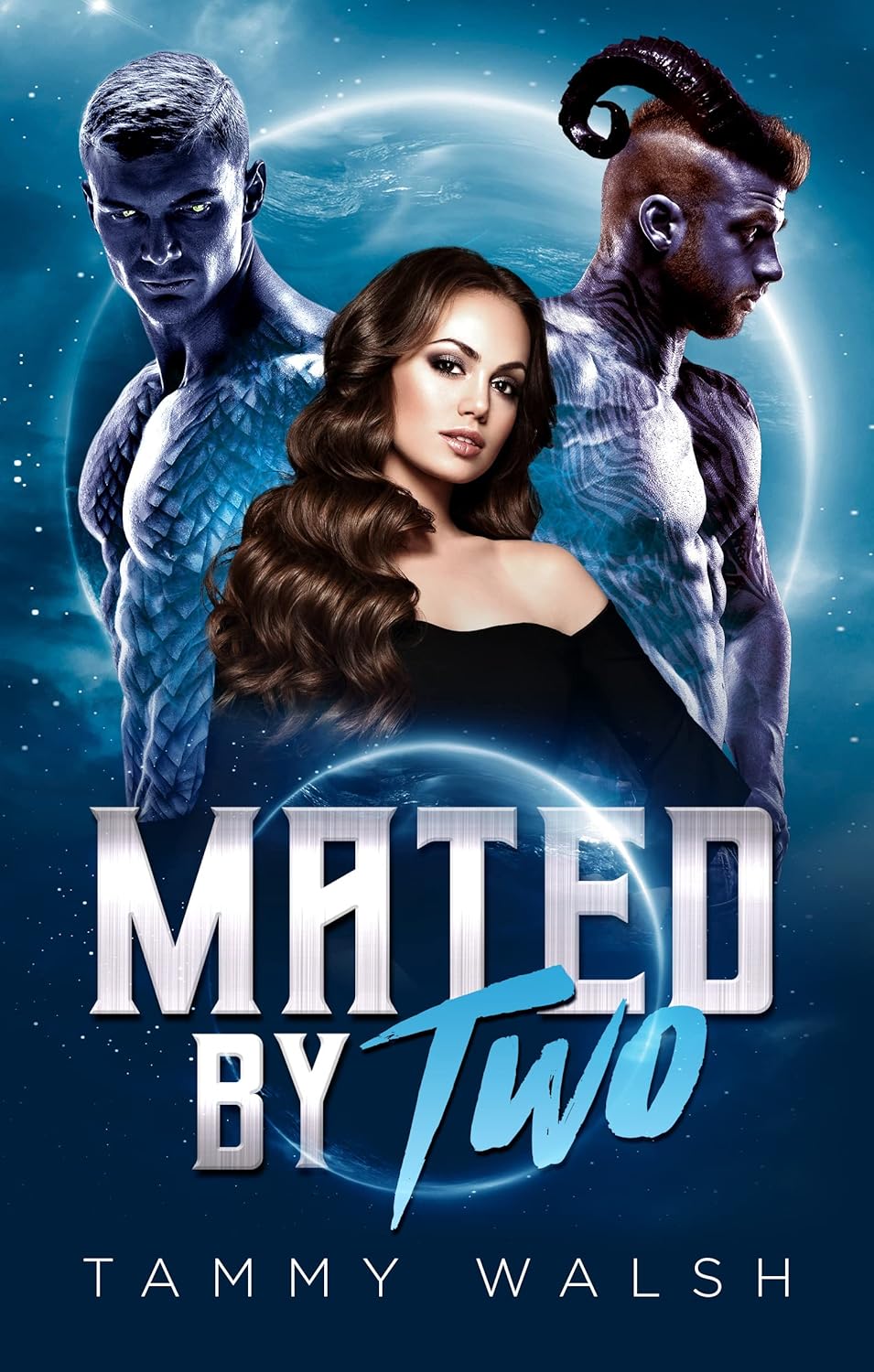
Mated By Two by Tammy Walsh opens the Claimed By Two series with a futuristic reproductive crisis, a human heroine hoping to conceive, and two alien males from rival species who complicate what should be a straightforward seeding arrangement. What begins as humanity’s attempt to solve an existential problem quickly becomes a much more personal story about attraction, destiny, trust, and whether a relationship has to follow conventional rules simply because everyone expects it to.
The heroine enters the alien seeding program with a clear purpose. Human women can no longer conceive naturally, so participating in the program offers a chance at motherhood that would otherwise be impossible.
She expects one alien partner. Instead, she ends up connected to two.
The situation becomes even more complicated because the males come from species with their own history of conflict. Attraction therefore develops inside a relationship where jealousy, rivalry, biology, and cultural expectations are constantly colliding.
The sacred Joisa tattoo adds another dimension by suggesting that the connection between them is more than physical. Fate appears to have brought these three people together, but Mated By Two becomes more interesting when destiny doesn’t automatically tell them how a three-person relationship is supposed to work.
For me, that is the strongest part of the premise. The book doesn’t simply ask which alien the heroine should choose. It asks what happens when the answer may genuinely be both.
Mated By Two Quick Review
Mated By Two is a high-heat science-fiction romance about a human woman who enters an alien reproductive program and unexpectedly becomes caught between two powerful males from rival species. Their attraction initially creates competition, but the relationship gradually develops toward something less conventional as the Joisa bond suggests that both men may have a legitimate place in her future.
The novel combines alien romance, reverse harem, fated mates, reproductive science fiction, rival alien males, interspecies relationships, high heat, destiny, secrets, and a heroine who has to decide what kind of future she actually wants rather than simply accepting the one created for her.
The broader fertility crisis gives the romance additional stakes because reproduction isn’t merely a private matter in this world. Humanity’s inability to conceive naturally has turned pregnancy into part of a species-level survival problem, making the seeding program both intensely personal and socially significant.
Mated By Two Summary
Humanity faces a reproductive crisis.
Women can no longer conceive naturally, which has forced society to search beyond Earth for another solution. Alien males provide one possible answer through a seeding program that pairs human women who want children with compatible extraterrestrial partners.
The heroine willingly enters the program because she wants the opportunity to become pregnant. She knows the arrangement will involve an alien male and unfamiliar reproductive customs, but she is prepared to accept those complications in exchange for the future she wants.
What she doesn’t expect is two potential mates.
Circumstances bring her into contact with alien males from rival species, creating a problem the program was never supposed to produce. Both men are attracted to her, both become increasingly possessive of their connection, and neither appears willing to simply withdraw so the other can have her.
Their rivalry creates immediate tension.
Each man represents a different possibility, and their contrasting personalities make the heroine’s attraction to both harder to dismiss as simple confusion. She doesn’t react to them in identical ways, which makes each relationship feel capable of standing on its own.
Then the Joisa tattoo changes the meaning of everything.
The sacred mark suggests a fated-mate connection, introducing the possibility that what is happening among the three of them is not a mistake or failure of the matching system. Destiny itself may be pointing toward a relationship that none of them expected.
That revelation does not immediately solve the problem.
The two alien males come from rival species and have reasons to distrust one another. Accepting that both may belong with the same woman requires them to reconsider assumptions about possession, mating, loyalty, and what it means to claim a partner.
The heroine faces an equally complicated challenge. She must determine whether accepting both males reflects what she genuinely wants or whether the intensity of the mating bond is making the decision for her.
Secrets surrounding the Joisa connection and the aliens themselves gradually deepen the mystery. The heroine has to navigate physical desire alongside emotional trust while learning that destiny may create a bond without automatically creating the communication required to sustain it.
The romantic arc therefore becomes as much about cooperation as attraction. The two males must stop treating the heroine as a prize one of them needs to win, while she has to become confident enough to define the relationship according to her own needs.
Mated By Two Characters
The central trio drives almost everything in Mated By Two. The science-fiction premise explains why they meet, but their very different expectations about mating and relationships determine whether the arrangement can become something emotionally sustainable.
The heroine has to understand what she wants from both men, while the two aliens must confront their rivalry without expecting her to solve every conflict between them. That balance becomes essential because a successful three-person romance requires more than two separate men being attracted to the same woman.
The Human Heroine
The heroine begins with more agency than the title might initially suggest because entering the seeding program is something she chooses. Humanity’s reproductive crisis limits her available options, but she still actively decides that motherhood is important enough to pursue an unconventional solution.
That matters because her romantic life becomes considerably less predictable once two alien males enter it.
She is open-minded enough to consider a relationship structure she never expected, but openness doesn’t mean passivity. Her most interesting conflict comes from determining whether her attraction to both men reflects genuine desire rather than confusion caused by mating instincts and supernatural or biological destiny.
The Joisa tattoo complicates that process.
Being told that a connection is fated can be comforting because it suggests there is a reason for feelings that otherwise seem overwhelming. It can also create pressure if fate is treated as more important than consent.
The heroine therefore has to make the connection her own.
Accepting both men should mean something because she chooses them, not merely because the universe appears to have marked them as hers.
Her development also comes from learning that wanting two partners doesn’t necessarily mean she is incapable of choosing. Her actual choice may be refusing the assumption that only one relationship is allowed to matter.
The First Alien Mate
The first alien male initially occupies the position readers might expect from a conventional fated-mates romance. He is powerful, protective, passionate, and strongly attached to the heroine, making it easy to imagine the story developing around the two of them alone.
The arrival of another male disrupts that expectation.
His initial instinct is naturally competitive because the second alien threatens a relationship he already views as important. Possessiveness becomes both part of his romantic appeal and one of the qualities he eventually has to reconsider.
Wanting the heroine intensely isn’t enough. He has to understand that loving her includes respecting the possibility that she may want something different from the exclusive relationship he initially imagined.
That gives his arc meaningful development. The rivalry forces him to distinguish between protecting a bond and controlling it.
The Second Alien Mate
The second alien male introduces the possibility that the heroine’s connection cannot be reduced to one predetermined pair. His presence creates romantic uncertainty, but it also expands what the Joisa mythology may actually allow.
He needs to become more than the alternative choice.
For the reverse-harem structure to work, his connection with the heroine has to possess its own emotional identity. She cannot simply want him because the first alien frustrates her or because the plot needs another body in the relationship.
The contrasting personalities described in your original review help here.
Each man offers something different emotionally, which allows the heroine to develop distinct relationships rather than one connection being a copy of the other.
His rivalry with the first alien also gives him room to grow. If he truly cares for the heroine, eventually defeating the other man becomes less important than understanding what arrangement allows her to be happy.
That shift from competition toward cooperation becomes essential to the trio.
The Three-Person Relationship Is the Heart of the Book
Mated By Two becomes more interesting once the story stops behaving like a conventional love triangle. A normal triangle promises that one romantic interest will eventually be selected while the other becomes the relationship that did not work.
That structure would be too simple here. The heroine’s feelings for both alien males matter, and the Joisa mythology appears to validate the possibility that both connections belong in her life.
That shifts the emotional problem. Instead of asking which man deserves her more, the story begins asking whether the three characters can create something functional together.
That requires everyone to change. The heroine has to become comfortable acknowledging that wanting two people does not automatically invalidate either relationship.
The aliens have to stop assuming that romantic success requires eliminating a rival. Most importantly, the trio has to understand that sharing the same partner does not mean the heroine becomes shared property.
That distinction determines whether the fantasy feels possessive in an appealing way or controlling in a way that undermines her agency.
Rival Species Make the Relationship More Complicated
The fact that the two males come from warring or rival species gives their conflict more depth than ordinary romantic jealousy. They are not simply two men who happen to want the same woman, because they bring cultural history and inherited mistrust into the relationship.
That makes eventual cooperation more meaningful. Accepting each other requires more than tolerating romantic competition. Both men have to reconsider assumptions shaped by conflict between their peoples.
The heroine becomes a bridge between them, but she shouldn’t be required to solve the political or cultural problems they inherited.
Their willingness to cooperate has to come from recognizing that their old rivalry no longer serves the future they want. That adds a broader theme of unity to the romance.
Two species accustomed to defining each other through conflict become connected through one relationship that refuses to respect the old boundaries.
The Seeding Program Gives the Story Its Science-Fiction Foundation
The alien seeding program is more than an excuse to place a human woman near attractive extraterrestrial men. It exists because humanity faces a reproductive problem serious enough to threaten its future.
That creates urgency before the romance even begins. The heroine doesn’t enter the program randomly. She wants to conceive.
Human science apparently can no longer provide that opportunity through natural reproduction, so extraterrestrial biology becomes part of humanity’s solution.
That premise raises interesting questions even when the book does not explore every one of them in depth.
Who controls the program? How are matches determined? What rights do women retain after entering it? What obligations do alien participants assume?
What happens when the matching system produces a relationship nobody expected? Mated By Two appears most interested in the final question.
The heroine enters a system designed around one structure and discovers that human bureaucratic expectations may not be capable of accounting for alien biology, alien destiny, or relationships involving more than two people.
The Joisa Tattoo Gives the Series Its Fated-Mate Mythology
The sacred Joisa tattoo is one of the most important recurring elements in the Claimed By Two series because it transforms attraction into something culturally and spiritually significant.
A tattoo associated with destiny provides tangible evidence that the characters are connected. That creates certainty. It also creates complications.
If the Joisa bond involves the heroine and both aliens, then the relationship challenges the assumption that a fated mate must always be singular.
That gives the mythology room to do something more interesting than simply identifying the correct love interest.
Destiny may not be telling the heroine whom to choose. It may be telling all three characters that their understanding of choice has been too narrow.
The relationship still needs consent, trust, and communication, however, because fate cannot perform those functions for them. A tattoo can identify a bond. It cannot maintain a relationship.
Mated By Two Tropes and Genres
The strongest elements include:
- Science-fiction romance
- Alien romance
- Reverse harem
- Fated mates
- Human heroine
- Two alien heroes
- Rival species
- Alien seeding program
- Reproductive science fiction
- Joisa bond
- Possessive alien males
- Ménage relationship
- Why choose
- High heat
- Destiny versus choice
- Rivalry to cooperation
- Interspecies romance
- Secrets
- Species-survival stakes
Fated Mates Become More Interesting With Two Heroes
Fated-mates romance usually provides a comforting form of certainty. Two people discover that they belong together, and the primary challenge becomes accepting or understanding the connection.
Mated By Two complicates that formula. The heroine doesn’t face one obvious destined partner. She has two.
That immediately creates questions about what fate actually means.
If both men are connected to her through the Joisa mythology, then rejecting one simply because romance traditionally happens in pairs may actually mean ignoring part of the bond.
That turns the trope into something more flexible. Destiny becomes less about identifying one correct partner and more about challenging the characters’ assumptions about what a legitimate relationship can look like.
Rivalry Has to Become Cooperation
The competition between the two alien males provides immediate romantic tension, but the relationship cannot remain a constant contest if all three characters are going to build a lasting partnership.
At some point, the men have to stop trying to win. That transition matters.
A shared relationship cannot function if each man privately believes he is still waiting for the other to disappear.
The heroine also should not have to keep reassuring two possessive men who refuse to accept one another. Their development therefore depends on learning cooperation.
They may never become identical in personality or stop feeling territorial altogether, but they need enough mutual acceptance to understand that loving the same woman does not necessarily make them enemies.
That growth gives their rivalry a destination, rather than letting jealousy become repetitive.
The Heroine’s Agency Matters More Because of the Title
A title such as Mated By Two immediately signals that two alien males are claiming a connection with one woman. The fantasy naturally includes possessiveness, instinct, and powerful males who feel an overwhelming need to keep their mate.
That can be part of the appeal. It also makes the heroine’s choices especially important. The romance becomes satisfying when she does not simply belong to two men because they decide she does.
She needs to decide that she wants both of them. That difference turns possession into consensual romantic fantasy rather than removing her authority over her own relationship.
Her willingness to explore something unconventional becomes one of her strongest characteristics because it requires her to distinguish what society expects from what actually makes her happy.
Desire and Reproduction Are Closely Connected
The seeding program places sex, mating, and reproduction at the center of the world-building, so the book’s high heat naturally connects to the larger science-fiction premise.
Physical intimacy is not simply recreational in this universe. It may carry reproductive consequences. It may activate or confirm alien mating traditions. It may also reinforce the Joisa connection.
That gives the erotic material more narrative weight than it would in a contemporary romance. The heroine explores attraction while navigating a system originally designed to help her become pregnant. That makes desire, biology, destiny, and future family structures difficult to separate.
The Fertility Crisis Could Have Been Explored More Deeply
One of the more intriguing aspects of Mated By Two is also an area where I would have liked additional development. A world where human women can no longer conceive naturally should produce enormous medical, political, cultural, and ethical consequences.
The seeding program is one response. There should logically be many others.
The novel understandably focuses on romance, but exploring how the reproductive crisis changed human society could have made the science-fiction setting even stronger.
The same applies to the alien cultures.
Knowing more about why the two species are rivals, how each views human women, and what mating means within their respective societies would give the romantic conflict additional context.
The existing world is intriguing. I simply wanted more of it.
Predictability Isn’t Necessarily a Problem Here
Readers familiar with alien romance will recognize many of the ingredients: a human heroine, powerful alien males, fated mates, possessiveness, biological compatibility, a reproductive crisis, and intense physical attraction.
Those elements are familiar for a reason. They create exactly the kind of escapist fantasy readers in this subgenre often want.
The more distinctive element is the relationship involving two alien males from rival species.
That gives Walsh room to play with cooperation, jealousy, and unconventional commitment rather than relying exclusively on the novelty of human-alien attraction.
The Joisa tattoo also gives the series a recognizable mythology that connects the books. Mated By Two may not reinvent alien romance, but it understands its audience.
Fast Pacing Keeps the Story Entertaining
The story moves quickly between reproductive stakes, romantic developments, alien rivalry, secrets, Joisa revelations, and physical intimacy.
That keeps the book energetic. Readers looking for a fast, steamy escape are unlikely to spend long waiting for something significant to happen.
The tradeoff is that certain emotional and world-building elements may not receive as much space as they deserve.
A relationship involving three people already requires more development than a conventional couple because every pair within the trio needs enough emotional substance to feel real.
Adding alien culture, species conflict, a fertility crisis, and fated-mate mythology creates even more material competing for page time.
Readers who prefer extensive introspection may therefore find some developments rushed. Readers who prioritize momentum and chemistry will probably view the same pacing as a strength.
What I Loved About Mated By Two
The strongest part for me is the decision not to resolve the alien rivalry through a conventional choice. Allowing both men to become meaningful romantic partners creates a more interesting relationship structure and gives the fated-mates mythology something unusual to do.
I also like that the heroine enters the story with a concrete goal. She wants the possibility of conceiving. Her reproductive decision puts her in the seeding program before romance complicates everything, so she has motivations that exist independently of either hero.
The rival-species element gives the men more to overcome than jealousy. Their relationship has to evolve if either expects to build a future with the heroine.
The Joisa tattoo also works well as a recurring series device. It creates a recognizable mythology without completely eliminating uncertainty. Fate may establish the connection, but the characters still have to decide whether they can actually live with what destiny has handed them.
What Might Not Work for Every Reader
Readers who dislike reverse-harem or multi-partner relationships should know that two alien love interests are fundamental to the romantic structure. This isn’t simply a temporary triangle designed to identify which hero eventually wins.
The fast pacing may also leave readers wanting additional character development. The heroine, both alien men, their rival cultures, the reproductive crisis, and the Joisa mythology all compete for attention inside a story primarily focused on romance.
The science-fiction setting may feel lighter than some readers expect from the premise. Humanity’s inability to reproduce naturally is an enormous concept, but the book appears more interested in how the crisis creates romantic circumstances than in deeply examining its social or scientific consequences.
The fated-mate element may also divide readers. Anyone who loves predestined relationships will probably enjoy the Joisa mythology.
Readers who prefer romance driven entirely by voluntary compatibility may want destiny to play a smaller role. For me, the relationship works best when the Joisa bond creates attraction and possibility without replacing the heroine’s ultimate decision.
Is Mated By Two an Alien Romance?
Yes. The heroine is human, and her two central romantic partners are alien males from rival species, making the interspecies relationship fundamental to the book.
Alien biology and culture are also connected directly to the reproductive premise. The men aren’t simply extraterrestrial versions of contemporary romantic heroes because the seeding program, mating traditions, and Joisa bond influence how the relationship develops.
Is Mated By Two Fated Mates?
Yes. The sacred Joisa tattoo signals a fated connection and helps explain why the attraction between the characters feels unusually powerful. The twist is that destiny appears to involve more than one alien male. That lets the book use the fated-mates trope while challenging the assumption that a destined relationship always involves exactly two people.
Is Mated By Two Spicy?
Yes. Mated By Two is a high-heat alien romance where physical desire, mating, and reproductive compatibility play major roles in the story.
The erotic content is part of the larger relationship development rather than completely separate from it. Jealousy, sharing, trust, and the gradual shift from rivalry to a three-person relationship give the intimate scenes emotional consequences.
What Is the Seeding Program in Mated By Two?
The seeding program is humanity’s response to a future in which women can no longer conceive naturally. Human women who want children can participate in a system that pairs them with compatible alien males.
The heroine enters the program voluntarily because she wants the opportunity to conceive. Her experience becomes unusual when circumstances connect her with two alien males rather than the single partner she expected.
What Is the Joisa Tattoo?
The Joisa tattoo is a sacred symbol associated with the series’ fated-mate mythology. Its appearance indicates that the connection between characters carries significance beyond ordinary physical attraction.
In Mated By Two, the tattoo becomes especially important because it appears to support a bond involving the heroine and two alien males. That makes the Joisa connection central to understanding why the relationship doesn’t fit a conventional one-woman, one-man structure.
Are the Two Alien Males From Rival Species?
Yes. The two male love interests come from rival or warring species, which adds cultural conflict to their romantic competition. Their eventual ability to cooperate therefore represents more than accepting that they love the same woman. They also have to overcome prejudices or hostility connected to conflicts that existed before any of them met the heroine.
Can Mated By Two Be Read as a Standalone?
Mated By Two is the first installment in the Claimed By Two series, so it is naturally the best place to begin. It introduces the reproductive crisis, alien seeding program, Joisa mythology, and relationship structure that later installments continue exploring.
Starting here should also make Owned By Two and Seeded By Two easier to understand. Both later stories build on concepts established in this opening book, particularly the seeding system and significance of the Joisa bond.
Claimed By Two Series Reading Order
The books you’ve given me so far establish the reading order as Mated By Two, followed by Owned By Two, and then Seeded By Two. Since the series shares important world-building concepts involving humanity’s fertility crisis, alien seeding, and the Joisa bond, I’d present them in order on Aireona rather than treating each book as completely disconnected.
Each installment explores a different variation on the central mating premise. That gives readers a familiar world while allowing the romantic complications to change from book to book.
Who Should Read Mated By Two?
I’d recommend Mated By Two to readers who want high-heat alien romance with a genuine multi-partner relationship rather than a love triangle that eventually removes one hero. It should especially appeal to readers who enjoy reverse harem, fated mates, possessive aliens, reproductive science fiction, rival species, mating programs, unconventional relationships, and heroes who have to move from competition toward cooperation.
It should also appeal to readers looking for quick, escapist science-fiction romance rather than dense speculative fiction. The world-building provides a strong premise and recurring mythology, but romance, chemistry, and the central trio remain the primary focus.
Mated By Two Review: Final Thoughts
What makes Mated By Two work for me is that the title tells readers exactly what kind of romantic complication they are getting while the story gradually gives that complication more emotional meaning.
The heroine doesn’t enter the seeding program expecting two partners. She expects a solution to one specific problem. She wants the opportunity to have a child.
Instead, the program places her on a path toward a relationship that challenges assumptions about exclusivity, alien culture, and what fated mates are supposed to look like.
The two alien males make that journey more complicated because their rivalry exists before cooperation becomes possible.
Both are possessive. Both feel entitled to protect their connection with her. Both initially have reasons to view the other as competition.
That creates heat and tension, but rivalry alone could never sustain the relationship. The real development begins when the possibility of sharing stops looking like defeat.
Neither man necessarily has to lose the woman he loves. The heroine doesn’t need to amputate one genuine connection simply to make the other conform to a more traditional relationship structure.
All three have to build something new. That is where the Joisa tattoo becomes most interesting. If fate itself recognizes their connection, then perhaps the characters’ assumptions are the problem rather than the relationship.
Still, destiny can’t be allowed to make every decision. The heroine needs to want both men independently of a tattoo. The men need to choose cooperation rather than merely submitting to some supernatural command.
Trust and communication have to transform a biological or mystical bond into an actual relationship. That distinction gives the reverse-harem structure more emotional substance.
The reproductive crisis also gives the story an interesting foundation. Humanity has turned to alien species because something once considered completely natural has become impossible.
The solution therefore requires people to reconsider ideas about reproduction, species, mating, and family.
A relationship involving one human woman and two alien men fits surprisingly well within that larger theme. The old rules are already broken. Everyone is improvising what comes next.
For me, that makes Mated By Two a fun opening to the Claimed By Two series. It delivers the high heat and possessive alien heroes the premise promises, but the rivalry, Joisa mythology, reproductive crisis, and unconventional relationship give it enough additional structure to keep the story from being only about physical attraction.
The book isn’t trying to become dense hard science fiction.
It is trying to create an entertaining, sexy alien romance where destiny points toward something unconventional and the characters have to decide whether they are brave enough to accept it. On those terms, it works.
Mated By Two FAQ
What is Mated By Two by Tammy Walsh about?
Mated By Two follows a human woman who enters an alien seeding program because women can no longer conceive naturally. Instead of being connected to a single alien male, she becomes romantically involved with two males from rival species, while the sacred Joisa tattoo suggests that their unusual connection may be fated.
Is Mated By Two an alien romance?
Yes. Both central male love interests are aliens, while the heroine is human, making interspecies romance fundamental to the story. The alien element also affects reproduction, mating, culture, and the central rivalry. This isn’t simply a contemporary romance transplanted into space.
Why does the heroine enter the seeding program?
She wants to conceive in a future where human women can no longer become pregnant naturally. The alien seeding program offers an alternative path to pregnancy and creates the circumstances through which she meets her alien partners.
What is the Joisa tattoo?
The Joisa tattoo is a sacred marker connected to fated mates within the Claimed By Two series. Its appearance indicates that a relationship carries deeper significance than ordinary attraction. In Mated By Two, the Joisa bond becomes particularly important because it appears to connect the heroine to two alien males rather than one.
Are the two alien heroes rivals?
Yes. They come from rival species and initially compete for the heroine, creating both romantic jealousy and a larger cultural conflict. Their development requires moving beyond competition. If all three characters are going to remain together, the two men have to learn that accepting the other does not mean losing their own relationship with her.
Is Mated By Two spicy?
Yes. Mated By Two is a high-heat science-fiction romance with substantial emphasis on physical attraction, mating, and intimate encounters. The sexual relationship is closely tied to the alien mating premise and eventual multi-partner dynamic. Readers looking for closed-door science-fiction romance should expect something considerably more explicit.
Is Mated By Two the first Claimed By Two book?
Yes. Mated By Two is the first installment in Tammy Walsh’s Claimed By Two series and establishes the fertility crisis, alien seeding program, Joisa mythology, and unconventional mating relationships explored in later books.