
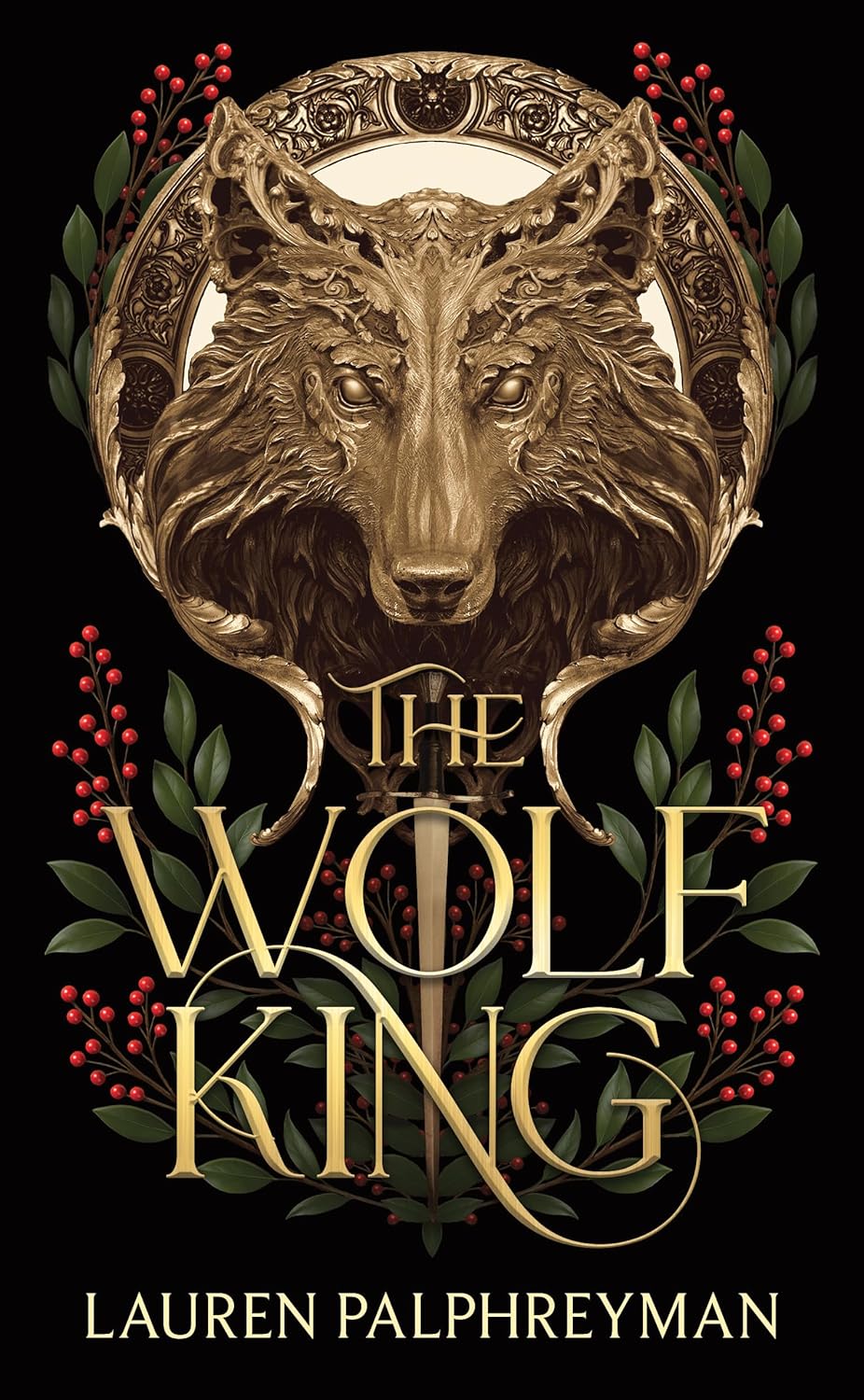
The Wolf King by Lauren Palphreyman begins with a princess who has spent her life being told exactly what she’s worth. Aurora’s value lies in her obedience, her beauty, and the political alliance her marriage can create. She’s expected to marry Lord Sebastian, endure whatever comes afterward, and accept that her future belongs to the men negotiating around her.
Then she meets the Wolves. Everything Aurora has been taught says they’re monsters. They’re dangerous, savage, uncontrollable creatures locked in a brutal war with her kingdom. Yet one of Aurora’s first encounters with them occurs while supposedly civilized humans force captured Wolves to fight for entertainment. That contradiction tells you almost everything you need to know about The Wolf King.
Lauren Palphreyman builds a romantasy around werewolves, forbidden attraction, captivity, political conflict, and enemies-to-lovers tension, but underneath all of it is a much more interesting question about who gets to decide which side is monstrous.
For me, that’s where the book becomes more than another alpha romance. Aurora isn’t simply falling for a dangerous Wolf. She’s discovering that almost everything she’s been taught about power, freedom, and civilization deserves to be questioned.
The Wolf King Quick Review
The Wolf King is the first book in Lauren Palphreyman’s Wolf King trilogy, an adult fantasy romance centered on Princess Aurora and Callum, a powerful Wolf alpha. The official publisher describes it as featuring wolf shifters, princess x alpha, a captive heroine, enemies to lovers, forbidden romance, a human-versus-Wolves war, and a love triangle.
It’s dark, romantic, politically charged, and considerably more interested in autonomy than I expected.
The romance is slow-burning rather than instantaneous. Aurora and Callum begin on opposite sides of a war, and the attraction between them develops alongside suspicion, ideological conflict, and the realization that neither humans nor Wolves fit neatly into the roles Aurora has been taught.
Most importantly, Aurora’s journey isn’t about trading one powerful man for another. It’s about learning that she has the right to choose at all.
The Wolf King Summary
Princess Aurora longs for freedom, but freedom isn’t something women in her position are given.
Her father has arranged her marriage to Lord Sebastian, a politically useful match who represents everything Aurora fears about her future. Sebastian’s civility hides cruelty, entitlement, and a belief that Aurora will become something he owns once the marriage is complete.
On the night before their wedding, Aurora attends a brutal spectacle where captured werewolves are forced to fight for human entertainment.
When she spares the life of a young Wolf, she attracts the attention of Callum, a powerful alpha among the prisoners. That decision changes everything.
Later that night, Callum escapes and takes Aurora with him, carrying her north into the lands of the Wolves. He believes the human princess may be useful in the ongoing war between their peoples.
Aurora believes she’s been kidnapped by exactly the kind of monster she has always been warned about. Neither understanding survives for long.
As Aurora travels through the Northlands, she begins seeing a world that contradicts much of what humans have taught her. The Wolves are capable of violence, certainly, but they’re also families, clans, warriors, friends, and people fighting for survival against a kingdom that has spent generations treating them as less than human.
Callum becomes equally difficult for Aurora to categorize. He’s dangerous. He’s an alpha. He’s capable of violence. But he isn’t Lord Sebastian.
Callum’s power doesn’t automatically translate into casual cruelty, and his restraint becomes increasingly important as Aurora begins questioning everything she thought she knew about the enemy.
Attraction slowly develops between them, complicated by war, loyalty, political alliances, Wolf hierarchy, and the fact that Aurora began this journey as Callum’s captive.
Meanwhile, the conflict surrounding the Wolf throne introduces another layer of danger.
James is the reigning Wolf King, and Callum’s relationship to the Wolves’ leadership turns out to be considerably more complicated than Aurora initially understands.
Blake, another powerful and deeply enigmatic Wolf, adds still more uncertainty. The farther Aurora travels from her father’s kingdom, the less certain she becomes about which world actually offered her freedom.
And eventually, the question stops being whether Aurora can return home. It becomes whether she wants to.
The official synopsis confirms this basic setup, including Aurora sparing the young Wolf, Callum kidnapping her, the war between humans and Wolves, and the forbidden attraction that grows between them.
The Wolf King Characters
One of the things I liked most about The Wolf King is that its characters rarely fit comfortably into the roles Aurora initially assigns them. Humans aren’t automatically civilized. Wolves aren’t automatically monstrous.
Heroes make questionable choices, and people who possess social respectability can be far more frightening than the creatures everyone has been taught to fear.
Princess Aurora
Aurora is the novel’s emotional center, and her development is one of its greatest strengths. She’s been raised to be useful rather than powerful. Her father expects obedience. Her marriage is political. Her future has effectively been negotiated without her participation.
Yet Aurora isn’t weak. She’s learned to survive through observation, restraint, compassion, and knowing when resistance would cost more than she can afford to pay. That’s an important distinction. Palphreyman doesn’t mistake loudness for strength. Aurora’s courage develops gradually because she’s spent her life learning that defiance can have consequences. Every time she speaks, challenges someone, protects someone weaker, or refuses to accept the morality she’s been handed, it means something.
Her compassion toward the Wolves is especially important. Before she understands their society, politics, or history, she recognizes that suffering doesn’t become acceptable simply because the victim has been labeled a monster. That instinct becomes the foundation of almost everything that follows.
Callum
Callum is the powerful alpha who kidnaps Aurora and takes her into the Northlands. He is not the reigning Wolf King, despite the title making that easy to assume. The official publisher description specifically identifies Callum as the alpha at the center of Aurora’s forbidden attraction.
What makes Callum compelling is restraint. He’s physically powerful enough that Aurora has every reason to fear him, but the story repeatedly distinguishes between having the ability to dominate someone and choosing to do so. That matters enormously given Aurora’s history. Callum is far from morally perfect. He kidnaps her. He views her as politically useful. He’s a warrior shaped by a brutal conflict.
But his violence has context rather than casual enjoyment behind it. As Aurora learns more about him, she begins recognizing the difference between someone dangerous and someone cruel. Those aren’t necessarily the same thing. That distinction gives their romance much of its tension.
James, the Wolf King
James is the actual Wolf King and the reigning monarch of the Northlands. His presence complicates Aurora’s developing understanding of Wolf society because discovering that humans have lied about the Wolves doesn’t mean every Wolf deserves her trust. James represents power on a much larger scale than Callum. He’s concerned with the throne, the war, Wolf survival, and the political future of his people. Individual lives can become pieces in a larger strategy.
That makes him important thematically as well as politically. Aurora is escaping one society where powerful men treat her as useful property only to discover that power can take similar forms elsewhere. The scenery changes. The question of who controls her remains.
Blake
Blake is one of the most intriguing characters introduced in The Wolf King, particularly because it’s difficult to decide exactly what to make of him. He’s intelligent, observant, unpredictable, and often seems to understand more than he’s willing to explain. That ambiguity becomes increasingly important as the story progresses.
Callum’s motivations are often easier to read. Blake operates differently. He watches. He calculates. He helps in ways that can raise almost as many questions as they answer. Knowing that The Night Prince exists makes his presence here even more interesting in retrospect, but even within this first book, Palphreyman clearly establishes Blake as someone readers should pay attention to.
Lord Sebastian
Lord Sebastian is perhaps the clearest example of the book’s fascination with the difference between appearance and monstrosity. He looks civilized. He holds status. He belongs to Aurora’s world. And he’s terrifying. Sebastian’s cruelty toward both Aurora and the captured Wolves strips away the comfortable assumption that humanity automatically occupies the moral high ground.
He represents institutional power at its ugliest: cruelty protected by wealth, tradition, gender, and social position. Aurora’s fear of marrying him also gives her later choices much more emotional weight. She’s not running from an inconvenient engagement. She’s facing a future in which her autonomy would effectively cease to exist.
Aurora and Callum’s Relationship
Aurora and Callum work for me because their romance isn’t built around instant trust. It couldn’t be. He kidnaps her. She’s a princess from the kingdom fighting his people. He’s an alpha raised inside a culture she barely understands. She has spent her entire life hearing that Wolves are monsters. There should be conflict between them. And there is. Their attraction develops alongside arguments, ideological differences, fear, curiosity, and increasingly uncomfortable realizations.
Aurora has to confront the possibility that the Wolves aren’t what she was taught. Callum must confront his assumptions about the human princess he initially sees as leverage.
What gradually connects them is recognition. Both understand captivity. Both understand expectation. Both have experienced what happens when other people decide what your life should look like. Their situations aren’t identical, but that shared understanding gives their attraction emotional weight beyond simple physical chemistry.
Callum also challenges Aurora without dismissing her. Aurora challenges him right back. That’s important because their relationship would be much less compelling if the alpha simply overwhelmed the inexperienced princess until she surrendered. Instead, trust develops through choices. For a story so preoccupied with captivity, choice becomes surprisingly central to the romance.
The Wolf King Tropes
Major tropes include wolf shifters, princess x alpha, enemies to lovers, forbidden romance, captive heroine, political fantasy, human-versus-wolves conflict, forced proximity, arranged marriage, possessive alpha energy, slow-burn attraction, morally complicated characters, and a developing love triangle.
Those aren’t guesses based on the plot. Sourcebooks specifically markets the novel around wolf shifters, princess x alpha, captive heroine, enemies to lovers, forbidden romance, the human-versus-Wolves war, and a love triangle.
What works especially well is that several of those tropes reinforce the same central theme. Almost everyone wants to define Aurora according to what she represents.
Princess. Bride. Human. Prisoner. Political asset. Potential lover. Aurora’s character arc is increasingly about deciding which of those labels, if any, she will accept.
How Spicy Is The Wolf King?
The Wolf King is an adult, spicy fantasy romance. Lauren Palphreyman herself describes it as a “spicy romantasy,” and the romance between Aurora and Callum grows increasingly physical as their emotional relationship develops.
I wouldn’t describe spice as the book’s primary purpose, though. The tension works because physical attraction is complicated by everything surrounding it. Aurora has been kidnapped. Callum is an alpha. Their kingdoms are at war. Trust has to develop despite all of that.
So when their relationship becomes more intimate, it feels connected to the larger emotional arc rather than inserted simply because the genre requires heat.
Power and Oppression Are Central to the Story
One of the strongest elements of The Wolf King is the way power operates through supposedly normal institutions. Aurora’s arranged marriage is legal.
Her father’s authority is legitimate. Lord Sebastian’s social standing protects him. The Wolves’ suffering is accepted because humans have decided they’re lesser beings.
None of that makes it moral. That distinction runs through the entire book.
Aurora’s kingdom doesn’t need a cartoon villain announcing that oppression is wonderful. The system works because cruelty has been normalized through tradition, political necessity, fear, and convenience.
The Wolves have their own hierarchies and problems, too. That’s crucial. Palphreyman doesn’t simply reveal that humans are bad and Wolves are secretly perfect.
The Northlands have power struggles, political calculations, alpha dynamics, and traditions capable of becoming oppressive in their own right.
Aurora is forced to learn that changing sides isn’t the same thing as finding moral certainty.
The Treatment of the Wolves Changes Everything
The early scenes involving captured Wolves are some of the most uncomfortable in the book, and they should be. Humans force them to fight for entertainment.
They’re caged, humiliated, and treated as creatures whose pain matters less because society has classified them as monsters. Aurora’s response separates her morally from the people around her before she knows anything else about Wolf society.
She doesn’t need proof that every Wolf is good. She only recognizes that suffering is suffering. That becomes one of the most important things about her character.
Aurora’s compassion isn’t presented as naïveté. It’s resistance. In a world where cruelty has become entertainment, refusing to enjoy it is already an act of rebellion.
What I Loved About The Wolf King
Aurora’s gradual transformation is probably my favorite part of the book. She doesn’t suddenly become a sword-wielding warrior who loses every trace of fear.
She remains Aurora. She’s compassionate, observant, emotionally vulnerable, and capable of being frightened. What changes is her willingness to let fear dictate every decision.
That feels much more satisfying to me than a heroine who becomes powerful overnight. I also loved the contrast between Callum and the supposedly civilized men in Aurora’s life.
Palphreyman repeatedly plays with the idea of monstrosity. Callum is visibly dangerous. Lord Sebastian is socially respectable. Which one should Aurora actually fear?
That question sounds simple once you know the characters, but the society Aurora comes from has spent generations answering it incorrectly.
The Wolf world is equally compelling because it doesn’t function merely as a romantic escape. There are clans, rivalries, hierarchy, political tensions, old wounds, and competing ideas about what the future should look like.
It feels like Aurora has entered another society rather than simply wandered into a handsome alpha’s camp. And then there’s Blake.
Even before he becomes more important later in the trilogy, there’s enough uncertainty surrounding him to make every appearance feel significant.
The World-Building Is Stronger Than the Romance Alone
I expected The Wolf King to primarily be a werewolf romance. It is. But the political structure gives the romance far more weight.
The war between humans and Wolves has history behind it. Neither side is operating in a vacuum, and propaganda has shaped how ordinary people understand the conflict.
The Wolves aren’t simply hiding in a forest waiting for Aurora to discover them. They have clans, alliances, rulers, traditions, and their own internal struggles.
The existence of the Wolf King adds another layer because unity doesn’t automatically mean stability. Power has to be maintained. Loyalty has limits.
And not every alpha necessarily agrees about who should rule.
The publisher describes the setting as one where previously warring Wolf clans are beginning to unite, which is one reason the internal politics become so important.
What Might Not Work for Every Reader
The captive-romance setup will probably be the biggest issue for some readers. Callum kidnaps Aurora. Even though the relationship develops gradually and the novel takes questions of choice and consent seriously, that initial power imbalance remains part of their story.
Readers who dislike captivity tropes may struggle with it regardless of how the relationship evolves. The book also contains significant cruelty and violence.
The treatment of captured Wolves, Aurora’s threatened future with Sebastian, warfare, political brutality, and the constant possibility of physical danger create a much darker background than the romance alone might suggest.
The love triangle elements may also divide readers. They become increasingly important across the trilogy, particularly once Blake’s role expands.
For me, that uncertainty adds complexity. Readers who want one immediately obvious romantic pairing may react differently.
Does The Wolf King End on a Cliffhanger?
The central story is definitely not complete at the end of The Wolf King. Major revelations reshape Aurora’s understanding of herself and the Wolves; relationships become considerably more complicated, and the political conflict moves directly into The Night Prince. So I would absolutely have Book 2 ready. This isn’t an interconnected fantasy-romance series where each installment introduces a different couple and provides a complete standalone romance. It’s one continuing trilogy.
The Wolf King Series Reading Order
The series contains three books: The Wolf King, The Night Prince, and The Wolf Queen. Penguin identifies them as Books 1, 2, and 3 respectively, with The Wolf Queen serving as the trilogy finale. They should be read in order because Aurora’s story, the romantic relationships, the fight over the Wolf Throne, and the supernatural mythology continue directly from one book to the next.
What Comes After The Wolf King?
The Night Prince is Book 2. It picks up directly after the consequences of The Wolf King and expands Blake’s role, Aurora’s connection to the Wolves, the fight over the throne, and the deeper mythology underlying the series. And if The Wolf King leaves you wondering whether everything is about to become considerably messier, the answer is yes. Very much yes.
Who Should Read The Wolf King?
I’d recommend The Wolf King to romantasy readers who enjoy their fantasy romance with genuine political conflict rather than using a fantasy kingdom merely as scenery.
If you like werewolves, alpha heroes, princesses, enemies to lovers, forbidden romance, morally complicated characters, arranged marriages, forced proximity, captivity, political intrigue, and heroines gradually taking control of their own lives, you’ll find plenty to enjoy.
It’s particularly well suited to readers who like darker fantasy romance without wanting the heroine’s emotional development swallowed by the romance. Aurora matters independently of Callum. That’s crucial.
Her journey would still have meaning even without the attraction between them because she’s fundamentally learning that obedience and goodness aren’t the same thing.
The Wolf King Review: Final Thoughts
What stayed with me most after The Wolf King wasn’t the kidnapping or even the forbidden romance. It was Aurora learning to question who gets to define a monster. She begins the story in a supposedly civilized world.
Humans have castles, laws, titles, marriages, traditions, and carefully maintained ideas about respectable behavior. They also cage sentient beings and force them to fight for entertainment.
Lord Sebastian looks human. Callum turns into a Wolf. Yet appearance tells Aurora almost nothing useful about which man is capable of cruelty.
That reversal gives the entire novel its emotional foundation. Aurora’s journey north isn’t simply geographic. She’s moving away from the moral certainty she inherited and toward a much more uncomfortable understanding of the world.
Callum helps destabilize those assumptions, but he doesn’t replace them with easy answers. The Wolves aren’t perfect. Their politics can be ruthless. Their hierarchy creates its own problems.
James’s position as Wolf King introduces another form of concentrated power. Blake makes everything more complicated still. Aurora therefore doesn’t escape one simplistic worldview only to adopt another.
She learns to judge people by what they do. That sounds obvious. In her world, it’s revolutionary. And that’s why her relationship with Callum works for me. The alpha isn’t compelling simply because he’s dangerous.
He’s compelling because Aurora learns to distinguish danger from cruelty, strength from domination, protection from ownership, and attraction from surrender.
Callum has to earn her trust. Aurora has to decide when giving that trust is actually her choice. Those distinctions matter in a story built around captivity and power.
The Wolf King delivers the werewolves, forbidden attraction, political intrigue, alpha energy, danger, and spice I expected. What I didn’t expect was how much I’d care about Aurora learning to claim ownership of herself.
She begins as a princess whose future has already been decided. By the end, that certainty has shattered. Her kingdom isn’t what she believed. The Wolves aren’t what she believed.
The men around her aren’t what they first appeared to be. And Aurora herself may be the greatest mystery of all. That’s a very good place to begin a trilogy.
The Wolf King FAQ
What is The Wolf King about?
The Wolf King follows Princess Aurora, whose arranged marriage to the cruel Lord Sebastian is interrupted after she shows mercy to a captured werewolf. Powerful alpha Callum later kidnaps her and takes her into the Northlands, where Aurora begins questioning everything she’s been taught about Wolves while forbidden attraction grows between them.
Who are the main characters in The Wolf King?
Aurora and Callum are the central characters. James, the reigning Wolf King, and Blake also become increasingly important to the larger political and romantic story.
Is Callum the Wolf King?
No. Callum is a powerful alpha and Aurora’s primary romantic interest in the first book. James is the reigning Wolf King.
Is The Wolf King enemies to lovers?
Yes. Aurora and Callum begin on opposing sides of the human-Wolf conflict, with Callum taking her captive before their relationship gradually develops into forbidden attraction. Sourcebooks officially lists enemies to lovers among the book’s tropes.
Does The Wolf King have a love triangle?
Yes. The romantic situation becomes more complicated than a straightforward Aurora and Callum pairing, and Sourcebooks specifically lists a love triangle among the novel’s major tropes.
Is The Wolf King spicy?
Yes. Lauren Palphreyman describes The Wolf King as a spicy romantasy for readers who enjoy Outlander, A Court of Thorns and Roses, and werewolves.
Is The Wolf King a werewolf romance?
Yes. Werewolves, Wolf clans, alpha dynamics, shifting, political hierarchy, and the war between humans and Wolves form the foundation of the fantasy world.
Is The Wolf King a standalone?
No. It’s Book 1 of a continuing trilogy and leads directly into The Night Prince.
What book comes after The Wolf King?
The Night Prince is the second book, followed by The Wolf Queen, which concludes the trilogy.
How many books are in The Wolf King series?
There are three: The Wolf King, The Night Prince, and The Wolf Queen.