
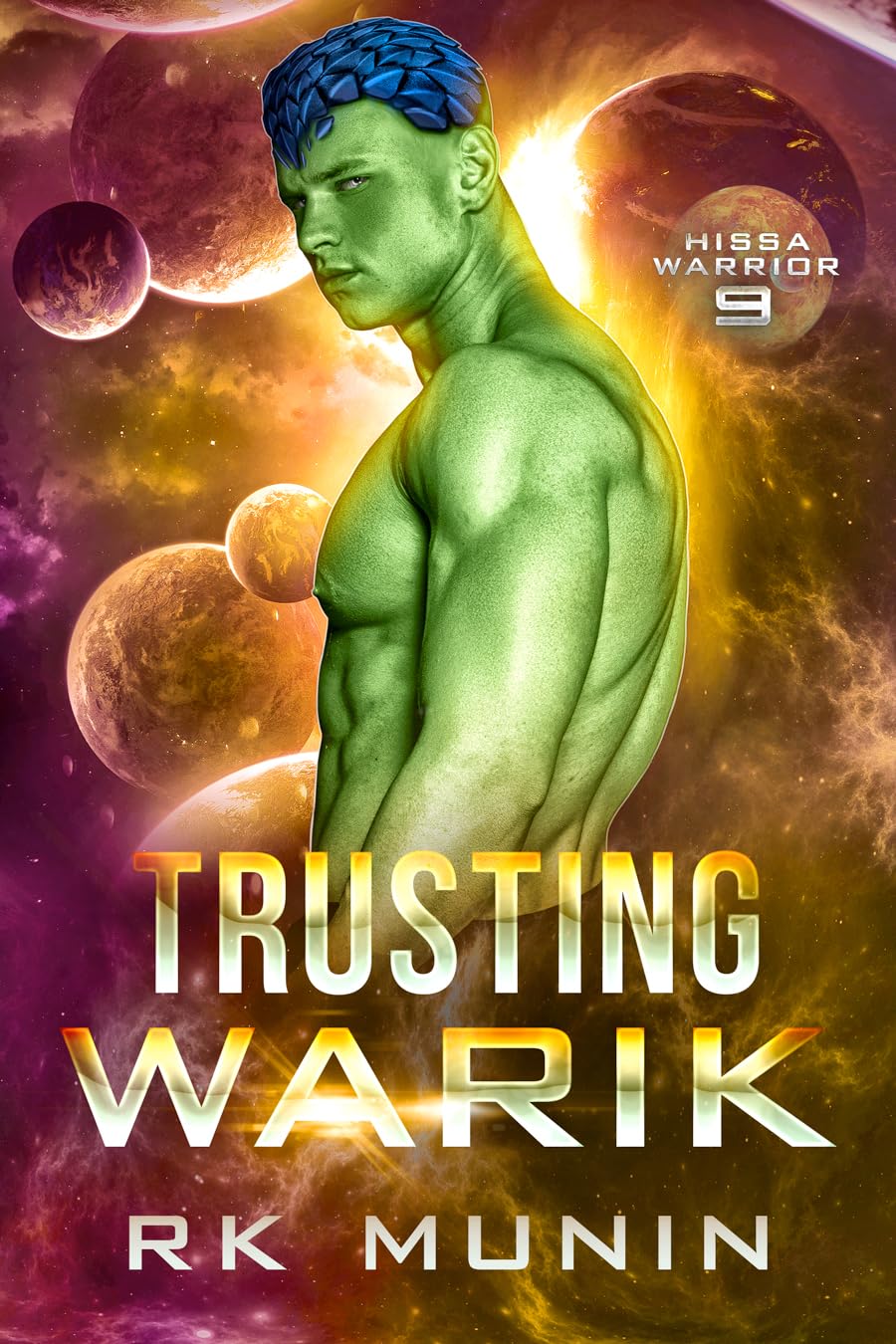
Trusting Warik by RK Munin brings the Kiss Warrior series to a close with a science-fiction romance built around freedom, bodily autonomy, artificial reproduction, and the uncomfortable question of what happens when technology capable of creating life becomes profitable to people who don’t necessarily consider that life fully human.
Nisha understands that danger better than almost anyone. Her mother helped develop Decanting technology, an achievement that should have represented scientific progress but now carries the possibility of something horrifying: human beings created specifically so corporations can exploit them.
Nisha refuses to allow that legacy to continue unchallenged. Her attempt to sabotage an Earth corporation’s plans puts her in direct danger and eventually brings her into contact with Warik, a Hissa warrior and investigator whose work already revolves around locating Decanted humans and offering them something they have rarely been given: a genuine choice.
That shared commitment gives the romance an unusually strong foundation. Nisha and Warik are attracted to one another, but what makes them compatible is that both believe freedom should belong to the person living the life, not whoever happens to have the money, technology, or authority to control it.
For me, that is what makes Trusting Warik such an effective series finale. The romance gives Nisha and Warik a personal emotional story, while the Decanting conflict allows the book to return to the larger questions of freedom and personhood that have shaped the series.
Trusting Warik Quick Review
Trusting Warik is the final installment in RK Munin’s Kiss Warrior series and centers on Nisha, a human woman trying to stop her late mother’s Decanting technology from being exploited, and Warik, a Hissa investigator devoted to finding Decanted humans and helping them reach safety.
The story blends science-fiction romance, alien romance, interstellar intrigue, corporate corruption, forced exploitation, investigative elements, cultural differences, action, and a relationship built on trust. Rather than treating the science-fiction setting as decoration around the romance, the conflict involving Decanted humans gives Nisha and Warik a shared moral purpose from the beginning.
Warik also works especially well as a romantic hero because his strength is paired with compassion. He is capable, formidable, and experienced at uncovering secrets, but his mission is fundamentally about giving vulnerable people control over their own lives rather than deciding what should happen to them.
Trusting Warik Summary
Nisha carries a difficult inheritance.
Her mother’s work on Decanting technology was scientifically groundbreaking, but Nisha has come to understand how easily that achievement can be twisted into a system for creating human beings who exist primarily to serve the interests of corporations and other powerful groups.
That possibility becomes impossible for her to ignore.
Rather than distance herself from the technology’s consequences, Nisha decides to act. She becomes determined to sabotage the Earth corporation attempting to exploit Decanting, even though challenging an organization with enormous resources places her life in danger.
Her mission eventually intersects with Warik.
Warik is a Hissa warrior and investigator who spends his life tracking down Decanted humans. Instead of viewing them as property, experiments, or lesser beings, the Hissa offer them an opportunity to live freely among their people.
That makes Warik uniquely suited to understand the stakes of Nisha’s mission.
He knows what happens when created people are treated as commodities, and his investigative experience gives him skills Nisha desperately needs. What begins as an alliance against a shared enemy gradually becomes much more personal.
Warik has long expected to live without a mate. His work and responsibilities have given his life purpose, but meeting Nisha immediately challenges assumptions he has made about what his future will look like.
Nisha has different obstacles.
Trust is dangerous when she is already fighting people willing to exploit technology capable of creating human life, and the shadow of her mother’s work leaves her carrying guilt and responsibility for choices she never personally made.
Warik becomes someone she can rely on without surrendering her independence.
Their relationship develops alongside the investigation and the growing threat from the corporation. As Nisha and Warik uncover more about the plans surrounding Decanting, the conflict becomes increasingly personal, forcing them to confront both the external danger and the emotional risks created by depending on another person.
The result is a romance where trust is not simply a romantic ideal.
It is a survival skill.
Trusting Warik Characters
Nisha and Warik work particularly well together because their goals overlap without making them identical. Both care about protecting Decanted humans, but Nisha approaches the problem through the burden of inherited responsibility while Warik approaches it through years of direct experience helping victims of the system.
That distinction gives both characters meaningful roles in the story. Nisha doesn’t become important simply because Warik protects her, while Warik doesn’t exist merely as muscle attached to her mission.
Nisha
Nisha is compelling because her conflict begins with something she didn’t personally create but nevertheless refuses to ignore. Her mother developed Decanting technology, so Nisha lives with the knowledge that a scientific legacy connected to her family could cause enormous suffering.
She could reasonably argue that none of this is her responsibility.
Instead, she chooses to act.
That decision tells us a great deal about her character because sabotaging the corporation offers no obvious personal reward. Nisha is putting herself at risk primarily because she understands what will happen to other people if the technology is allowed to become another mechanism for slavery.
Her relationship with her mother’s legacy also adds emotional complexity. Scientific achievement isn’t inherently good just because it represents innovation, and Nisha has to separate admiration for what her mother accomplished from the moral consequences of how that accomplishment might be used.
That gives her mission more depth than simple revenge. She isn’t trying to destroy the past. She is trying to prevent other people from using the past to control the future.
Nisha’s romantic arc fits that theme beautifully because trusting Warik requires allowing another person into a mission she has every reason to guard carefully. She has to learn that relying on someone does not automatically mean surrendering autonomy.
Warik
Warik is a Hissa warrior, but the investigator side of his character is just as important as his physical strength. His work requires him to uncover hidden networks, locate Decanted humans, assess dangerous situations, and determine how to help people who may have spent much of their lives being controlled by others.
That makes compassion central to his profession.
Warik isn’t rescuing people so he can decide what happens to them next. The goal is to give them the opportunity to choose a life among the Hissa rather than exchanging one form of ownership for another.
That philosophy matters enormously once he meets Nisha.
She is fiercely independent and already undertaking a dangerous mission of her own, so Warik cannot treat protecting her as a reason to take control away from her.
His support works because it strengthens her ability to act.
The expectation that he would live without a mate adds another layer to his emotional arc. Warik has created a meaningful life without assuming romantic partnership will eventually complete it, so Nisha becomes significant because she changes what he wants rather than filling an emptiness he has spent his entire existence waiting for someone else to fix.
That makes his growing attachment feel more deliberate. He had already accepted one future. Meeting Nisha makes him imagine another.
Nisha and Warik’s Relationship
The title Trusting Warik captures the central romantic challenge beautifully because trust has consequences for both characters. Nisha is working against powerful people with reasons to manipulate, threaten, or silence her, which means blindly placing faith in someone else could be catastrophic.
Warik has to earn that faith.
His strength alone isn’t enough because Nisha does not need another powerful figure deciding what is best for her. If their relationship is going to work, she needs evidence that his protectiveness will remain compatible with her autonomy.
That distinction is especially important because of the larger Decanting storyline.
A book centered on people being denied control over their own lives would undermine itself if the romance celebrated Warik taking control away from Nisha in the name of protecting her.
Instead, their partnership becomes meaningful when support and freedom coexist. Warik can help. He can advise. He can investigate. He can fight beside her.
Nisha still remains the person who decides what risks she is prepared to take. That balance connects the relationship to the story’s ethical framework rather than separating it from it.
The Decanting Technology Gives the Story Its Strongest Conflict
The concept of Decanting raises one of the book’s most interesting questions: if technology can create a sentient human being, who has the right to determine why that person exists?
The corporation’s answer appears horrifyingly simple. The creator owns the product. The Hissa reject that idea. A person who was created through technology is still a person, and origin does not erase the right to self-determination.
That conflict gives Nisha’s mission enormous stakes because the danger isn’t limited to one laboratory or one group of victims. Once technology capable of producing exploitable human beings becomes profitable, the incentive to expand the system becomes almost impossible to contain.
Decanting therefore functions as more than futuristic world-building. It becomes a way of examining slavery, commodification, consent, and the ethics of technological power.
Nisha Isn’t Responsible for Her Mother’s Choices
One of the most emotionally interesting parts of Nisha’s situation is the difference between responsibility and guilt. Her mother created the technology, but Nisha didn’t make the decisions that let others exploit it.
That doesn’t mean she can ignore what she knows. Her decision to intervene comes from conscience rather than inherited blame.
That distinction matters because Nisha’s story would become considerably less satisfying if she spent the entire novel accepting moral responsibility for another person’s choices.
What she can control is what she does now. She understands the danger. She has access to information. She has an opportunity to interfere. Choosing to act therefore becomes a demonstration of character rather than repayment for a family debt.
The Hissa Approach to Freedom Matters
Warik’s mission reveals something important about Hissa culture because locating Decanted humans is only part of the goal. What matters afterward is that those humans receive an opportunity to choose freedom.
That is a crucial distinction.
Rescuing someone from one controlling system only to decide their future for them would reproduce the same underlying problem. The Hissa approach, as presented here, places autonomy at the center of liberation.
That gives Warik’s culture a meaningful connection to the romance as well. His respect for choice isn’t something he suddenly develops because he falls in love with Nisha, but an ethical principle already embedded in the work he has chosen to do.
Nisha can therefore trust him gradually because his behavior toward others shows how he understands freedom. He doesn’t merely talk about respecting autonomy. He has built his life around it.
Trusting Warik Tropes and Genres
The strongest elements include:
- Science-fiction romance
- Alien romance
- Human heroine
- Alien warrior hero
- Investigator hero
- Interstellar adventure
- Corporate conspiracy
- Forced exploitation
- Fighting slavery
- Protective hero
- Competent heroine
- Partners against a common enemy
- Trust and vulnerability
- Cultural differences
- Action romance
- Series finale
- Freedom and autonomy themes
This Is More Than a Human and Alien Love Story
The alien-romance framework is important, but the strongest element isn’t simply that Nisha and Warik come from different species. Their cultural differences matter because they expose competing ideas about freedom and personhood.
Warik comes from a society where offering Decanted humans freedom has become part of his work. Nisha comes from Earth, where a corporation is apparently attempting to turn the same technology into a system of exploitation.
Their relationship therefore places two cultures side by side and asks which one is behaving more humanely.
That comparison gives the science-fiction setting thematic weight. The supposedly alien culture may understand human autonomy better than the humans seeking to profit from manufactured life.
Warik’s Protectiveness Works Because It Doesn’t Erase Nisha’s Competence
Alien-warrior romances frequently rely on heroes who are physically stronger than their human partners, and Warik certainly fits the capable-warrior role. The dynamic works because strength doesn’t automatically make him the only competent person in the relationship.
Nisha is already acting before Warik enters her life. She has identified the threat. She has chosen a mission. She is willing to place herself in danger to stop the corporation.
Warik adds investigative experience, physical protection, and knowledge Nisha lacks, but he doesn’t create her courage. That makes their partnership more satisfying. Nisha doesn’t become heroic because Warik selects her. Warik recognizes the courage already there.
The Romance and the Main Plot Actually Belong Together
One of my favorite things about Trusting Warik is how naturally the romance connects to the external conflict. Nisha and Warik don’t meet while pursuing unrelated goals and then spend half the book alternating between romance scenes and a separate science-fiction plot.
They care about the same fundamental problem. Nisha wants to stop Decanting technology from creating more victims. Warik has dedicated his life to helping people already victimized by systems built around that technology.
Their attraction grows through cooperation. That gives the relationship a stronger foundation because each character can see the other’s values through action. Nisha sees how Warik treats vulnerable people.
Warik sees how much Nisha is willing to risk for people she may never personally know. Respect therefore develops alongside attraction.
Trust Is More Important Than Instant Attraction
The book’s romantic premise becomes much stronger when trust remains distinct from chemistry. Nisha may be drawn to Warik quickly, but attraction alone cannot answer whether he is someone safe enough to include in a mission involving enormous consequences.
Warik faces a related challenge. He can feel unexpectedly drawn toward Nisha without assuming that feeling gives him automatic access to her life.
That creates a healthier emotional progression. Trust has to be demonstrated. It grows from shared danger, reliable behavior, difficult conversations, and repeated evidence that each character takes the other seriously.
The title therefore becomes more than a description of Nisha eventually falling for Warik. Trust becomes the actual mechanism through which their relationship develops.
The Corporate Villainy Fits the Larger Theme of Commodification
The Earth corporation represents the darkest possible use of Decanting technology because it transforms the creation of human life into an economic calculation.
If people can be manufactured, someone will eventually ask how cheaply they can be produced. If they are treated as products, someone will eventually ask how profitably they can be sold.
That logic is exactly what Nisha fears.
The danger therefore comes from more than one particularly evil executive or isolated organization. It comes from a system capable of convincing itself that exploitation is acceptable once the victims have been categorized as something less than fully autonomous people.
That gives the story an effective science-fiction moral dilemma. Technology itself doesn’t decide whether Decanting becomes liberation or slavery. People do.
What I Loved About Trusting Warik
Nisha’s connection to the Decanting technology gives her unusually strong personal stakes. She has every reason to wish the problem belonged to someone else, yet she refuses to ignore what might happen simply because facing it is dangerous.
Warik is equally effective because compassion is built into his strength. He isn’t merely an intimidating alien warrior who happens to become gentle around one woman, because his work helping Decanted humans demonstrates that respect for vulnerable people already exists at the center of his character.
Their compatibility therefore feels rooted in values.
I also appreciate the way the larger conflict raises genuine questions about personhood. Science fiction is at its best when futuristic technology creates moral problems that feel recognizable, and Decanting works because the basic issue is ancient: what happens when powerful people decide another person exists for their benefit?
The action helps keep those ideas from turning the book into a philosophical exercise. Nisha and Warik face immediate dangers, giving the ethical questions consequences that affect real lives rather than remaining abstract arguments.
What Might Not Work for Every Reader
Because Trusting Warik is the final installment of an established series, readers beginning here may understand the central romance but miss some of the broader emotional significance surrounding the Hissa, Decanted humans, and the conflicts developed in earlier books. Your original review describes it as accessible enough to work on its own, but the series conclusion will naturally carry more weight for readers who already know the larger universe.
The science-fiction conflict is also substantial enough that readers looking only for a light alien romance may find the book more plot-driven than expected. Corporate exploitation, slavery, technological ethics, investigation, and interstellar danger occupy meaningful space alongside Nisha and Warik’s relationship.
For me, those elements strengthen the romance because the characters reveal who they are through the choices they make under pressure. Readers who prefer nearly all attention to remain on the couple, however, may find the larger conflict more prominent than they want.
Is Trusting Warik an Alien Romance?
Yes. Warik is a Hissa warrior, and Nisha is human, making their relationship an alien romance within a larger science-fiction setting.
The interspecies relationship is more than a visual or physical difference. Hissa culture, its approach to Decanted humans, and Warik’s understanding of freedom all influence the moral and romantic conflicts in the story.
Is Trusting Warik a Science-Fiction Romance?
Yes. The plot depends heavily on futuristic Decanting technology, interstellar travel and societies, alien cultures, corporate exploitation, and questions about artificially created human life.
Is Trusting Warik Romantic Suspense?
It has strong romantic-suspense elements because Nisha is attempting to sabotage a dangerous corporation while Warik investigates secrets connected to Decanted humans. Their romance develops amid threats, pursuit, hidden information, and situations where trusting the wrong person could have serious consequences.
What Is Decanting in Trusting Warik?
Decanting is a technology connected to the creation of human beings, and Nisha’s mother played an important role in its development. The central conflict arises because an Earth corporation intends to exploit that technology in ways that could perpetuate slavery and deprive Decanted humans of autonomy.
The technology therefore creates the book’s central ethical question. Being created through a technological process does not make a sentient person property, and much of the conflict revolves around people who either accept or reject that principle.
Who Is Nisha in Trusting Warik?
Nisha is a human woman whose mother helped develop the controversial Decanting technology. Knowing the technology could be exploited to create or control human beings drives Nisha to sabotage the corporation attempting to use it for harmful purposes.
Her character is defined by determination and moral responsibility rather than simple guilt. She did not create the system herself, but once she understands the danger, she refuses to pretend the consequences belong exclusively to someone else.
Who Is Warik?
Warik is a Hissa warrior and investigator who finds Decanted humans and helps them reach a society where they can live freely. His experience investigating hidden systems makes him a valuable ally when Nisha begins fighting the corporation exploiting her mother’s technology.
He is also Nisha’s central romantic interest. His respect for autonomy, combined with his strength and investigative abilities, makes him especially compatible with a heroine whose entire mission revolves around preventing others from losing control of their lives.
Is Trusting Warik the Last Kiss Warrior Book?
Yes. Based on the review information you provided, Trusting Warik is the final installment in RK Munin’s Kiss Warrior series and brings the larger story to a satisfying conclusion.
That position gives the book two responsibilities at once. It needs to complete Nisha and Warik’s romance while also resolving broader conflicts and themes surrounding the Hissa, Decanted humans, freedom, and exploitation.
Can Trusting Warik Be Read as a Standalone?
Your original review describes the book as satisfying both as a standalone romance and as the series’ culmination. The central Nisha and Warik relationship therefore appears understandable on its own, even though the larger world and series-level resolution will naturally carry more meaning for readers familiar with the earlier installments.
Because it is the finale, I’d still recommend reading the Kiss Warrior series in order when possible. Earlier books should provide more context for the Hissa, Decanted humans, and the larger conflict this final installment brings together.
Who Should Read Trusting Warik?
I’d recommend Trusting Warik to readers who enjoy alien romance where the science-fiction story matters just as much as the species difference between the couple. It should especially appeal to readers who like competent heroines, protective alien warriors, interstellar investigations, corporate conspiracies, action, technological ethics, cultural differences, and romances built around mutual respect.
It should also appeal to readers who want science fiction to ask ethical questions rather than simply provide exotic scenery. The Decanting storyline gives the novel something meaningful to say about bodily autonomy, personhood, exploitation, slavery, and the responsibility that comes with technological innovation.
Trusting Warik Review: Final Thoughts
What makes Trusting Warik work for me is how completely the romance reinforces the story’s larger argument about freedom. Nisha is trying to stop a system that views created people as resources.
Warik has dedicated his life to helping those same people reclaim control over what happens to them. Their relationship could only work if it respected the very autonomy they are fighting to protect.
That gives trust a meaning far beyond romantic vulnerability. Nisha has to know that accepting Warik’s help will not result in him taking control of her mission. Warik has to understand that protecting Nisha does not mean removing her right to make dangerous choices.
Their partnership is strongest when both can contribute without turning support into authority over the other. The Decanting technology also gives the series finale an effective moral center.
Scientific progress is often discussed as though invention itself represents success, but Trusting Warik asks what happens after the breakthrough. A technology capable of creating life also creates responsibility for the lives it produces.
Nisha’s mother helped make Decanting possible. Other people decide how to use it. Nisha’s contribution is recognizing that technological legacy does not excuse moral passivity.
She can’t rewrite what happened before her. She can decide what she is willing to allow next. Warik makes an ideal romantic partner for that story because his own work rests on a similar principle.
Finding Decanted humans isn’t enough. Saving them isn’t enough. They have to be allowed to choose. That belief separates rescue from ownership and makes his relationship with Nisha feel consistent with the man he has already chosen to become.
The fact that he never expected to find a mate adds another appealing dimension. Warik already has purpose. Nisha already has a mission.
Neither enters the relationship as an incomplete person waiting for love to provide meaning. Instead, they discover someone whose values make the future feel larger than the one either had imagined alone.
For a series finale, that feels particularly appropriate. The larger conflict concerns whether people should be allowed to control their own futures, while the central romance ends with two people choosing to build one together.
That connection between the intimate and the interstellar is what gives Trusting Warik its emotional strength. It is a romance about trust, but it is equally a story about why choice matters in the first place.
Trusting Warik FAQ
What is Trusting Warik by RK Munin about?
Trusting Warik follows Nisha, a human woman trying to prevent her mother’s Decanting technology from being exploited by a powerful Earth corporation, and Warik, a Hissa warrior and investigator who tracks down Decanted humans and helps them find freedom. Their alliance develops into a romance while they confront corporate corruption, interstellar danger, and the moral consequences of creating sentient life for exploitation.
Who are the main characters in Trusting Warik?
The central characters are Nisha and Warik. Nisha is determined to stop the misuse of technology connected to her mother’s legacy, while Warik is a Hissa investigator whose work rescuing Decanted humans makes him a natural ally in her mission.
Is Trusting Warik an alien romance?
Yes. Warik is Hissa, and Nisha is human, making the central relationship an alien romance set within a broader interstellar science-fiction world.
What is Decanting technology?
Decanting is technology associated with creating human life, and Nisha’s mother played an important role in its development. The danger arises when an Earth corporation seeks to exploit that technology in ways that could create or perpetuate systems of slavery.
Why does Warik search for Decanted humans?
Warik works to locate Decanted humans and offer them the opportunity to live freely among the Hissa. His mission reflects one of the story’s central beliefs that the circumstances of someone’s creation should not determine whether they deserve autonomy.
Is Trusting Warik a romantic suspense novel?
The book contains substantial romantic-suspense elements, including investigation, danger, corporate conspiracy, hidden information, and threats against the protagonists. Its strongest overall classification remains science-fiction alien romance because the Decanting technology and interstellar world are fundamental to the plot.
Is Trusting Warik the final Kiss Warrior book?
Yes. Trusting Warik is presented as the final installment in RK Munin’s Kiss Warrior series, bringing together major themes surrounding freedom, Decanted humans, Hissa culture, and the larger interstellar conflict.
Can Trusting Warik be read as a standalone?
The central romance between Nisha and Warik appears accessible on its own, but the larger series conclusion should have greater emotional impact for readers familiar with the previous Kiss Warrior books. Since this is the finale, reading the series in order will provide more context for the larger world and continuing conflicts.
What themes does Trusting Warik explore?
The novel explores freedom, bodily autonomy, slavery, technological responsibility, identity, trust, cultural differences, and the moral obligations involved in creating sentient life. Nisha and Warik’s romance reinforces those themes because their relationship depends on supporting one another without sacrificing individual choice.