
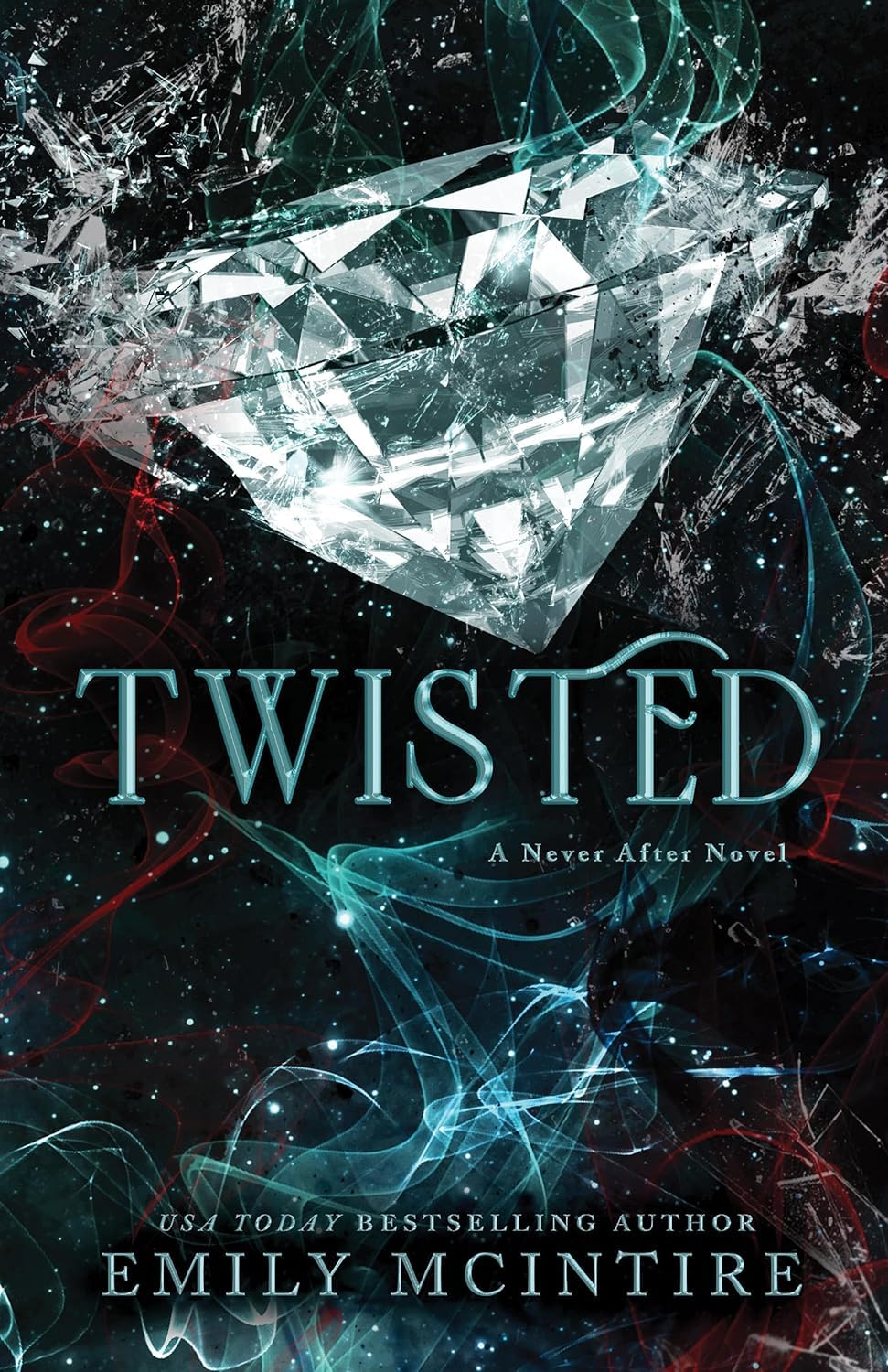
Twisted by Emily McIntire is the fourth complete standalone novel in the Never After series, and it takes inspiration from Aladdin while transforming familiar fairy-tale elements into something darker, sexier, and far more morally complicated. At the center of the story are Yasmin Karam, the privileged daughter of a powerful jeweler, and Julian Faraci, her father’s ruthless right-hand man, whose ambition and obsession make him one of the most deliciously unhinged heroes in the series.
Yasmin begins the story caught between duty and desire. Her father is dying and wants to see her married before he passes, but the man she loves is someone he would never approve of, leaving her trapped between honoring his final wish and protecting the future she thought she wanted.
Julian sees that conflict as an opportunity. He wants the empire, the power, and eventually Yasmin herself, and he is willing to manipulate the situation until marriage becomes the solution to both his ambition and her father’s dying request.
What follows is a dark marriage-of-convenience romance packed with manipulation, possessiveness, sharp banter, sexual tension, betrayal, and the kind of “touch her and die” energy that suits Julian perfectly. For me, Twisted is one of the strongest installments in the Never After series because Julian never stops feeling dangerous, while Yasmin remains strong enough to push against him instead of disappearing underneath his personality.
Twisted Quick Review
Twisted is a dark contemporary romance inspired by Aladdin, but the familiar fairy-tale framework is reshaped around wealth, inheritance, manipulation, marriage, ambition, and obsession. Julian Faraci is not a softened villain pretending to be dangerous, because he genuinely believes power is something to be seized and that obstacles exist to be removed.
Yasmin gives him exactly the kind of resistance that makes their relationship work. She may have grown up surrounded by wealth and privilege, but she is not easily controlled, and her refusal to simply accept Julian’s plans creates much of the friction that turns their marriage arrangement into something combustible.
The chemistry between them is intense from the beginning. Their arguments carry attraction underneath them, their power struggle constantly shifts, and Julian’s possessiveness becomes increasingly personal as his original plan to secure the empire turns into something far more dangerous.
I also loved how unapologetically excessive the book can be. A ruthless antihero, forced marriage, business power plays, a giant python, vicious possessiveness, and an unforgettable coffee-table scene should probably feel ridiculous together, but McIntire makes the entire package feel completely at home inside the Never After universe.
Twisted Summary
Yasmin Karam has spent her life surrounded by privilege as the daughter of one of the most powerful jewelers in the business. Wealth may have given her security and opportunity, but it has not protected her from the one reality money cannot change: her father is dying.
His final wish places Yasmin in an impossible position. He wants to see her married before he dies, but the man she loves is someone he views as unsuitable, leaving Yasmin desperate to find a way to honor her father without surrendering control over her own future.
Julian Faraci is already watching the situation closely.
As her father’s right-hand man, Julian understands the business, the power structure, and exactly what will happen once his mentor is gone. He also has ambitions of his own, and those ambitions reach far beyond remaining a loyal employee.
Julian wants the empire. Marrying Yasmin offers him a direct path toward it.
His plan begins as calculated manipulation. He can present himself as the respectable match Yasmin’s father wants, convince a dying man that the marriage is based on love, and place himself exactly where he needs to be once the business changes hands.
Yasmin initially views Julian as an obstacle rather than a romantic possibility. He is controlling, arrogant, ambitious, and far too willing to manipulate circumstances to get what he wants, while Julian sees Yasmin as both the key to his future and someone whose resistance only makes him more determined.
Their arrangement develops into a marriage of convenience with very little emotional convenience attached to it. Yasmin does not simply submit to Julian’s plan. She challenges him. She argues with him.
She continues wanting a future that does not necessarily align with the one he has decided to build around her. Julian responds exactly as expected from a man who is not accustomed to losing.
He becomes more possessive, more calculating, and increasingly obsessed with making Yasmin his in every sense that matters.
The most interesting shift occurs when his ambition stops being the only thing driving him. The empire still matters, but Yasmin gradually stops feeling like the means to an end and becomes the person he is most unwilling to lose.
That change does not magically make Julian gentle. He remains manipulative. He remains possessive. He remains capable of making choices that would send most people running in the opposite direction.
What changes is the source of his ruthlessness. He may begin by using Yasmin to gain power, but eventually protecting and keeping her becomes the power he values most.
Yasmin’s journey is equally important because she must decide whether the man she originally sees as the villain in her life can offer something genuine beneath the manipulation. Loving Julian doesn’t require pretending he is morally good, but it does force her to see the difference between the monster she imagined and the complicated man he actually is.
Their marriage becomes the battleground where ambition, attraction, loyalty, and control collide.
Yasmin Karam
Yasmin is easy to underestimate because she begins from a position of privilege. She is wealthy, protected by her family name, and connected to an empire that gives her access to a world most people could never enter.
That privilege does not make her powerless.
Her father’s illness immediately exposes how little control money provides when the thing she wants most cannot be purchased. It also places her under emotional pressure because his final wish asks her to make a lifelong commitment based partly on duty.
Yasmin’s conflict therefore becomes deeply personal. She wants to honor her father. She wants to follow her heart. She also wants to remain the person making decisions about her own life.
Those goals are not always compatible. Julian exploits that tension, but Yasmin’s strength comes from refusing to let his manipulation completely define her role in the relationship.
She can be cornered without becoming passive. She can be attracted to him without forgetting why she distrusts him. She can eventually love him without pretending that his methods were harmless.
That complexity makes her a much stronger match for Julian than someone who simply melts under his attention.
Yasmin needs enough backbone to survive loving a man like him.
She has it.
Julian Faraci
Julian is easily the biggest reason Twisted works for me. He is ambitious, manipulative, obsessive, ruthless, and wonderfully unhinged without ever feeling as though the story is embarrassed by how dark he actually is.
He wants power because power matters to him. He wants the empire because he believes it should become his. He wants Yasmin because once that desire takes hold, accepting that she might belong to someone else becomes intolerable.
That combination makes him dangerous in ways that go beyond standard alpha-male possessiveness. Julian plans. He calculates.
He understands people well enough to identify weaknesses and use them. His arrangement with Yasmin is not born from romantic idealism but from strategy, which gives the eventual emotional transformation much more weight.
The fascinating part is that love does not reform him into a conventionally good man. Instead, love redirects some of his ruthlessness.
The man capable of manipulating Yasmin into marriage becomes the same man who cannot tolerate threats against her once she has become central to his life.
That is where the “touch her and die” energy works so well. Julian does not suddenly discover morality. He develops loyalty. For a character like him, that distinction is much more believable. His giant python also fits him almost absurdly well.
Nothing about Julian should be understated, and a dangerous, powerful man keeping an enormous snake as a pet feels completely in character.
Yasmin and Julian’s Relationship
Yasmin and Julian begin from a position of mutual distrust. She sees him as calculating and dangerous, while he initially views her as both an obstacle and the key to obtaining what he wants.
That foundation gives the romance immediate friction. Neither is approaching the other innocently. Yasmin knows Julian has an agenda. Julian knows Yasmin would not willingly choose the future he is creating for them.
Their marriage therefore begins with imbalance and manipulation rather than emotional security. That makes the gradual shift much more interesting. Julian’s feelings become increasingly difficult to separate from obsession.
Yasmin’s attraction becomes harder to dismiss once she realizes that the man she hates is also capable of provoking reactions she cannot easily control.
Their banter adds another layer because neither character backs down gracefully. Arguments become flirtation without either wanting to admit it. Challenges become invitations.
Power struggles begin carrying enough sexual tension that conflict itself becomes part of their chemistry.
The relationship becomes especially compelling once Julian’s original motives start changing.
He may have approached marriage as a path to the empire, but Yasmin gradually becomes something he values independently from the business.
That emotional shift creates the strongest version of the romance. Julian is no longer merely trying to own what Yasmin represents. He wants Yasmin herself.
The Marriage of Convenience Turns Into a Power Struggle
Marriage of convenience works especially well in dark romance because the arrangement can place two people in intimate circumstances long before genuine trust exists. Yasmin and Julian are forced to negotiate proximity, expectations, attraction, and control while both understand that the marriage began for practical reasons.
The arrangement also gives Julian access to the one thing he believes he needs most.
Power. At least initially. The more time he spends with Yasmin, the more complicated that ambition becomes.
The empire may have motivated the marriage, but keeping the marriage eventually becomes a separate desire.
That distinction matters because Julian’s emotional development would feel hollow if he simply decided love mattered more than money overnight.
Instead, the two desires become intertwined. He wants the empire. He wants Yasmin. Eventually, losing either begins to feel unacceptable. That is exactly the kind of obsessive logic that fits him.
The Aladdin Inspiration Works Without Feeling Like a Copy
The Aladdin influence gives Twisted recognizable elements without forcing the story into a literal retelling. Wealth, power, social position, manipulation, a powerful father, forbidden affection, ambition, and characters inspired by familiar archetypes all help create the connection.
Julian works particularly well as the darker reinterpretation of ambition.
He is not trying to become powerful because he believes power will allow him to do something noble.
He wants power because possessing it satisfies something fundamental in him.
Yasmin carries recognizable princess-like elements through wealth and family status, but McIntire gives her enough resistance and independence to keep her from becoming someone passively waiting for men to determine her future.
The fairy-tale inspiration therefore functions more like a skeleton.
McIntire builds an entirely adult dark romance around it.
That is one of the reasons the Never After format works so well.
The books are familiar enough to trigger recognition while remaining unpredictable enough to stand on their own.
Ambition Drives the Romance Before Love Does
Julian’s ambition is not separate from the romance because it is the reason the marriage begins. He enters Yasmin’s life with a plan, and that plan is built around securing influence over the empire.
That makes his eventual attachment much more dangerous. A man motivated entirely by ambition can make rational decisions. A man whose ambition becomes tangled with obsession may stop caring whether those decisions remain rational.
Yasmin gradually becomes part of Julian’s definition of success. That is not necessarily healthy. It is, however, completely appropriate for this kind of dark romance. Julian does not simply want love.
He wants possession, certainty, loyalty, and power all at once. Yasmin forces him to confront the fact that love cannot be managed as easily as a business takeover. That conflict gives his character arc much of its tension.
Possession Is Part of Julian’s Love Language
Julian’s possessiveness is extreme, but it fits the character McIntire creates from the beginning. He does not naturally approach relationships through compromise and vulnerability because control is much more familiar to him.
Once Yasmin becomes emotionally important, that controlling instinct intensifies. The result is some of the strongest “touch her and die” energy in the series.
Julian does not merely dislike threats against her. He treats interference with Yasmin as interference with something he has decided belongs within his sphere of protection. That kind of possessiveness will not work for every romance reader.
For readers who enjoy morally dark heroes, however, it is part of the fantasy. The key is that Yasmin remains capable of pushing back. Her resistance prevents Julian’s personality from completely swallowing the relationship.
The Banter Keeps the Darkness Entertaining
The dynamic between Yasmin and Julian would become exhausting if every interaction revolved around intimidation. Their banter gives the relationship enough humor and friction to prevent the darkness from becoming monotonous.
Yasmin refuses to treat Julian with the deference he expects. That irritates him. It also fascinates him. The more she challenges him, the more attention he gives her.
Their verbal exchanges therefore become part of the attraction. Neither character wants an easy opponent.
Julian may claim to want obedience, but the woman who continually challenges him becomes the one he cannot stop thinking about.
That contradiction makes the romance fun. He wants control. He falls for the person least interested in giving it to him freely.
Twisted Tropes and Genres
The strongest elements include:
- Dark romance
- Contemporary romance
- Marriage of convenience
- Forced marriage elements
- Enemies to lovers
- Morally gray hero
- Villain romance
- Obsessive hero
- Possessive hero
- “Touch her and die”
- Billionaire and wealth themes
- Powerful family
- Business empire
- Forbidden love
- Manipulation
- Power struggle
- Opposites attract
- High heat
- Sharp banter
- Hidden agendas
- Jealousy
- Family duty
- Inheritance and succession
- Aladdin inspiration
- Fractured fairy tale
- Dark retelling
The Coffee Table Scene Earns Its Reputation
The chemistry between Yasmin and Julian is not subtle, and the book does not pretend otherwise. Their attraction is tangled with anger, frustration, possession, and power, which makes the intimate scenes feel like extensions of the conflict rather than pauses between plot developments.
The coffee-table scene is one of the moments that makes the heat level especially memorable.
It works because the sexual tension has been building through so many arguments and challenges beforehand.
By the time that tension becomes physical, it feels less like a sudden change in the relationship, and more like the inevitable result of two people who have spent far too long pretending hostility is the only thing happening between them.
That intensity is one of the reasons Twisted became such a favorite for me. The book knows exactly what kind of dark romance it wants to be.
Yasmin’s Father Creates the Emotional Pressure Behind the Plot
Yasmin’s father is important even when he is not driving every scene because his illness creates the deadline that forces the story into motion. His desire to see his daughter married turns an already complicated family situation into an immediate emotional problem.
Yasmin is not simply trying to escape parental control. She is dealing with a dying father. That changes the emotional context completely.
Rejecting his wish is not as simple as telling an overbearing parent to mind his own business. She knows time is limited.
She knows she may eventually have to live with whatever choice she makes after he is gone. That vulnerability gives Julian the opening he needs. It also gives Yasmin’s decisions much more emotional weight.
Julian and Yasmin Both Think the Other Is the Villain
One of the most enjoyable aspects of the relationship is that both characters can justify seeing the other as the antagonist. Yasmin has excellent reasons to view Julian as manipulative.
He is manipulating her. Julian can also convince himself that Yasmin is obstructing what he believes should naturally become his.
Neither perspective is entirely neutral. That makes their conflict much more entertaining than a simple good heroine versus bad hero setup. Yasmin has her own blind spots.
Julian has enough intelligence and self-awareness to recognize exactly how ruthless he can be while still believing his goals justify the methods.
Their eventual relationship therefore does not require deciding one of them was completely wrong.
It requires understanding why their original versions of each other were incomplete.
The Giant Python Is Ridiculous in Exactly the Right Way
A giant python could easily feel like an unnecessary eccentric detail, but in Twisted it becomes part of Julian’s larger-than-life presence. He is already dramatic enough that giving him a dangerous exotic pet feels less like excess and more like characterization.
The snake also reinforces the atmosphere surrounding him. Julian is controlled on the surface, dangerous underneath, and capable of striking when someone crosses the wrong line.
That symbolism may not be subtle, but subtlety is not really the point. The entire story thrives on heightened emotion, wealth, danger, possession, and excess. The python belongs in that world.
What I Loved About Twisted
Julian is the biggest reason this installment stands out for me. He is ruthless enough to feel genuinely morally dark, but his obsession with Yasmin gives him an emotional vulnerability that never requires turning him into a completely different man.
I also love that Yasmin is capable of standing against him. A character like Julian needs a heroine with enough confidence and stubbornness to create genuine resistance.
Without that, his dominance would overwhelm the romance.
The marriage-of-convenience setup works especially well because it places them together before either possesses the trust normally required for marriage.
That creates immediate intimacy without emotional safety. The resulting tension is exactly where the story thrives. The Aladdin inspiration is another strength.
The influence is recognizable, but McIntire uses it as a foundation rather than allowing the original story to dictate every beat.
That gives Twisted enough familiarity to feel like part of the Never After concept while still developing its own personality.
The ending also landed especially well for me.
The story builds so much tension around ambition, betrayal, possession, and control that the final payoff needed to feel substantial.
It does.
What Might Not Work for Every Reader
Julian is extremely controlling, manipulative, and possessive, so readers who need traditionally healthy behavior from romantic heroes may struggle with him. The book clearly belongs in dark romance, and the relationship works best when approached with that expectation rather than conventional contemporary-romance standards.
The forced-marriage and manipulation elements may also be difficult for some readers.
Yasmin’s consent and agency exist inside circumstances Julian has deliberately manipulated, which is part of what makes the relationship dark.
Anyone uncomfortable with coercive power dynamics should take that aspect seriously.
The level of heat is another important consideration.
The sexual content is intense and closely connected to dominance, anger, possession, and the couple’s ongoing power struggle.
Readers looking for restrained romance will find something very different here.
Some readers may also wish for more realism around the business and inheritance elements.
For me, the heightened tone works because Twisted behaves more like a dark fairy tale set inside a contemporary world than a realistic corporate drama.
Standalone Status and Series Placement
Twisted is the fourth complete standalone novel in Emily McIntire’s Never After series. Yasmin and Julian receive their own central romance and story, so readers do not need to follow one continuing couple through the earlier books.
The series is connected through its approach to dark reimaginings rather than through a single ongoing romantic storyline. Each installment takes inspiration from a familiar tale and then reshapes the characters, morality, and romantic dynamics into something much darker.
That makes Twisted accessible as an individual book.
Readers already familiar with the series will still recognize McIntire’s preference for morally complicated heroes, strong heroines, high heat, and familiar stories turned inside out.
For me, this installment is one of the best examples of that formula working exactly as intended.
Who Should Read Twisted
Twisted should appeal to readers who enjoy dark romance with heroes who genuinely behave like villains rather than simply possessing a bad reputation. Julian is ambitious, manipulative, jealous, possessive, and ruthless, which makes him ideal for readers who prefer dangerous romantic heroes over polished ones.
The book should also work especially well for readers who enjoy marriage of convenience, forced-marriage elements, enemies to lovers, “touch her and die” possessiveness, business empires, wealth, sharp banter, fractured fairy tales, and very high sexual tension.
Readers who love the Never After series for its combination of recognizable inspiration and morally twisted romance will find plenty of that here. Anyone beginning specifically for the Aladdin connection should expect inspiration rather than a faithful retelling.
Twisted Review: Final Thoughts
Twisted had me completely hooked because Julian Faraci is exactly the kind of dark-romance hero who becomes more entertaining the worse his plans become. He wants power, understands exactly how to manipulate people, and initially approaches Yasmin as part of a strategy rather than the great love of his life.
That foundation makes the eventual obsession far more satisfying. Julian does not begin as a man searching for love. He begins as a man searching for control.
Yasmin becomes the person who proves those two desires are not always compatible.
She may be useful to his plans, but she is not easily manageable. She argues. She resists.
She continues making choices that interfere with the future Julian has already decided they should have. That resistance is exactly why their chemistry works.
Julian needs someone capable of disrupting him. Yasmin needs someone who eventually learns that loving her means valuing more than what she can give him. Their relationship remains dark even as it becomes more emotional.
Julian does not suddenly turn into a gentle hero. His possessiveness becomes stronger rather than disappearing. His willingness to destroy obstacles remains part of him.
The difference is that Yasmin eventually becomes one of the few things he values as much as power. For this particular character, that feels much more convincing than traditional redemption.
The marriage-of-convenience structure also gives the romance a wonderful sense of inevitability. They are legally bound before they are emotionally ready for the relationship.
That means attraction, distrust, resentment, desire, and loyalty all have to develop inside a commitment that arrived first.
The imbalance creates tension almost constantly. Every moment of genuine intimacy therefore feels significant because it develops despite the manipulation that brought them together.
Yasmin’s role in that progression is equally important. She cannot simply become the prize Julian earns once he has proven he loves her enough.
She needs enough agency to decide whether the man who manipulated her future is also the person she wants inside it.
That choice gives the ending its emotional payoff. I also love how unapologetically dramatic Twisted is.
There is a massive jewelry empire, a dying patriarch, hidden agendas, a ruthless right-hand man, a marriage scheme, a giant python, obsessive possessiveness, and enough heat to make the coffee-table scene difficult to forget.
A quieter book might collapse under all of that. Twisted embraces it. That is exactly why it works. The novel is not interested in making Julian respectable.
It is interested in making him irresistible within the logic of a dark fairy tale. Yasmin does not need a prince who rescues her from the villain. She ends up discovering that the villain may be the man she chooses.
For me, that makes Twisted one of the strongest installments in the Never After series and one of the books I enjoyed most. The ending delivers, the chemistry never disappears, and Julian remains gloriously unhinged all the way through.
Twisted FAQ
What is Twisted by Emily McIntire about?
Twisted follows Yasmin Karam, the daughter of a wealthy jeweler whose dying father wants to see her married, and Julian Faraci, her father’s ambitious right-hand man. Julian manipulates circumstances to marry Yasmin as part of his plan to secure the family empire, but their hostile arrangement gradually becomes complicated by obsession, attraction, jealousy, and genuine emotional attachment.
Is Twisted based on Aladdin?
Yes. Twisted is a dark contemporary romance inspired by Aladdin, using familiar ideas involving wealth, power, forbidden affection, ambition, status, and characters shaped by recognizable fairy-tale archetypes.
McIntire does not simply recreate the original story. She transforms its inspiration into a dark adult romance built around marriage, manipulation, possession, and morally complicated characters.
Is Twisted a marriage-of-convenience romance?
Yes. Julian and Yasmin enter a marriage that initially serves practical and strategic purposes rather than beginning as a conventional love match.
The arrangement becomes much more complicated once genuine attraction and emotional attachment develop. Their marriage creates forced intimacy while trust is still uncertain, which gives the trope much of its tension.
Is Julian Faraci a villain hero?
Yes. Julian is ambitious, manipulative, ruthless, possessive, and willing to use other people to achieve his goals, which places him firmly in morally dark hero territory.
His relationship with Yasmin does not erase those qualities. Love makes his loyalty more personal, but it does not transform him into a traditionally wholesome romantic hero.
Is Twisted enemies to lovers?
Yes. Yasmin and Julian begin in conflict, with each seeing the other as an obstacle and Julian deliberately manipulating circumstances to secure the marriage he wants.
Their hostility gradually becomes intertwined with attraction, banter, jealousy, and emotional vulnerability. The shift works because neither character immediately forgets the reasons they originally distrusted the other.
Is Twisted spicy?
Yes. Twisted contains strong sexual tension and explicit intimacy, with the couple’s physical relationship closely connected to their ongoing power struggle.
The heat is one of the most memorable aspects of the book. The coffee-table scene in particular stands out as one of the moments that makes the intensity of Yasmin and Julian’s chemistry impossible to ignore.
Does Twisted have a possessive hero?
Absolutely. Julian has intense “touch her and die” energy and becomes increasingly possessive once Yasmin stops being merely part of his business strategy and becomes emotionally important to him.
His possessiveness remains consistent with the ruthless personality established from the beginning. Readers who enjoy obsessive dark-romance heroes will find plenty of that dynamic here.
Does Julian have a pet python?
Yes. Julian has a giant python, one of the more memorable details associated with his character. The pet fits the heightened and slightly extravagant tone of the book. It also feels completely appropriate for a hero built around danger, control, and intimidation.
Can Twisted be read as a standalone?
Yes. Twisted is the fourth complete standalone novel in the Never After series, with Yasmin and Julian receiving their own central story and romantic arc.
The series is connected through dark reimaginings of familiar tales rather than one continuing couple. Readers can therefore begin with Twisted without needing to follow an unresolved romance from the earlier installments.
Who should read Twisted?
Readers who enjoy dark romance, morally gray or villainous heroes, marriage of convenience, enemies to lovers, possessive men, manipulation, high heat, fractured fairy tales, and Aladdin-inspired stories should find plenty to enjoy. Julian will especially appeal to readers who prefer romantic heroes who remain dangerous rather than becoming conventionally good once they fall in love.