
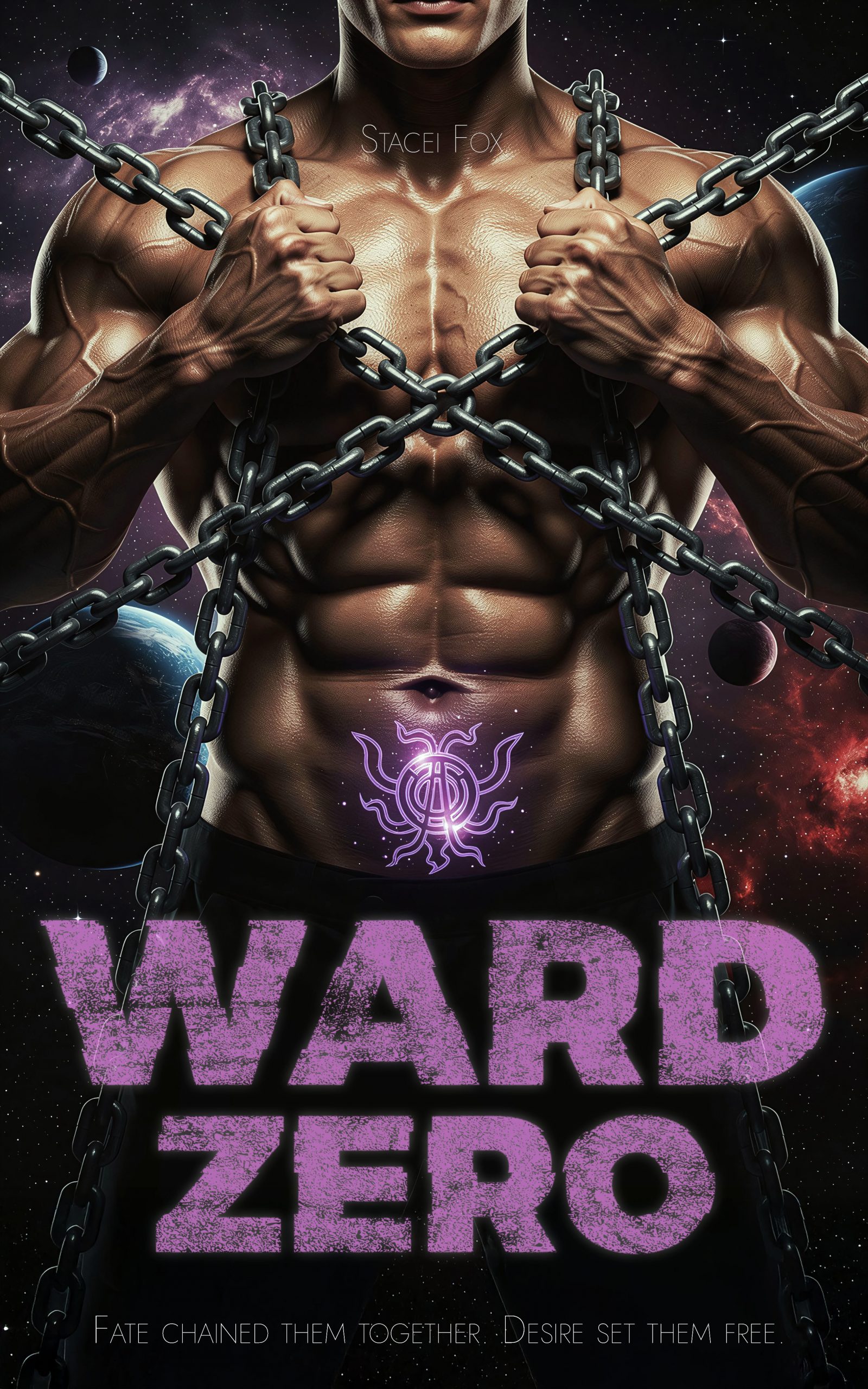
Ward Zero by Stacei Fox is a dark, immersive sci-fi alien romance that refuses to separate love from power, survival, and resistance. It’s a story about what happens when systems are built to extract value from living beings—and how connection becomes both rebellion and salvation inside those systems.
At its core, Ward Zero is about captivity. Not just physical imprisonment, but economic, psychological, and biological confinement. From the opening chapters, Fox establishes a setting where survival itself accrues debt: air, water, food, medical scans, and even pauses for rest are monetized. The result is a world that feels relentlessly oppressive, not because it relies on constant violence, but because of its bureaucratic cruelty. The system doesn’t need to beat you every day; it simply lets the math do the work.
The Kethra Vault is one of the novel’s greatest strengths. It isn’t just a backdrop, it’s an active force in the story. The Vault hums, breathes, and watches. It’s a place designed to grind people down while remaining impeccably efficient, and Fox makes the reader feel that weight in every scene. Sanitation corridors, administrative levels, containment wards, all of it feels intentional, functional, and hostile.
What’s especially effective is how ordinary the horror becomes. There are no grand speeches about injustice early on; instead, the cruelty is embedded in procedures, quotas, and automated deductions. This makes the world feel disturbingly plausible, and it gives the story a quiet rage that builds over time rather than exploding all at once.
Tinsley is an exceptional protagonist precisely because she isn’t exceptional in the way sci-fi heroines often are. She doesn’t arrive with secret training, combat prowess, or a hidden destiny. Her primary skills are endurance, observation, and an engineer’s mindset. She survives by understanding systems, how they work, where they’re lazy, and how they fail.
Her humor is dry and understated, often surfacing in moments where fear would otherwise take over. It’s not quippy bravado; it’s a coping mechanism. Fox does an excellent job showing how Tinsley has learned to make herself small, invisible, and compliant when necessary while still holding onto a core of stubborn defiance that refuses to be erased.
Importantly, Tinsley’s growth never feels like a betrayal of who she is. When she begins to change, it’s not because she suddenly becomes fearless or powerful, but because circumstances force her to acknowledge the strength she’s been using quietly all along. Her arc is about recognizing her own agency, even inside a system designed to deny it.
Serrek could easily have been written as a typical “dangerous alien alpha,” but Ward Zero takes a far more nuanced approach. He is terrifying in his capacity for destruction, yes, but what defines him is restraint. Chains bind his body, but isolation and exploitation have bound his identity even more tightly.
Fox is careful to show how Serrek has been reduced from a being to an asset. He is monitored, measured, throttled, and starved not out of sadism, but out of optimization. That distinction matters. The cruelty he faces isn’t emotional; it’s logistical. And that makes it worse.
Serrek’s interactions with Tinsley slowly peel back layers of control and resignation. He is not “tamed” by her. Instead, he is reminded—gradually, painfully—of what it means to be seen as more than output. His power becomes more focused in her presence, not because she dominates him, but because the connection provides grounding that isolation stripped away.
The romance in Ward Zero is a true slow burn, and it earns every step. There is no instant attraction, no sudden declarations, no magical compatibility that solves everything. Instead, the relationship grows through proximity, curiosity, shared vulnerability, and choice.
What’s particularly compelling is how the romance is intertwined with consent and control. Both characters are acutely aware of power imbalances—not just between them, but within the system surrounding them. Fox avoids romanticizing captivity or dominance, instead framing intimacy as something negotiated, deliberate, and deeply meaningful in a place where autonomy is constantly stolen.
Their connection is as much emotional and psychological as it is physical. Touch matters because it’s rare. Food matters because it’s real. Presence matters because isolation has been weaponized against them both. The romance feels grounded, intense, and quietly fierce.
Ward Zero explores heavy themes without becoming preachy. Exploitation, commodification of bodies, debt as control, and the ethics of energy extraction all run beneath the narrative like a current. The story asks uncomfortable questions: What does freedom actually mean? Is survival enough if it comes without choice? How do systems justify cruelty when it’s profitable?
One of the novel’s most effective ideas is the concept of people as infrastructure. The Vault runs because living beings are forced to function as components. This framing makes the eventual push toward resistance feel inevitable rather than heroic—less about overthrowing evil and more about refusing to continue being used.
Fox’s prose is immersive and sensory, with a strong focus on physical sensations: vibration, pressure, heat, hums of energy beneath the skin. This makes the sci-fi elements feel visceral rather than abstract. The pacing is deliberate, allowing tension to build organically. Quiet moments are given space, and they often carry more emotional weight than the action scenes.
The book trusts the reader. It doesn’t overexplain its science or its emotions. Instead, it lets patterns emerge, connections form, and realizations land naturally.
Ward Zero will strongly appeal to readers who enjoy:
- Dark sci-fi romance with moral and emotional complexity
- Alien love interests are defined by restraint rather than dominance
- Slow-burn relationships rooted in trust and shared survival
- Stories that critique systems of exploitation and control
- High-stakes intimacy where connection itself is dangerous
Readers looking for light, escapist romance may find this book heavy, but for those who want romance with teeth, depth, and consequence, Ward Zero delivers.
Ward Zero is not just a romance set in a sci-fi world; it’s a story about reclaiming humanity in a place designed to erase it. The connection between Tinsley and Serrek feels radical precisely because it exists where it shouldn’t and challenges the system that profits from their isolation.
By the time the book reaches its later chapters, the question is no longer whether they will fight back but what it will cost, and whether freedom can exist without destruction. It’s tense, emotionally rich, and deeply satisfying, leaving the reader both unsettled and hopeful.
In short: Ward Zero is a powerful, slow-burning sci-fi alien romance that understands love as resistance and treats survival as an act of defiance.