
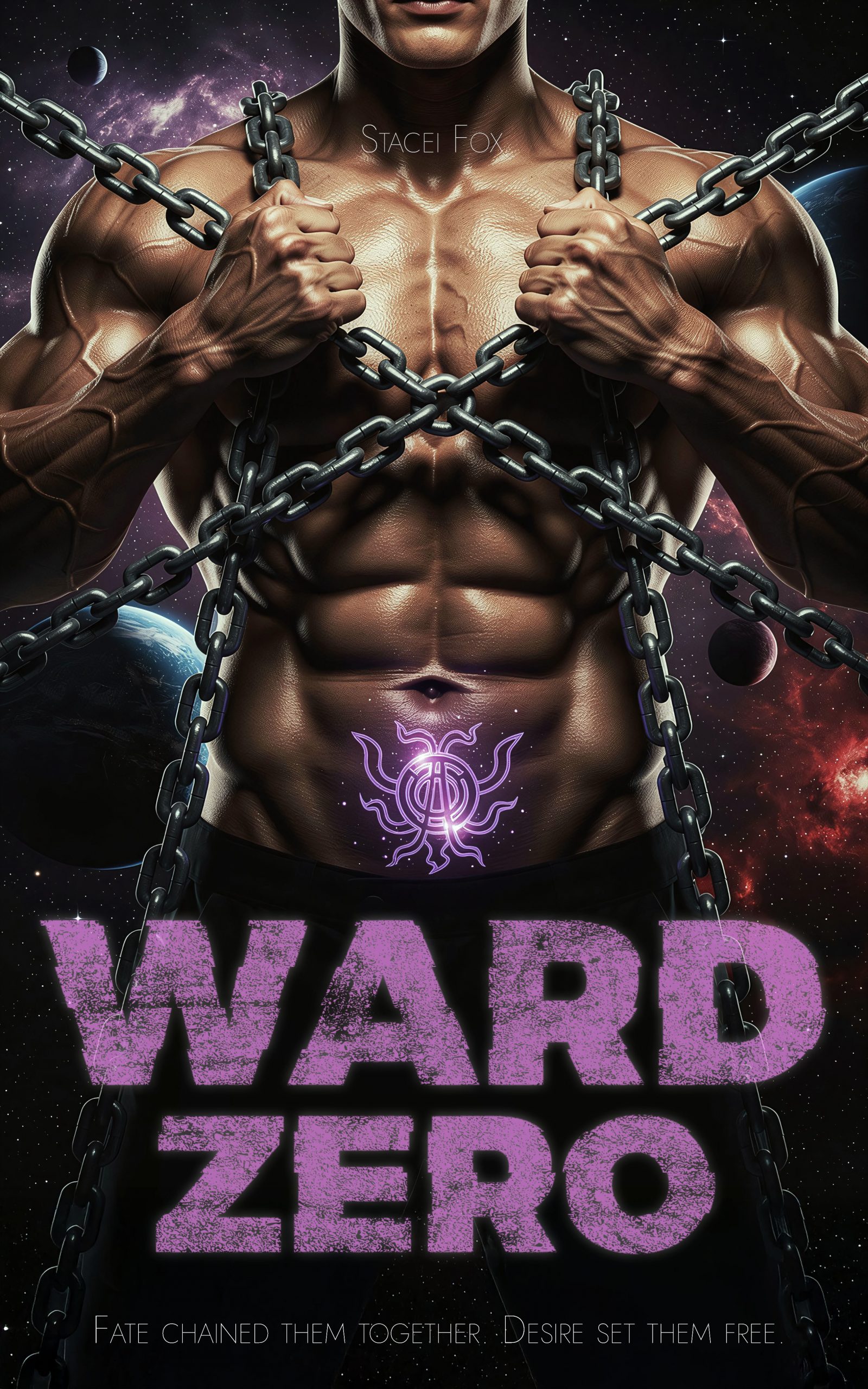
Ward Zero by Stacei Fox is a dark sci-fi alien romance about two people trapped inside a system that has found profitable uses for almost every part of them. Air costs money, food creates debt, medical treatment becomes another line item, and even survival is something the Kethra Vault can calculate, record, and charge back to the people barely managing to endure it.
That makes the romance between Tinsley and Serrek feel dangerous long before either character begins thinking of it as love. Both have survived by becoming useful enough to keep alive and compliant enough not to attract the wrong attention, but their connection begins disrupting the isolation that makes the Vault’s control possible.
What impressed me most is how thoroughly the world-building supports the emotional story. Ward Zero isn’t simply arguing that oppression is bad while giving readers an alien hero and a human heroine to root for. It shows how effective exploitation becomes when cruelty is turned into procedure, how people can become infrastructure without anyone needing to call them slaves, and how reclaiming the ability to choose can become more radical than open rebellion.
Tinsley and Serrek don’t fall in love because destiny decides they belong together. Their relationship grows because one frightened, observant human begins treating an imprisoned alien as a person, and one immensely powerful alien slowly remembers that connection doesn’t have to mean control.
Ward Zero Quick Review
Ward Zero is a dark science-fiction romance centered on Tinsley, a human engineer surviving inside the Kethra Vault, and Serrek, a powerful alien prisoner whose body has been transformed into a resource the facility can monitor, throttle, and exploit. The story combines captivity, forced proximity, survival, institutional oppression, alien-human romance, slow-burning trust, and an eventual resistance that grows naturally from everything both characters have endured.
The novel is especially effective for readers who want an alien hero defined by restraint rather than dominance. Serrek has the physical capacity to be terrifying, but the emotional arc doesn’t depend on Tinsley taming him or proving herself worthy of a dangerous male. Instead, both characters gradually recover parts of themselves that captivity has trained them to suppress, with Tinsley’s observational intelligence and Serrek’s disciplined control becoming equally important to their survival.
For me, the Kethra Vault is almost a third central character. It shapes every choice Tinsley makes, determines the conditions under which Serrek exists, and creates the pressure that turns their growing attachment into something politically dangerous as well as emotionally meaningful.
Ward Zero Summary
Tinsley survives inside the Kethra Vault by understanding systems. She isn’t a soldier, rebel leader, or secretly gifted chosen one, and she doesn’t possess the kind of physical strength that would let her simply fight her way out. What she does understand is machinery, routines, overlooked weaknesses, and the thousand tiny shortcuts institutions begin taking once they assume everyone trapped inside them has stopped looking for exits.
Life in the Vault is designed to make resistance expensive. Essential needs such as food, water, medical care, rest, and basic survival generate costs that accumulate faster than most people can realistically repay, creating a system where debt functions as a form of confinement. Violence exists, but the Vault doesn’t need to rely on constant brutality because bureaucracy does most of the work more efficiently.
Tinsley has adapted by becoming useful, quiet, and easy to overlook. She follows procedures when necessary, keeps her observations to herself, and uses dry humor to preserve some private part of herself the facility hasn’t managed to monetize.
Then her work brings her into contact with Ward Zero.
Serrek is imprisoned there.
He isn’t treated like a prisoner in the conventional sense because the Vault has reduced him even further. His body, energy, responses, and extraordinary capacity are monitored as assets, with every aspect of his existence evaluated according to output and efficiency rather than dignity.
The people controlling him don’t need to hate Serrek. They only need him to remain profitable.
Tinsley notices the distinction immediately because she’s been living inside a less extreme version of the same system. Both characters are valuable because of what they can provide, and both remain trapped because their usefulness gives the Vault a financial reason to keep them exactly where they are.
Their earliest interactions are cautious. Tinsley understands that Serrek is capable of enormous destruction, while Serrek has been conditioned to expect that anyone approaching him ultimately wants something from his body or power.
Trust therefore develops in small increments. Food offered without manipulation matters, conversation without interrogation matters, and physical proximity without extraction begins acquiring emotional significance neither character is prepared to acknowledge.
As Tinsley learns more about Serrek and the way the Vault uses him, she also begins recognizing vulnerabilities in the system surrounding them. The engineer who survived by studying how things function starts seeing exactly where those functions can fail.
What begins as quiet connection gradually becomes resistance, because the Vault depends on Tinsley and Serrek remaining isolated enough to believe they have no meaningful choices.
Once they stop believing that, the system has a problem.
Ward Zero Characters
The characters work because Fox doesn’t make either Tinsley or Serrek extraordinary in the easiest possible way. Tinsley’s strength comes from skills she already possessed before the story began, while Serrek’s power is obvious from the beginning but has been systematically stripped of agency.
Their relationship becomes compelling because each recognizes a form of captivity in the other. Tinsley sees what happens when a living being is treated entirely as output, while Serrek gradually recognizes how thoroughly Tinsley’s supposedly greater freedom has been constrained by debt, fear, and institutional control.
Tinsley
Tinsley is one of the strongest parts of Ward Zero because she feels capable without becoming implausibly invincible. Her intelligence is practical, observational, and rooted in the habits of someone who has spent a long time surviving by understanding the systems stronger people take for granted.
She notices maintenance patterns, inefficiencies, routines, vulnerabilities, and the places where rules don’t quite match reality. That engineer’s mindset shapes how she interprets the Vault and eventually becomes more valuable than combat training ever could.
Her humor works for the same reason. Tinsley isn’t constantly delivering clever lines because she thinks danger is entertaining, and her sarcasm doesn’t erase fear. Humor functions as a pressure valve, allowing her to retain some private control over situations where almost every external choice has already been restricted.
I especially liked that her growth doesn’t require becoming a different woman. Tinsley doesn’t suddenly transform into a fearless revolutionary once she meets Serrek, because the qualities required for resistance have been present from the beginning. She simply starts recognizing that endurance, observation, and stubbornness are forms of strength rather than evidence that she has only been surviving.
Serrek
Serrek could easily have become another enormous alien hero whose dangerous instincts are romanticized because the heroine is supposedly the one person capable of controlling him. Ward Zero takes a much more interesting approach by making restraint one of his defining characteristics.
He is capable of violence, but raw destructive ability isn’t what makes him compelling. Serrek has spent so long being restrained, monitored, starved, measured, and treated as infrastructure that the emotional damage comes from losing the ability to think of himself as someone whose wants matter.
The Vault doesn’t need to torment him emotionally when it can accomplish the same result through logistics. His body has become equipment, his responses have become data, and his continued existence is justified only according to what the facility can extract from him.
Tinsley’s presence begins disrupting that conditioning because she doesn’t approach him as a problem to solve or a resource to optimize. She notices his reactions, respects his space, and treats choices that might look insignificant from the outside as meaningful because Serrek has been denied meaningful choice for so long.
That makes his developing attachment to her much more interesting than a possessive alien bond. Tinsley doesn’t tame Serrek, and Serrek doesn’t simply claim Tinsley. Their relationship gives both characters enough emotional stability to begin imagining themselves as people rather than components inside someone else’s system.
Tinsley and Serrek’s Relationship
The romance between Tinsley and Serrek succeeds because the story gives them time to become safe for one another before asking either character to become vulnerable. Their attraction develops inside a facility where almost every interaction is monitored, transactional, or potentially dangerous, which means ordinary gestures acquire much greater emotional significance.
Touch matters because bodily autonomy is scarce, while food matters because nourishment has been monetized and weaponized. Quiet conversation matters because surveillance has taught both characters to guard information, and simply remaining beside someone without demanding anything can become an extraordinary expression of trust.
That gives the slow burn genuine purpose. Tinsley and Serrek aren’t delaying intimacy because the plot needs another hundred pages of romantic tension, but because both understand what happens when trust is given to the wrong person.
The power imbalance between them is also handled intelligently. Serrek is physically far more dangerous than Tinsley could ever become, but the Vault has stripped him of meaningful autonomy while Tinsley possesses forms of mobility and institutional knowledge he lacks. Neither character has absolute power over the other, which means partnership becomes necessary rather than decorative.
Their connection gradually becomes one of the few spaces where consent can exist without qualification. In a world built around extraction, choosing what to give another person becomes intimate precisely because almost everything else has already been taken.
The Kethra Vault Is the Real Monster
The Kethra Vault works so well because its cruelty is rarely theatrical. It doesn’t need villains pacing hallways to explain how evil they are when automated deductions, quotas, surveillance systems, medical protocols, and administrative procedures can do the same thing more efficiently.
That makes the environment disturbingly believable. Systems rarely describe exploitation using the language of exploitation, especially when profitability allows cruelty to be reframed as procedure, necessity, or resource management.
Tinsley experiences this through debt. Every essential requirement becomes another amount she owes, making freedom mathematically possible while practically unreachable.
Serrek experiences the same philosophy more directly because his body has become infrastructure. The Vault calculates what it can extract from him, how much deprivation he can tolerate, and what level of restraint produces the most useful output without damaging the asset beyond repair.
Both characters therefore inhabit different positions inside the same machine. Tinsley is a worker kept compliant through economic pressure, while Serrek is a resource kept operational through physical containment.
The romance becomes threatening because people who recognize each other as people are harder to manage like equipment.
The Debt System Makes Captivity More Disturbing
One of my favorite ideas in Ward Zero is making survival itself a source of debt. Tinsley doesn’t need iron bars around her cell because the system has created a version of freedom that becomes increasingly impossible to purchase.
That approach adds much more complexity to the novel’s captivity theme. Tinsley can technically move through parts of the facility, work, make decisions, and keep living, but all those freedoms exist within economic boundaries designed to prevent genuine escape.
The system can therefore maintain the appearance of choice while controlling the available outcomes. A person can decide whether to rest, eat, seek treatment, or continue working, but each option comes with consequences structured to benefit the institution rather than the individual.
Serrek’s imprisonment exposes the same philosophy without the pretense. Once the Vault identifies a living being as sufficiently valuable, the question stops being whether exploitation is morally acceptable and becomes how efficiently the asset can be maintained.
That parallel is one of the smartest parts of the book because it makes Tinsley and Serrek’s experiences different without making them unrelated.
Ward Zero Tropes
Readers looking for science-fiction romance will find alien-human romance, captivity, forced proximity, slow burn, shared survival, morally oppressive institutions, a protective alien hero, an engineer heroine, rebellion, emotional healing, a dangerous connection, forbidden intimacy, and a strong emphasis on consent. The alien romance is important, but it never overwhelms the science-fiction setting or turns the larger conflict into background decoration.
What makes the familiar tropes work is the way the story connects them to autonomy. Forced proximity creates intimacy because both characters are trapped, while the protective element remains meaningful because protection can’t become another excuse for controlling someone whose choices have already been restricted by everyone else.
Tinsley’s Engineering Mindset Drives the Story
I especially appreciate that Tinsley’s profession actually matters. Too many science-fiction heroines are described as engineers or technically skilled only for the plot to eventually require them to solve every problem through bravery, weapons, or abilities unrelated to their supposed expertise.
Tinsley approaches danger as a systems problem. She studies how the Vault functions, where procedures overlap, which assumptions have become habitual, and how an institution built around efficiency can become vulnerable precisely because it expects everyone inside it to follow established patterns.
That way of thinking makes her resistance believable. She doesn’t suddenly know how to overthrow a massive facility, but she understands enough small pieces to begin recognizing how one failure can cascade into another.
Her knowledge also makes her partnership with Serrek more balanced. He possesses tremendous physical and energetic power, but power without access, knowledge, or strategic understanding can remain useless.
Tinsley knows the machine. Serrek can break it. Neither can realistically succeed alone.
Serrek’s Restraint Makes Him More Compelling Than His Strength
Serrek’s destructive capacity is impressive, but his restraint gives his character emotional depth. The book understands that someone capable of causing enormous damage becomes much more interesting when the reader understands what keeps him from doing it.
The Vault has also manipulated his control. Isolation, starvation, monitoring, and containment have taught him that any loss of regulation will be used to justify further restriction, which means restraint becomes both a survival strategy and an emotional prison.
Tinsley doesn’t make that restraint unnecessary. Instead, her presence allows it to become something Serrek chooses rather than something the institution demands.
That distinction is subtle but important. Being controlled by someone else and controlling yourself are not the same thing, even when the visible behavior looks identical.
Serrek’s arc becomes partly about reclaiming ownership over his own power. He isn’t becoming safer because Tinsley civilizes him, but because having someone who sees him as a person gives him another reason to decide what he wants his strength to mean.
The Romance Treats Consent as Resistance
Consent becomes especially meaningful in Ward Zero because both characters live inside environments where autonomy is routinely violated. Tinsley’s economic choices are manipulated by debt, while Serrek’s body is literally managed according to institutional need.
That means intimacy has to operate according to completely different rules if their relationship is going to represent anything other than another form of exploitation.
The story understands that consent is larger than a single romantic scene. It includes whether someone can say no, whether information is being withheld, whether physical contact is expected, whether one person’s strength gives them automatic authority, and whether vulnerability is being offered freely rather than extracted.
Those questions make even small moments between Tinsley and Serrek feel intense. Something as simple as offering rather than taking becomes meaningful in a setting where the distinction has almost disappeared.
Their relationship gradually creates a private vocabulary of choice inside a system that survives by denying choice to everyone around them.
People as Infrastructure Is the Most Disturbing Idea in the Book
The concept that living beings can become infrastructure gives Ward Zero much of its thematic power. Serrek represents the most literal version because his body and energy have been incorporated into the facility’s operational logic, but he isn’t the only person being treated that way.
Workers like Tinsley also become components. The institution manages their labor, debt, health, and productivity according to what it requires, translating human cost into metrics that make exploitation easier to justify.
That translation is what makes the system frightening. Once suffering becomes a number, those who maintain the system can discuss optimization instead of cruelty.
The story gradually pushes Tinsley toward recognizing that survival within such a structure can only go so far. Becoming exceptionally good at functioning as someone else’s component may keep you alive, but it doesn’t necessarily make you free.
Her relationship with Serrek gives that realization emotional urgency. Once she recognizes his imprisonment as intolerable, it becomes harder to ignore the less visible forms of captivity surrounding her own life.
What I Loved About Ward Zero
Tinsley is probably my favorite part of the novel because the story respects her competence without turning her into a superhero. Her intelligence is specific, useful, and grounded in skills she has developed over time, which makes every contribution to the resistance feel earned.
Serrek works for almost the opposite reason. His physical power is extraordinary, but the story refuses to treat extraordinary strength as the answer to every problem, especially when someone else controls the conditions under which that strength can be used.
Their relationship becomes satisfying because both characters contribute what the other lacks. Tinsley understands systems, patterns, and weaknesses, while Serrek possesses the force and energy required to turn knowledge into meaningful change.
I also loved the bureaucratic horror of the Kethra Vault. The story becomes darker because much of the cruelty is calm, rational, and efficiently administered, which feels more unsettling than an institution where everyone openly behaves like a sadist.
Most importantly, all of those elements support the same argument. Systems designed around extraction become most vulnerable when the people they reduce to resources begin recognizing one another as human, even when one of them isn’t technically human at all.
What Might Not Work for Every Reader
Ward Zero is heavy enough that readers looking primarily for playful alien-romance escapism may find the atmosphere oppressive. Captivity, deprivation, economic exploitation, bodily control, surveillance, isolation, and the commodification of living beings aren’t occasional background details, because they define the environment in which the romance develops.
The pacing is also deliberately patient. Tinsley and Serrek’s connection grows through small interactions and gradual shifts in trust, while the larger resistance emerges from understanding the system rather than attacking it immediately.
For me, that patience makes the relationship stronger because every gain matters. Readers who prefer immediate attraction, rapid bonding, highly dominant alien heroes, or constant action may want a faster and more conventional story.
The book also asks readers to spend significant time thinking about systems rather than simply villains. The Kethra Vault is disturbing because removing one cruel individual wouldn’t necessarily fix anything, and that structural focus gives the story more thematic weight but also makes it less escapist.
Is Ward Zero a Slow-Burn Alien Romance?
Yes, and the slow burn is central to the story’s emotional logic. Tinsley and Serrek begin in circumstances where trust could be dangerous for either of them, so intimacy grows through repeated evidence rather than immediate attraction or supernatural compatibility.
Their relationship develops through observation, shared vulnerability, food, touch, conversation, and the gradual recognition that neither intends to use the other. Those details carry emotional weight because both characters live in a system where almost every interaction has become transactional.
The slow burn therefore doesn’t feel artificially stretched. It reflects how long it would realistically take for two deeply controlled people to believe that another person’s presence might represent safety rather than another threat.
Is Ward Zero a Captive Romance?
Captivity is fundamental to the story, although the romantic relationship itself isn’t built around one character imprisoning the other. Tinsley and Serrek are both constrained by the Kethra Vault in different ways, which means the romance develops between two people trying to reclaim autonomy rather than between captor and captive.
That distinction matters because the story doesn’t romanticize the mechanisms restricting them. Debt, surveillance, bodily control, deprivation, and forced extraction are consistently treated as violations rather than exciting expressions of dominance.
Their connection becomes romantic precisely because it offers an alternative. Inside a system that takes constantly, Tinsley and Serrek begin learning how to give without demanding ownership in return.
Is Ward Zero a Fated-Mates Romance?
The relationship described in Ward Zero doesn’t depend on an instant fated bond or supernatural claim that removes meaningful choice. Tinsley and Serrek become important to one another through proximity, observation, trust, shared survival, and deliberate decisions.
That makes the romance especially effective for readers who enjoy alien love stories but don’t want destiny to do the emotional work for the characters. Connection has consequences because both characters keep choosing it despite the danger around them.
Their bond may become powerful, but the story’s emphasis remains on autonomy. In a novel so concerned with what happens when choice is taken away, keeping choice central to the romance feels exactly right.
Who Should Read Ward Zero?
I’d recommend Ward Zero to readers who want alien romance with substantial science-fiction world-building and a strong thematic core. It should especially appeal to readers who enjoy slow burn, captivity-and-escape stories, engineer heroines, dangerous but restrained alien heroes, dystopian institutions, shared survival, rebellion, and romances built on trust rather than immediate possession.
It will also work particularly well for readers who enjoy speculative fiction about systems of exploitation. The Kethra Vault isn’t merely evil because bad people run it, but because exploitation has been built so completely into its economic and operational structure that cruelty can continue while everyone responsible insists they are simply following procedure.
Readers who prefer lighter alien romances may find that bleak, but anyone looking for a romance where the science-fiction world meaningfully shapes the emotional relationship should find plenty to appreciate.
Ward Zero Review: Final Thoughts
What stayed with me most about Ward Zero is how completely it connects love with the restoration of personhood. Tinsley and Serrek live inside a facility that has become extraordinarily efficient at translating living beings into measurable value, whether that value comes from labor, energy, debt, output, or biological usefulness.
Serrek experiences the most extreme version of that process because the Vault has transformed his extraordinary abilities into infrastructure. His existence is monitored according to what can be extracted from him, and even the conditions of his survival are calibrated around maintaining usefulness rather than dignity.
Tinsley’s captivity looks less dramatic, but the underlying logic is similar. She works, accumulates costs, manages debt, sacrifices rest, and survives inside a structure where basic needs become financial obligations that continually reduce the possibility of escape.
The relationship between them matters because each becomes evidence that the other is more than the function the Vault has assigned.
Tinsley doesn’t see an energy source when she looks at Serrek. She sees someone capable of fear, control, anger, dignity, curiosity, and eventually tenderness.
Serrek doesn’t see another employee of the institution imprisoning him. He gradually sees a woman whose apparent freedom has been constrained by different mechanisms and whose intelligence has allowed her to survive without surrendering every part of herself.
That recognition changes them before any larger rebellion does.
Tinsley begins understanding that becoming excellent at survival isn’t the same thing as being free, while Serrek begins reclaiming the idea that his power belongs to him rather than to whatever system has learned to exploit it.
Their romance becomes radical because it operates according to rules the Vault can’t easily understand. They give things without calculating repayment, protect one another without automatically demanding obedience, and allow intimacy to grow through choices that create value precisely because nobody can invoice them afterward.
That is where the book’s central idea becomes strongest. The Vault understands extraction. Tinsley and Serrek begin creating reciprocity. The Vault understands output. They begin recognizing need. The Vault understands control. They begin practicing consent.
Those opposing values turn the relationship itself into resistance long before either character openly challenges the institution surrounding them.
I also love that the eventual rebellion doesn’t require Tinsley to become physically extraordinary or Serrek to simply unleash enough power to solve everything. Tinsley’s ability to understand systems remains crucial, while Serrek’s strength only becomes useful once it can be combined with knowledge, opportunity, and a reason to believe destruction might lead somewhere better.
Neither replaces the other. They become more dangerous to the Vault because they become partners.
That makes Ward Zero more than a dark alien romance set inside an oppressive sci-fi world. The romance and the world-building are telling the same story about what happens when people stop accepting the identities assigned to them by institutions designed to profit from their compliance.
Tinsley is more than labor. Serrek is more than energy. Neither is infrastructure. Their connection matters because they begin proving that truth to each other before they can prove it to anyone else.
For me, that’s what makes Ward Zero linger. It understands that freedom isn’t simply getting out of the cage, especially when captivity has taught you to think of yourself in the language of the people who built it.
Sometimes resistance begins much earlier, with the quiet realization that your life was never theirs to calculate in the first place.
Ward Zero FAQ
What is Ward Zero by Stacei Fox about?
Ward Zero follows Tinsley, an engineer surviving inside the oppressive Kethra Vault, and Serrek, a powerful alien prisoner whose body and energy have been turned into resources for the facility. Their slow-building connection gradually challenges the isolation that keeps both characters controllable, while Tinsley’s understanding of the Vault’s systems begins revealing possibilities for resistance.
Who are the main characters in Ward Zero?
The central characters are Tinsley and Serrek, whose very different forms of captivity create the foundation for their relationship. Tinsley is a human engineer who survives through observation and systems thinking, while Serrek is an immensely powerful alien who has been reduced to an asset whose output is monitored and controlled.
What is the Kethra Vault?
The Kethra Vault is the facility where much of the novel takes place, and it operates through a combination of economic control, surveillance, containment, debt, and resource extraction. It treats workers and prisoners according to usefulness rather than personhood, making the Vault itself one of the story’s most important antagonistic forces.
Is Ward Zero an alien romance?
Yes, Ward Zero is a human-alien science-fiction romance centered on Tinsley and Serrek. The romantic relationship develops alongside the larger story about captivity, exploitation, institutional control, and their growing determination to reclaim autonomy.
Is Ward Zero a slow burn?
Yes, Tinsley and Serrek’s relationship develops gradually through shared proximity, observation, trust, consent, and small acts of vulnerability. Their circumstances make immediate intimacy unrealistic, so the slow development gives their eventual connection considerably more emotional weight.
Is Ward Zero a fated-mates romance?
The romance doesn’t rely on an unavoidable supernatural mate bond that eliminates choice. Tinsley and Serrek become connected through their experiences, growing trust, and deliberate decisions, which fits the story’s larger emphasis on reclaiming autonomy.
Is Ward Zero a captive romance?
Captivity is central to the story, but neither romantic lead functions as the other’s captor. Both are constrained by the Kethra Vault in different ways, allowing the relationship to become a source of mutual resistance rather than another extension of institutional control.
What tropes are in Ward Zero?
The story includes alien-human romance, slow burn, forced proximity, captivity, shared survival, engineer heroine, powerful alien hero, protective instincts, dystopian oppression, rebellion, consent-focused intimacy, and a relationship built through earned trust.
Is Ward Zero dark?
Yes, the story deals with economic exploitation, bodily control, deprivation, surveillance, captivity, and the treatment of living beings as resources. Its darkness comes as much from institutional cruelty and loss of autonomy as from physical danger.
What makes Ward Zero different from other alien romances?
One of its biggest differences is the way the romance and science-fiction themes are inseparable. Tinsley doesn’t need to become superhuman and Serrek isn’t defined primarily by dominance, while their relationship grows through restraint, consent, systems knowledge, and the shared recognition that neither should exist merely for someone else’s use.